

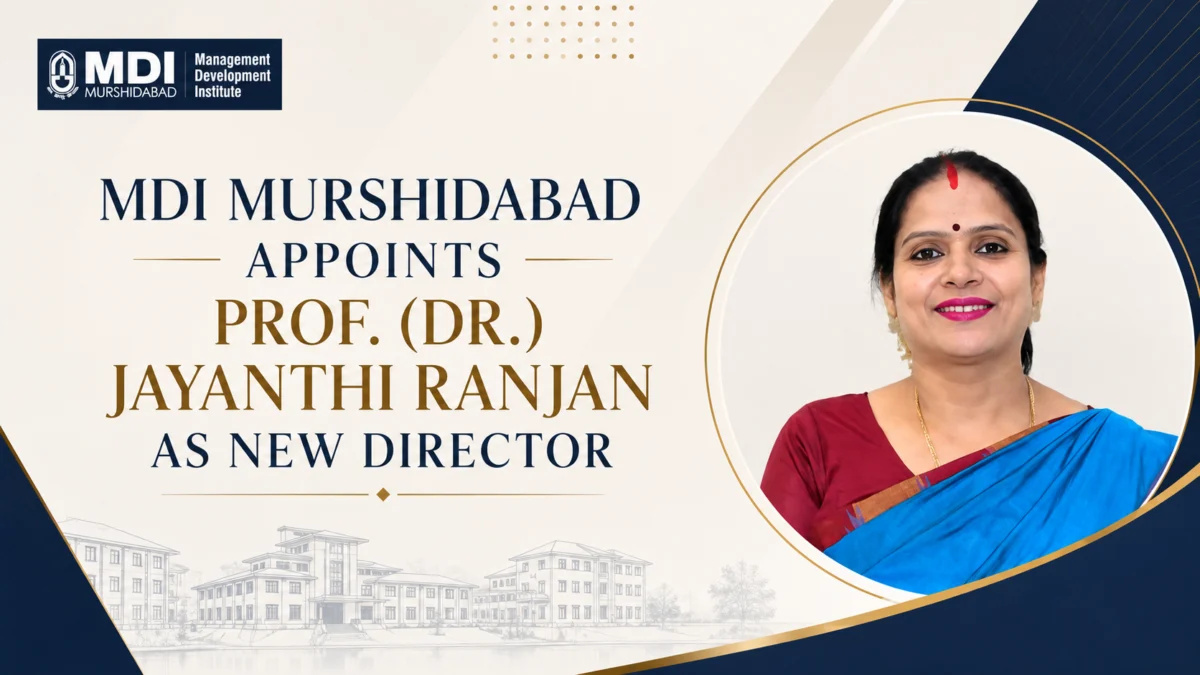
Murshidabad, India – [Date of Publication] – In a significant leadership development poised to shape the future trajectory of management education in eastern India, the Management Development Institute (MDI) Murshidabad has announced the appointment of Prof. (Dr.) Jayanthi Ranjan as its new Director. This pivotal transition marks the beginning of a new chapter for the esteemed business school, renowned for its commitment to fostering industry-ready management professionals. Prof. Ranjan, a distinguished academician and administrator with an illustrious career spanning over three decades, brings a wealth of experience in critical domains such as Information Systems, Digital Transformation, Business Analytics, Knowledge Management, and Artificial Intelligence. Her appointment is expected to infuse MDI Murshidabad with renewed vigor, particularly in areas increasingly central to modern business strategy and the evolving landscape of management education.
A New Dawn for MDI Murshidabad: The Significance of Prof. Ranjan’s Appointment
The appointment of Prof. (Dr.) Jayanthi Ranjan as the new Director of MDI Murshidabad is more than just a change in leadership; it signifies a strategic alignment with the contemporary demands of the global business environment. In an era characterized by rapid technological advancements, data-driven decision-making, and the imperative for continuous innovation, Prof. Ranjan’s expertise in Information Systems, Digital Transformation, and Artificial Intelligence is particularly relevant. Her extensive background in these cutting-edge fields is anticipated to drive MDI Murshidabad’s curriculum development, research initiatives, and overall academic offerings, ensuring that graduates are not only well-versed in foundational management principles but also adept at navigating the complexities of the digital age.
MDI Murshidabad has consistently strived to bridge the gap between academia and industry, nurturing a cohort of future business leaders. Prof. Ranjan’s leadership is expected to amplify these efforts. Her career has been marked by a deep engagement with curriculum design, research, institutional growth, and fostering robust industry partnerships. This holistic approach to academic leadership suggests a vision that encompasses not only academic excellence but also practical relevance and strong corporate connect. As MDI Murshidabad seeks to solidify its position as a premier B-school, her guidance will be instrumental in refining its pedagogical approaches, expanding its research footprint, and enhancing its engagement with the corporate world, thereby ensuring its graduates are equipped with the skills and perspectives needed to thrive in dynamic markets.
A Legacy of Excellence: Prof. Ranjan’s Illustrious Career and Vision
Prof. (Dr.) Jayanthi Ranjan’s illustrious career is a testament to her dedication to academic rigor and administrative acumen. With over thirty years of experience, she has established herself as a thought leader in several key areas that are shaping the future of business. Her deep understanding of Information Systems has been crucial in helping organizations leverage technology for strategic advantage. In an increasingly digitized world, this expertise is invaluable for equipping future managers with the skills to manage and optimize technological resources.
Her work in Digital Transformation is particularly pertinent. As businesses across sectors undergo profound changes driven by digital technologies, Prof. Ranjan’s insights into managing this complex transition will be a significant asset to MDI Murshidabad. This involves not only understanding the technological aspects but also the organizational, cultural, and strategic implications of embracing digital solutions. Her contributions to Business Analytics are also noteworthy. In an era where data is often referred to as the new oil, her proficiency in extracting meaningful insights from data to inform business decisions will undoubtedly enrich the analytical capabilities of MDI Murshidabad’s students.
Furthermore, Prof. Ranjan’s experience in Knowledge Management underscores her understanding of how organizations can effectively capture, share, and utilize intellectual assets. This is crucial for fostering innovation and maintaining a competitive edge. Her expertise in Artificial Intelligence (AI) positions her at the forefront of one of the most transformative technologies of our time. The integration of AI into business processes is rapidly reshaping industries, and her leadership will be vital in ensuring that MDI Murshidabad’s students are well-prepared to understand and utilize AI ethically and effectively.
Throughout her career, Prof. Ranjan has demonstrated a strong commitment to academic leadership. She has held numerous significant positions, contributing substantially to curriculum development, ensuring that educational programs remain relevant and forward-looking. Her involvement in research has pushed the boundaries of knowledge in her fields of expertise, and her leadership in institutional growth has fostered environments conducive to learning and development. Moreover, her dedication to industry engagement has helped create valuable bridges between academic institutions and the corporate world, facilitating internships, collaborative projects, and guest lectures that provide students with real-world exposure.
This extensive and multifaceted background positions Prof. Ranjan perfectly to guide MDI Murshidabad’s strategic direction. Her vision is likely to be one that emphasizes a holistic approach to management education, integrating technological advancements with core business principles and fostering a culture of innovation, research, and practical application.
The Strategic Imperative: MDI Murshidabad’s Evolving Role in Management Education
MDI Murshidabad, since its inception, has been committed to providing high-quality management education that addresses the evolving needs of the industry. The institute has consistently aimed to cultivate leaders who possess not only strong analytical and strategic thinking skills but also a deep understanding of ethical practices and social responsibility. The current global economic landscape, marked by rapid technological disruptions, geopolitical shifts, and an increasing focus on sustainability, demands a new breed of management professionals. These professionals must be agile, adaptable, and equipped with the foresight to anticipate and respond to emerging challenges and opportunities.
Prof. Ranjan’s appointment comes at a critical juncture where management education is undergoing a significant transformation. The traditional classroom model is being augmented by digital learning platforms, personalized learning experiences, and a greater emphasis on experiential learning. Furthermore, the integration of cutting-edge technologies like AI, big data analytics, and blockchain is no longer an option but a necessity for business schools aiming to remain relevant. MDI Murshidabad’s decision to appoint a director with such profound expertise in these areas signals a clear intent to be at the vanguard of this transformation.
The institute’s vision under Prof. Ranjan’s leadership is expected to be characterized by several key strategic thrusts:
- Enhanced Technology Integration: A significant focus will likely be placed on embedding technology-centric learning across all programs. This could involve introducing new courses on AI in business, advanced data analytics, cybersecurity management, and digital marketing. Furthermore, the institute may explore the use of advanced educational technologies to deliver more engaging and personalized learning experiences.
- Strengthened Research and Innovation Ecosystem: Prof. Ranjan’s background in research suggests a commitment to fostering a vibrant research culture at MDI Murshidabad. This could involve encouraging faculty and students to engage in cutting-edge research, establishing specialized research centers focused on areas like digital innovation or sustainable business practices, and promoting the publication of research in leading academic journals.
- Deepened Industry-Academia Collaboration: The institute is expected to further strengthen its ties with the corporate sector. This could translate into more robust internship programs, industry-sponsored research projects, executive education initiatives tailored to corporate needs, and a greater involvement of industry professionals in curriculum design and delivery. Such collaborations are crucial for ensuring that the curriculum remains aligned with industry demands and that students gain practical exposure to real-world business challenges.
- Global Outlook and Diversity: In an increasingly interconnected world, MDI Murshidabad will likely continue to emphasize a global perspective in its programs. This could involve expanding international collaborations, fostering student exchange programs, and encouraging a diverse student body and faculty to bring a wider range of perspectives to the learning environment.
- Focus on Future-Ready Skills: Beyond technical skills, the emphasis will also be on developing critical soft skills such as leadership, communication, problem-solving, and adaptability. The goal is to produce well-rounded individuals who can not only manage businesses effectively but also lead with integrity and contribute positively to society.
Supporting Data and Context: The Growing Importance of Digital Transformation in Management Education
The global management education landscape is undergoing a profound shift, driven by the relentless pace of technological innovation and the evolving demands of the business world. Data from various reports underscore the critical importance of digital transformation and AI in modern business. For instance, a report by McKinsey Global Institute indicated that AI could deliver additional global economic activity of around $13 trillion by 2030. This highlights the immediate need for management professionals to understand and leverage AI technologies.
Similarly, the increasing reliance on data analytics for strategic decision-making is evident. A survey by Gartner revealed that by 2025, the number of data analysts globally is expected to grow significantly, indicating a surge in demand for individuals with analytical skills. This trend necessitates that B-schools integrate advanced data analytics into their curricula, equipping students with the ability to interpret complex data sets and derive actionable insights.
The COVID-19 pandemic further accelerated the adoption of digital technologies and remote work, underscoring the need for business schools to adapt their pedagogical approaches. Online learning platforms, virtual collaboration tools, and digital content delivery have become integral to management education. This shift has also highlighted the importance of digital literacy and the ability to manage distributed teams effectively.
The growing emphasis on sustainability and corporate social responsibility (CSR) also influences management education. Businesses are increasingly expected to operate ethically and sustainably, and management professionals need to be equipped with the knowledge and skills to navigate these complexities. This includes understanding environmental, social, and governance (ESG) factors and integrating them into business strategy.
MDI Murshidabad, by appointing a director with expertise in these critical areas, is strategically positioning itself to address these contemporary challenges and opportunities. The institute’s commitment to fostering a strong industry-academia connect, as evidenced by its continued engagement with alumni and prospective students through platforms like PaGaLGuY, further reinforces its dedication to producing graduates who are not only academically sound but also practically relevant and well-prepared for the demands of the modern business world.
Official Responses and Forward-Looking Statements
While a direct quote from Prof. (Dr.) Jayanthi Ranjan upon her appointment was not available in the provided text, her extensive career and stated areas of expertise speak volumes about her strategic vision for MDI Murshidabad. The text highlights that her appointment comes at a time when management education is increasingly focused on technology integration, research, innovation, and stronger industry-academia collaboration. This implies that her immediate priorities will likely revolve around these crucial aspects.
The editorial team at PaGaLGuY has extended its "best wishes to Prof. (Dr.) Jayanthi Ranjan as she takes on this new responsibility and looks forward to the institute’s continued progress under her leadership." This sentiment reflects the broader anticipation within the academic and professional communities for the positive impact her tenure will have on MDI Murshidabad. The institute’s proactive approach in announcing this leadership change and the emphasis on Prof. Ranjan’s relevant expertise signals a clear commitment to staying ahead of the curve in management education.
The inclusion of a direct link to the PaGaLGuY forum for "Official MDI Murshidabad (MDIM): PGDM Admission 2027-2029 | PaGaLGuY" further underscores the institute’s dedication to transparency and engagement with its stakeholders. This platform serves as a crucial channel for prospective students, current students, and alumni to connect, share insights, and stay informed about the institute’s developments. Such initiatives are vital for building a strong community and fostering a sense of belonging, which are integral to the success of any educational institution.
Implications for Students, Faculty, and the Industry
Prof. (Dr.) Jayanthi Ranjan’s appointment as Director of MDI Murshidabad carries significant implications for all stakeholders:
- For Students: The most direct beneficiaries of this leadership transition are the students, both current and prospective. With a Director deeply rooted in Information Systems, Digital Transformation, and AI, MDI Murshidabad is poised to offer a more technologically advanced and relevant curriculum. Students can expect enhanced learning opportunities in areas like data science, digital strategy, and emerging technologies, preparing them for future-proof careers. The emphasis on research and industry collaboration will also translate into more opportunities for internships, live projects, and potential research collaborations, providing invaluable practical experience.
- For Faculty: The faculty at MDI Murshidabad can anticipate a renewed focus on research and innovation. Prof. Ranjan’s expertise is likely to foster a more dynamic research environment, potentially leading to increased opportunities for grants, publications in high-impact journals, and collaborations with industry partners. There may also be an emphasis on faculty development programs to keep pace with the evolving technological landscape and pedagogical advancements. This will undoubtedly contribute to their professional growth and the overall academic standing of the institute.
- For the Industry: The corporate world stands to benefit from a steady supply of graduates who are not only well-versed in management fundamentals but also possess a strong understanding of digital technologies and their applications. MDI Murshidabad’s enhanced focus on industry-academia collaboration will ensure that its students are aligned with the evolving needs of businesses. This could lead to more effective recruitment pipelines, access to cutting-edge research and consulting services, and a stronger pool of talent equipped to drive digital transformation and innovation within organizations. The institute’s graduates will be better equipped to tackle the challenges of the digital economy and contribute to the growth and competitiveness of businesses across various sectors.
- For the Educational Landscape: MDI Murshidabad’s strategic direction under Prof. Ranjan’s leadership could set a precedent for other management institutions in the region and beyond. By prioritizing technological integration, research, and industry relevance, the institute is contributing to the broader evolution of management education, pushing for a more dynamic and responsive approach that aligns with the demands of the 21st-century global economy. This proactive stance is crucial for ensuring that management education remains a powerful engine for economic growth and societal progress.
