

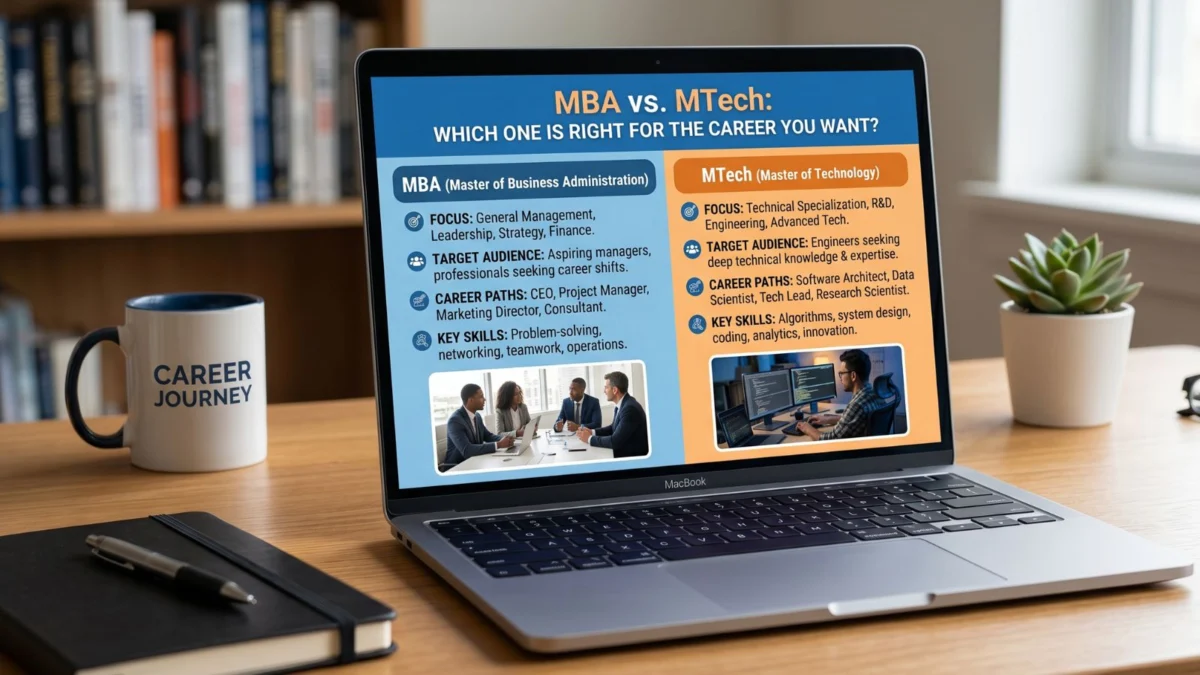
The pursuit of higher education in today’s dynamic professional arena is no longer merely about accumulating credentials. For contemporary graduates, postgraduate studies represent a strategic investment in acquiring relevant skills and cultivating a distinct competitive advantage. It’s a transformative journey that shapes not only one’s professional trajectory but also their very approach to thinking, working, and evolving as an individual. Among the most frequently considered advanced degrees are the Master of Business Administration (MBA) and the Master of Technology (MTech). Both are highly respected qualifications, capable of unlocking fulfilling career paths and catering to a spectrum of aspirations. The critical differentiator, therefore, lies not in a universal declaration of superiority, but in the precise alignment of each degree with an individual’s personal goals, professional ambitions, and envisioned career roadmap.
The MTech: Deepening Technical Mastery and Innovation
The MTech degree is meticulously crafted for individuals driven by a desire to cultivate profound technical expertise. It is the ideal choice for those with a passion for engineering disciplines, the intricacies of computing, the burgeoning fields of data science and artificial intelligence, sophisticated systems design, and the forefront of research and technological development. This academic pursuit typically resonates with students who find intellectual stimulation in dissecting and solving complex technical challenges, and who aspire to significantly enhance their capabilities within a specialized technological domain.
Core Focus: Technical Acumen and Specialization
An MTech program delves deeply into the scientific and engineering principles that underpin modern innovation. Students are immersed in advanced coursework, rigorous problem-solving methodologies, and often, hands-on research projects. The curriculum is designed to foster a comprehensive understanding of specific technologies, enabling graduates to become subject matter experts. This could range from advanced algorithms in computer science to novel materials in mechanical engineering, or sophisticated cybersecurity protocols. The emphasis is on building a robust theoretical foundation coupled with practical application, preparing individuals to contribute directly to the creation, refinement, and advancement of technology.
Career Pathways: The Engine of Technological Advancement
Post-MTech career trajectories are inherently domain-led, charting courses through critical areas such as software development, cutting-edge research and development, the rapidly evolving landscape of artificial intelligence, robust cybersecurity solutions, intricate engineering design, and the architecture of complex systems. These roles are exceptionally well-suited for individuals who are motivated to remain closely engaged with the technological frontier, cultivating deep specialist knowledge and becoming indispensable assets in their chosen fields. MTech graduates are the architects of the future, the innovators who translate complex scientific concepts into tangible solutions that drive progress across industries.
The MBA: Cultivating Strategic Leadership and Business Acumen
In stark contrast, the MBA program is dedicated to the development of broad managerial and leadership capabilities. It equips students with the essential tools to comprehend intricate market dynamics, understand customer behaviors and needs, analyze organizational structures and functions, effectively lead teams, formulate strategic objectives, and make sound, data-driven decisions. As the business world becomes increasingly intertwined with technological advancements, the contemporary MBA curriculum has undergone a significant evolution. It now embraces crucial areas such as advanced analytics, the strategic imperatives of digital transformation, fostering innovation, nurturing entrepreneurship, and navigating the complexities of global business operations.
Core Focus: Strategic Thinking and Organizational Impact
The MBA experience is designed to broaden perspectives and hone strategic thinking. It moves beyond a single technical discipline to encompass the holistic functioning of an organization. Graduates are trained to identify opportunities, mitigate risks, manage resources effectively, and drive organizational growth. The curriculum often features case studies, simulations, and group projects that mimic real-world business scenarios, fostering skills in negotiation, communication, and leadership. The emphasis is on developing individuals who can understand the interplay between different business functions and make informed decisions that impact the bottom line.
Career Pathways: Orchestrating Business Success
Management-focused postgraduate pathways, exemplified by the MBA, frequently open doors to a wider array of career possibilities. These include roles in strategic consulting, product management, financial analysis and management, marketing and brand strategy, operations and supply chain management, data analytics leadership, entrepreneurial ventures, and general management positions. The inherent value of an MBA lies in its versatility, particularly for individuals who aspire to work across diverse industries or transition into roles where the convergence of technology, human capital, and business outcomes is paramount. MBA graduates are the strategists, the orchestrators who ensure that technological advancements are leveraged for maximum commercial and organizational benefit.
The Crucial Distinction: Depth vs. Breadth
To distill the essence of these two powerful degrees: an MTech cultivates depth within the realm of technology, while an MBA cultivates breadth in the arena of business leadership. One is fundamentally centered on achieving technical mastery and becoming an expert in a specialized domain. The other focuses on developing the capacity to create significant organizational and commercial impact through strategic management and leadership. This fundamental difference dictates the nature of the challenges graduates are equipped to tackle and the types of contributions they are positioned to make.
Evolving Employability: Beyond the Degree Title
The landscape of recruitment and talent acquisition is continuously shifting. Today, employers are increasingly looking beyond the mere possession of academic qualifications. Their focus is shifting towards assessing a candidate’s preparedness for the practical demands of the workplace. They place a premium on graduates who demonstrate exceptional critical thinking abilities, communicate ideas with clarity and persuasion, collaborate effectively within diverse teams, and possess the capacity to translate their academic learning into tangible solutions for real-world business challenges.
The Learning Environment: A Catalyst for Success
This heightened emphasis on practical readiness underscores the critical importance of the learning environment itself, which is as consequential as the qualification obtained. A truly impactful postgraduate experience must extend far beyond the confines of textbooks and lectures. It must actively integrate a diverse range of pedagogical approaches, including immersive case-based learning, challenging live projects that mirror industry demands, exposure to global perspectives and best practices, technology-enabled classrooms that foster interactive learning, and opportunities to engage with a diverse cohort of peers. Furthermore, robust and meaningful career support services are indispensable. In an increasingly interconnected global economy, students must be equipped with a nuanced understanding of how work operates across varied markets, cultures, and contexts.
Strategic Decision-Making: Aligning with Long-Term Career Goals
The decision to pursue an MTech or an MBA should be a deliberate and deeply personal one, rooted in a clear understanding of one’s long-term career aspirations, rather than being swayed by transient popularity or the prevailing winds of industry trends.
The MTech Candidate Profile:
An MTech is the compelling choice for individuals who possess a genuine and enduring fascination with technical specialization, groundbreaking research, pioneering engineering innovation, and the advancement of sophisticated technological frontiers. For those who derive satisfaction from working with intricate systems, crafting elegant code, designing robust product architectures, mastering complex technical frameworks, or engaging in the intellectual rigor of solving highly complex problems, an MTech offers an unparalleled opportunity to cultivate profound and specialized domain expertise. These graduates are poised to become the leading engineers, scientists, and researchers who push the boundaries of what is technologically possible.
The MBA Candidate Profile:
Conversely, an MBA may represent a more strategic fit for individuals who harbor aspirations of ascending to leadership positions, shaping organizational strategy, and making pivotal business decisions. This degree is particularly pertinent for those who envision themselves managing and motivating teams, building and scaling businesses, spearheading significant organizational transformations, embarking on careers in management consulting, taking on pivotal product management responsibilities, or navigating the complexities of global business environments. These individuals are driven by the desire to lead, to innovate within an organizational context, and to drive commercial success.
Beyond Popularity: The Core of the Choice
The selection process should be entirely independent of external influences such as fleeting popularity, the expectations of peers, or the ephemeral nature of short-term industry trends. The decision must ultimately be anchored in the fundamental nature of the work one desires to perform and the impact one wishes to create. Some individuals may be profoundly passionate about the intrinsic act of building technology itself, reveling in the intricacies of its creation. Others, however, may find their greatest fulfillment in leading and guiding organizations that strategically leverage technology to achieve growth, foster innovation, and drive competitive advantage. Both of these pathways offer exceptionally strong career prospects, but they inherently demand distinct skill sets, cultivate differing perspectives, and are fueled by unique career motivations.
The Future of Professional Excellence: Adaptability and Integration
Looking towards the horizon of professional achievement, it is increasingly evident that successful professionals will be defined less by the specific title of their academic degree and more by their demonstrable ability to adapt to changing circumstances, collaborate effectively across diverse disciplines, and commit to a lifelong journey of continuous learning. As businesses become progressively more digitized, interconnected, and characterized by rapid evolution, professionals who possess the unique capacity to seamlessly integrate a deep understanding of technology with sharp strategic thinking will undoubtedly emerge as leaders and innovators.
The Ultimate Question: Who Do You Aspire to Be?
For students standing at this pivotal decision juncture, the more profound and consequential question transcends a simple binary choice between an "MBA or MTech?" It compels a deeper introspection: "What kind of professional do I truly aspire to become?" The answer to this fundamental question serves as the most potent compass, often guiding and shaping the ensuing career trajectory with clarity and purpose. The journey of postgraduate education is not merely about acquiring knowledge; it is about self-discovery and strategic self-creation.
