

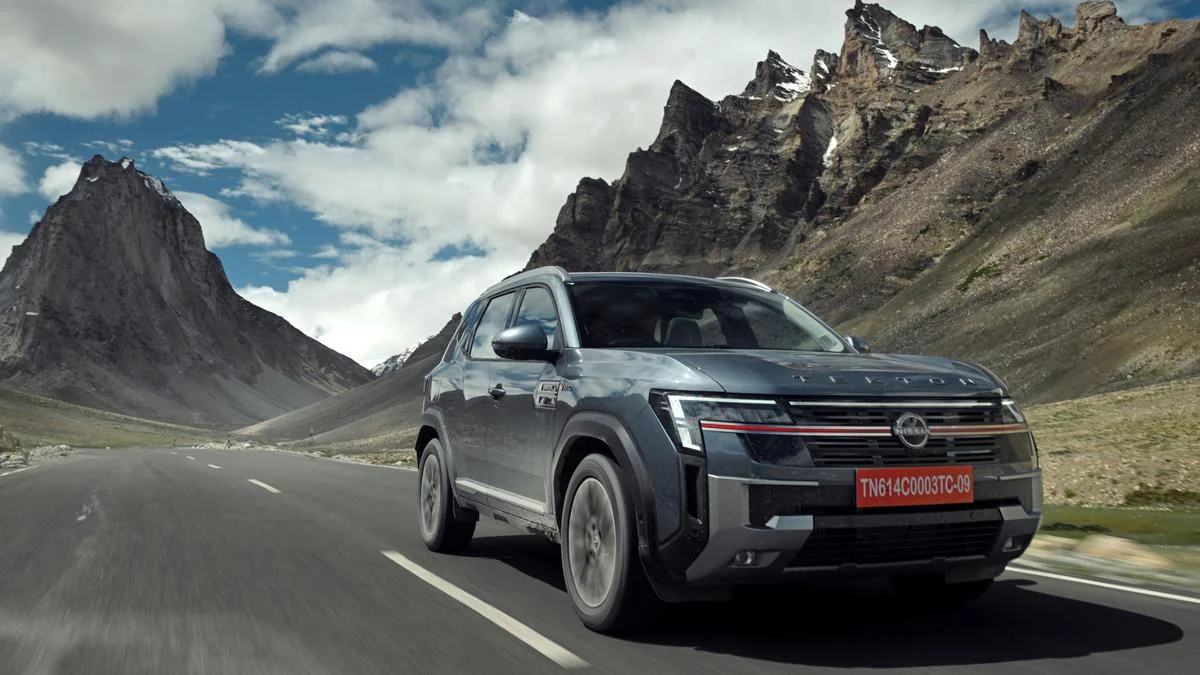
The Indian automotive landscape is currently dominated by a singular, unyielding trend: the rise of the mid-size SUV. Within this fiercely contested arena, manufacturers are constantly seeking the perfect equilibrium between rugged capability, urban sophistication, and technological prowess. Nissan’s latest entrant, the Tekton, arrives not just as a new model, but as a strategic pivot for the Japanese automaker in the subcontinent.
While the Tekton inevitably faces questions regarding its lineage—specifically its shared DNA with the Renault Duster—a 700km expedition from the plains of Chandigarh to the high-altitude desert of Leh reveals a vehicle that is far more than a mere exercise in badge engineering. It is a calculated, premium reinterpretation of a proven platform, designed to offer a distinct alternative to the established Korean and European hegemony.
I. Main Facts: The Tekton’s Market Proposition
The Nissan Tekton enters the Indian market with an aggressive price bracket of ₹10.49 lakh to ₹18.59 lakh (ex-showroom). Positioned as a premium mid-size SUV, it sits atop the CMF-B platform, a global architecture shared within the Renault-Nissan-Mitsubishi Alliance. However, Nissan has gone to great lengths to ensure the Tekton carries the visual and tactile weight of its larger, more legendary siblings, specifically the Nissan Patrol.
Key Specifications at a Glance:

- Engine Options: 1.0L Turbo-Petrol (T160) and 1.3L Turbo-Petrol (T280).
- Power/Torque: 100PS/166Nm (T160) and 163PS/280Nm (T280).
- Transmission: 6-speed Manual, 6-speed DCT (Dual-Clutch Transmission).
- Ground Clearance: 212mm.
- Safety: 5-star Bharat NCAP rating, 6 airbags as standard.
- Cargo Capacity: 518-litre boot space.
The Tekton’s primary mission is to capture the "explorer" demographic—drivers who require a vehicle that can navigate the congested arteries of Delhi or Mumbai during the week but possess the mechanical grit to tackle the Manali-Leh highway on the weekend.
II. Chronology of the Drive: From Chandigarh to the Roof of the World
To truly understand if the Tekton is more than the sum of its shared parts, the testing route was chosen with deliberate severity. The 700km journey from Chandigarh to Leh serves as a microcosm of every challenge an Indian driver might face.
The Highway Sprint: Leaving Chandigarh
The journey began on the smooth, multi-lane highways exiting Chandigarh. This initial leg highlighted the Tekton’s high-speed stability. In the T280 variant, the 1.3-litre turbocharged engine demonstrated a refined cruising ability. At 100-120kph, the SUV felt planted, with the aerodynamic silhouette (inspired by the Patrol) minimizing wind noise more effectively than its predecessor on this platform.
The Ascent: Into the Himalayas
As the altitude climbed and the roads narrowed into the winding passes of Himachal Pradesh, the Tekton’s powertrain was put to the ultimate test. The transition from the plains to the mountains revealed a characteristic "turbo lag" in the T280 at low RPMs. On steep hairpins, the driver must be mindful of the engine’s power band. However, once the tachometer crossed the 2,000 RPM mark, the 280Nm of torque provided a surge that made overtaking slow-moving trucks on short straights a confident affair.

The Gauntlet: Broken Roads and Water Crossings
Beyond Keylong and towards the formidable Baralacha La pass, the tarmac often gives way to "broken surfaces"—a polite term for ruts, loose gravel, and glacial melt streams. It was here that the Tekton’s 212mm ground clearance and chassis tuning shone. Unlike many of its rivals that prioritize a stiff, "sporty" ride, the Tekton’s suspension offered enough compliance to soak up sharp edges without the "pogo-stick" effect often seen in softer SUVs.
III. Supporting Data: Engineering, Design, and Interior Ambience
Exterior: The "Mini-Patrol" Aesthetic
Nissan’s design team focused on "verticality" and "presence." The front fascia is dominated by C-shaped daytime running lights (DRLs) and a sculpted bonnet that sits high in the driver’s line of sight, providing a sense of security. The 18-inch diamond-cut alloys and the chunky wheel arches give it a "go-anywhere" stance that differentiates it from the more curvaceous design of the Hyundai Creta or the Kia Seltos.
Interior: A Polarizing Palette
The cabin is perhaps the most significant departure from the Renault Duster. Nissan has opted for a bold purple detailing on the dashboard and upholstery. While traditionalists might have preferred a monochrome black or beige, the purple trim lends the Tekton a "boutique" feel.
- Technology: The 10.1-inch infotainment system is crisp, featuring wireless smartphone integration.
- Comfort: The inclusion of ventilated front seats and a panoramic sunroof addresses the specific demands of the Indian climate and consumer preferences.
- Space: The 518-litre boot is class-leading, easily accommodating the heavy luggage and gear required for a week-long Himalayan expedition.
Performance Metrics and Efficiency
Data gathered during the drive suggests that while the T160 (1.0L) engine is a capable city commuter, the T280 is the definitive choice for enthusiasts.

- Acceleration: The T280 Manual hits 0-100kph in 9.51 seconds, while the DCT follows closely at 9.89 seconds.
- Fuel Economy: Despite the grueling climbs, the Tekton maintained a respectable efficiency. Nissan claims 17.8kpl for the manual and 18.5kpl for the DCT under standard conditions, though real-world mountain driving will naturally see these figures dip.
IV. Official Strategy: Nissan’s "Premium Differentiation"
Nissan’s corporate strategy with the Tekton is a response to the "badge-engineering" fatigue seen in the Indian market. In previous years, partnerships often resulted in cars that were identical save for the logo. With the Tekton, Nissan officials have emphasized that the "interpretation" of the platform is entirely their own.
By drawing on the heritage of the Patrol, Nissan is attempting to build a "halo effect" around the Tekton. They are not marketing it as a budget-friendly alternative, but as a "rugged premium" choice. This is evidenced by the inclusion of a 3D Around View Monitor and a comprehensive ADAS (Advanced Driver Assistance Systems) suite in higher trims—features typically reserved for vehicles a segment above.
Furthermore, the decision to achieve a 5-star Bharat NCAP rating before launch signals a commitment to safety that is becoming a non-negotiable factor for Indian car buyers. By making six airbags standard across the range, Nissan is positioning the Tekton as a responsible family vehicle, not just an adventurer’s toy.
V. Implications: Competition and the Road Ahead
The arrival of the Nissan Tekton has significant implications for the mid-size SUV segment.

The Competitive Landscape
The Tekton enters a "ring of fire" occupied by the Hyundai Creta, Kia Seltos, Maruti Suzuki Grand Vitara, and the Volkswagen Taigun.
- Against the Koreans (Creta/Seltos): The Tekton lacks a diesel engine and a strong hybrid option, which may deter high-mileage urban users. However, it counters with superior ground clearance and a more robust suspension setup for rough roads.
- Against the Europeans (Taigun/Kushaq): The Tekton offers more interior space and a larger boot, addressing the "smallness" often cited as a drawback for the VW/Skoda twins.
The Hybrid Omission
Perhaps the most significant risk in Nissan’s strategy is the absence of a hybrid powertrain. With Toyota and Maruti Suzuki seeing massive success with their "Strong Hybrid" variants, Nissan is banking entirely on the efficiency and performance of its turbo-petrol engines. While the T280 is a masterclass in power delivery, the lack of an electrified option may limit its appeal in the ultra-competitive fleet and fuel-conscious urban segments.
Conclusion: A Purpose-Built Contender
The drive to Leh proved that the Nissan Tekton is a vehicle of substance. It is not a city car pretending to be an SUV; it is a capable tourer that happens to be comfortable in the city. Its strength lies in its "dual personality"—the ability to offer a premium, tech-laden cabin for the daily commute while possessing a chassis that refuses to be intimidated by the world’s most treacherous roads.
For Nissan India, the Tekton is more than just a volume generator; it is a brand-builder. If the company can back this product with a robust service network and consistent marketing, the Tekton has the potential to move Nissan out of the shadows of its alliance partners and into the spotlight as a purveyor of rugged, premium engineering. On the long, winding road to Leh, the Tekton didn’t just survive; it excelled, proving that while its bones may be shared, its soul is pure Nissan.
