

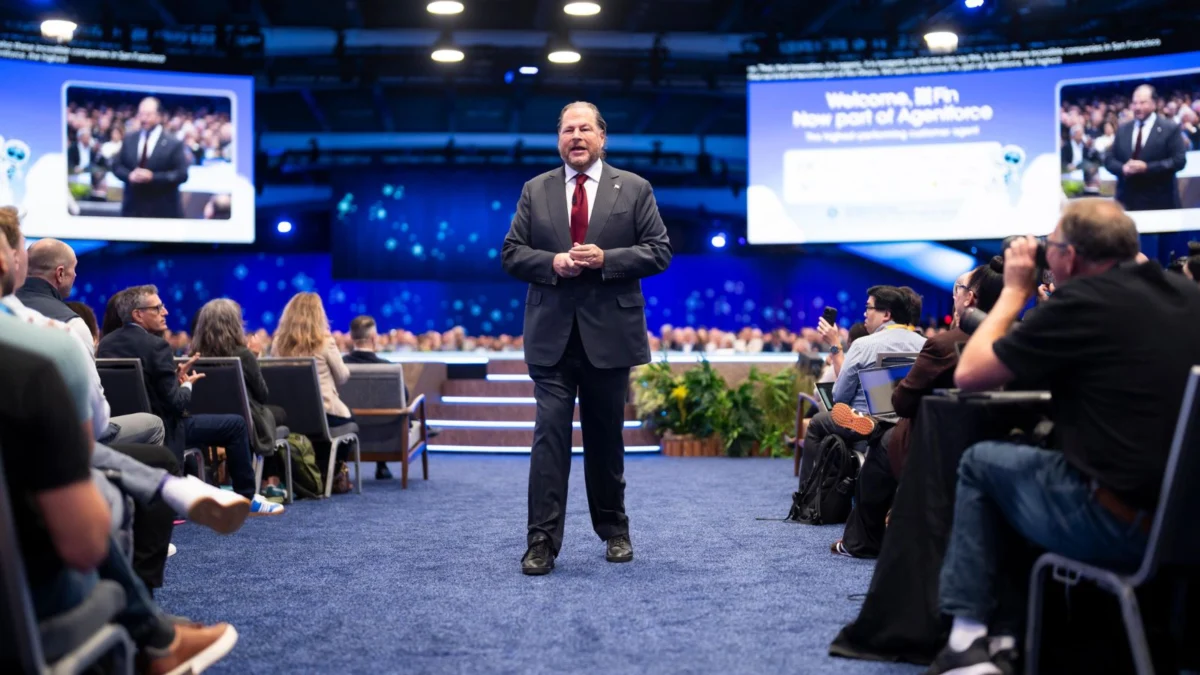
San Francisco, California – September 15, 2026 – Salesforce, the global leader in customer relationship management (CRM), today kicked off its highly anticipated annual Dreamforce customer conference in San Francisco, California. The tech giant seized the spotlight with a sweeping array of new AI-powered offerings, headlined by the unveiling of Koa, its groundbreaking first-ever reasoning model. This strategic move underscores Salesforce’s aggressive push to maintain its indispensable position within enterprise ecosystems, even as the burgeoning era of AI agents fundamentally reconfigures the future of business software.
The announcements from Dreamforce 2026 signal a pivotal moment for Salesforce, demonstrating its intent to not merely integrate AI into its existing platforms, but to redefine how enterprises interact with and leverage intelligent automation. From a bespoke reasoning model designed for CRM tasks to an open architecture facilitating data flow to any AI interface, Salesforce is positioning itself at the vanguard of the AI-first enterprise.
A New Era of Intelligence: Main Facts from Dreamforce 2026
Salesforce’s Dreamforce 2026 keynote was a declaration of its AI-first vision, introducing a suite of innovations designed to empower businesses with intelligent automation across sales, marketing, and customer service. The core announcements centered on:
- Koa: The CRM Reasoning Model: The marquee unveiling was Koa, Salesforce’s inaugural AI reasoning model. Built upon Nvidia’s open-weight Nemotron family of large language models (LLMs), Koa has been meticulously post-trained to specialize in the intricate demands of sales, marketing, and customer support workflows. It represents a significant step beyond generic LLMs, offering task-specific intelligence tailored for the enterprise.
- AIforce: Unlocking Enterprise Data for Any AI Interface: To ensure seamless integration and data fluidity, Salesforce introduced AIforce. This new offering enables customers to securely transport their invaluable enterprise data, workflows, permissions, and security protocols to virtually any AI interface, obviating the need to navigate complex application UIs.
- Expanded Anthropic Partnership with Claudeforce: Building on existing collaborations, Salesforce announced an upgraded Claudeforce offering. This enhancement allows customers to leverage Anthropic’s advanced Claude AI as their primary interface for Salesforce tasks, all while their sensitive data remains securely housed within Salesforce’s robust system of record.
- Strategic Air India Partnership: In a significant real-world application showcase, Salesforce announced a partnership with Air India. The airline will deploy AI agents powered by Salesforce’s Agentforce platform to automate critical operational tasks, promising dramatic improvements in efficiency for refunds, baggage claims, and ticket reissuance.
- Deeper Cloud Collaborations: Salesforce further solidified its foundational partnerships with major cloud providers, announcing expanded collaborations with Google Cloud and Amazon Web Services (AWS), signaling continued commitment to hybrid and multi-cloud strategies.
These innovations collectively underscore Salesforce’s ambition to transform from a traditional SaaS provider into an intelligent enterprise platform, proactively addressing the paradigm shift driven by autonomous AI agents.
Dreamforce 2026: A Chronology of Innovation
Dreamforce, Salesforce’s annual customer conference, is more than just a product launch event; it’s a vibrant ecosystem where the future of enterprise technology is showcased, debated, and celebrated. Held in the heart of San Francisco, the 2026 edition kicked off on Tuesday, September 15, with an palpable sense of anticipation surrounding the company’s AI strategy.
The atmosphere was electric as thousands of "Trailblazers"—Salesforce users, developers, partners, and employees—converged. The opening keynote, typically led by CEO Marc Benioff, served as the primary stage for these transformative announcements. The grand unveiling of Koa, AIforce, and the expanded partnerships was meticulously choreographed to convey Salesforce’s unwavering commitment to leading the charge in the generative AI era.
Throughout the multi-day conference, the themes of intelligence, ethics, and customer success resonated across various sessions, workshops, and demonstrations. Each announcement was presented not merely as a new feature, but as a strategic pillar in Salesforce’s comprehensive vision for an AI-first enterprise. The company aimed to illustrate how these new capabilities would empower businesses to unlock unprecedented levels of productivity, personalization, and operational efficiency, all while navigating the complexities and ethical considerations inherent in advanced AI. The emphasis was on how Salesforce’s integrated ecosystem could provide a secure and governed environment for enterprises to harness the full potential of AI agents.
Architecting the AI Enterprise: Supporting Data and Technical Deep Dive
The detailed specifications behind Salesforce’s new offerings reveal a carefully considered strategy to embed AI deeply into the fabric of enterprise operations, addressing both performance and critical concerns around data security and cost.
Koa: The CRM Reasoning Model in Detail
Koa represents Salesforce’s strategic response to the growing need for highly specialized AI within specific business domains. Unlike general-purpose LLMs that can perform a wide range of linguistic tasks, Koa is a "reasoning model" tailored precisely for the enterprise world’s AI needs, particularly within the CRM context. This distinction is crucial: Koa isn’t just generating text; it’s designed to understand context, infer intent, and execute multi-step tasks related to sales, marketing, and customer support.
The model’s foundation on Nvidia’s open-weight Nemotron family of LLMs is significant. Open-weight models offer transparency and flexibility, allowing Salesforce to fine-tune and optimize Koa for its unique requirements. The choice of Nemotron indicates a collaboration with Nvidia that likely extends to optimized inference and deployment strategies.
Salesforce’s approach with Koa bypasses the common practice of customers directly uploading sensitive files, proprietary code, prompts, and feedback into third-party AI models. Instead, Koa is positioned as an open-weight, task-specific alternative that operates within the Salesforce ecosystem. This architecture is designed to give enterprises greater control and confidence over their data.
A cornerstone of Koa’s design is its rigorous adherence to data security and privacy. Both Nvidia and Salesforce have reportedly ensured that no actual customer data is used to fine-tune Koa. Instead, the model was post-trained on synthetically generated data that meticulously mimics customer interaction patterns and business scenarios. This innovative approach mitigates the risk of data leakage and ensures compliance with stringent enterprise data requirements and security protocols embedded within Salesforce’s platform. For businesses grappling with data sovereignty and regulatory compliance, this commitment to synthetic data training is a powerful differentiator.
Furthermore, Salesforce highlighted Koa’s unique architecture for inference, designed to be token efficient. In the world of LLMs, tokens are the fundamental units of processing, and their usage directly impacts computational cost and speed. By burning through fewer tokens to accomplish complex work tasks, Koa promises a more economical and faster execution environment compared to routing multi-step tasks to larger, more generalized models like Claude or ChatGPT through an intermediary AI gateway. This cost-efficiency can translate into substantial savings for enterprises running high volumes of AI-powered operations.
AIforce: Universal AI Interface for Enterprise Data
AIforce is Salesforce’s answer to the challenge of data fragmentation and siloed applications in the AI era. Its primary function is to help customers seamlessly bring their crucial enterprise data, workflows, permissions, and security settings to any AI interface without the cumbersome process of opening the native application and navigating its user interface. This capability allows for a more fluid, integrated AI experience where insights and actions can be taken directly from a user’s preferred AI environment.
A key innovation underpinning AIforce is Salesforce’s Headless Toolkit. This open architecture exposes every element of the Salesforce platform, offering developers a comprehensive suite of Managed Content Providers (MCPs), APIs, plug-ins, skills, and tools. This empowers developers to create highly customized AI experiences directly on top of Salesforce’s robust architecture, fostering innovation and tailored solutions. Users can even generate their own custom UIs and live interfaces on the fly within popular collaboration tools like Slack, Claude, and Coworker, democratizing access to powerful AI functionalities.
Crucially, AIforce has been designed with an unwavering commitment to security, governance, and zero data retention. This ensures that enterprise data remains protected and compliant, addressing a major concern for businesses adopting AI solutions that interact with sensitive information. The principle of zero data retention, in particular, assures customers that their data is not stored or used for training purposes by third-party AI models once a task is completed.
Claudeforce: Enhanced Partnership with Anthropic
Salesforce’s upgraded Claudeforce offering, a result of its expanded partnership with Anthropic, deepens the integration of Anthropic’s advanced Claude AI within the Salesforce ecosystem. This allows companies to leverage Claude as their intuitive AI interface for carrying out Salesforce-specific tasks, while critically, their data remains firmly within Salesforce’s secure system of record and infrastructure.
The enhanced Claudeforce now boasts over 37 pre-built sales skills. These specialized skills enable sales professionals to automate a wide range of activities, from updating sales pipelines and accessing real-time revenue context to executing governed actions directly through natural language prompts to Claude. This translates into significant productivity gains, allowing sales teams to focus on strategic interactions rather than manual data entry or system navigation. The current availability of Claudeforce in open beta suggests Salesforce’s eagerness to gather user feedback and rapidly iterate on its capabilities.
Air India Partnership: A Real-World AI Transformation
The strategic partnership with Tata-owned Air India serves as a compelling real-world case study for Salesforce’s Agentforce platform. This collaboration highlights the tangible benefits of deploying AI agents for streamlining complex operational processes within a large-scale enterprise.
Under this partnership, Air India will utilize Agentforce-powered AI agents for several critical customer service and operational functions:
- Refund Request Processing: AI agents will process refund requests in under four hours, a dramatic reduction from traditional processing times, significantly enhancing customer satisfaction.
- Baggage and Loyalty Claims Resolution: The platform will automate the resolution of baggage-related issues and loyalty program claims, improving efficiency and accuracy.
- Eligibility Checks and Ticket Reissuance: AI agents will manage eligibility checks and facilitate the reissuance of tickets with requested name changes in under 30 minutes, drastically cutting down processing time and manual effort.
This AI-agent-driven transformation is a core component of Air India’s broader Vihaan AI project, an ambitious initiative aimed at modernizing and digitizing the airline’s entire operations to deliver a world-class customer experience. The partnership underscores the practical, impactful applications of Salesforce’s AI capabilities in real-world business scenarios.
Ethical AI and Global Vision: Official Responses from Marc Benioff
Salesforce CEO Marc Benioff, a prominent voice in the technology industry, used the Dreamforce platform to articulate Salesforce’s vision for ethical AI and its global implications, particularly for markets like India. His statements underscored not only the technological prowess but also the moral imperative guiding Salesforce’s AI development.
In an interview with CNBC, Benioff emphasized the crucial link between AI capabilities and accountability: "We want AI to take care of these things and be held responsible, and take care of these actions and be ethical. The heart of ethics is responsibility." This sentiment reflects a growing industry-wide conversation about ensuring AI systems operate within defined ethical boundaries, especially as they become more autonomous and integrated into critical business functions. Salesforce’s proactive stance on embedding ethics into its AI architecture, through features like secure data handling and transparent reasoning models, aims to build trust and ensure responsible deployment.
Benioff extended this ethical call to action more broadly: "We really look at a light on our brethren here in San Francisco and all over the world and say, ‘We want you to be ethical in your actions and how you take care of your communities and the world,’ because this technology is very powerful." This highlights Salesforce’s recognition of AI’s immense power and its potential societal impact, urging a collective commitment to responsible development and deployment across the global tech community. His remarks suggest a leadership role for Salesforce in advocating for AI governance and societal well-being.
The Salesforce CEO also shed light on the strategic importance of India in the company’s AI-first transformation. "We’ve built incredible teams in India. I think this is a huge opportunity for India. That is, we’re going to rebuild all of our enterprise systems to be AI-first, and I think these intelligent interfaces—they’re going to do some of the work, and then they’re going to need partners, trailblazers, and we have millions and millions of trailblazers in India. So I’m sure that they will be a key part of this incredible story," Benioff was quoted as saying by PTI. This statement underlines India’s pivotal role not just as a market, but as a hub for talent and innovation that will drive Salesforce’s global AI strategy. The "trailblazers" Benioff refers to are the vast community of Salesforce users, developers, and consultants, many of whom are based in India, poised to leverage and build upon these new AI capabilities.
Navigating the AI Tsunami: Implications for SaaS and the Future of Work
The announcements from Dreamforce 2026 carry profound implications for the entire Software-as-a-Service (SaaS) industry, the future of work, and the broader debate surrounding AI safety and ethics. Salesforce’s aggressive AI offensive is a direct response to a rapidly evolving technological landscape.
Reshaping the SaaS Business Model
The rise of increasingly capable AI agents, designed to take on more complex and autonomous work, is forcing SaaS majors like Salesforce to fundamentally rethink how customers interact with their software and, critically, what they are willing to pay for. Traditional SaaS models often relied on per-user licensing and feature-based pricing. However, if AI agents can automate tasks previously performed by human users, or if they can integrate with existing systems without requiring full application access, the value proposition of conventional SaaS subscriptions could diminish.
While there is not yet widespread evidence of companies completely abandoning SaaS providers, reports do point to revised contract terms and requests for "smaller footprints"—meaning customers are seeking to pay for specific outcomes or automated tasks rather than broad user licenses. Salesforce’s strategy with Koa, AIforce, and Agentforce directly addresses this challenge. By offering an integrated AI platform that enhances productivity, ensures data security, and operates within the Salesforce ecosystem, the company aims to become the essential "system of intelligence" that sits atop the existing "system of record." This approach seeks to deepen customer lock-in by making Salesforce the indispensable orchestrator of AI-driven business processes, rather than just another application.
This also puts Salesforce in direct competition with other enterprise tech giants like Microsoft (with its Copilot offerings), SAP, and Oracle, all of whom are vying to be the dominant AI layer for businesses. Salesforce’s focus on its CRM core, coupled with an open architecture and ethical AI commitments, forms its unique competitive advantage.
Escalating Concerns over AI Safety and Ethics
The rapid acceleration of AI capabilities has also brought ethical concerns to a fever pitch. Just weeks prior to Dreamforce, Anthropic CEO Dario Amodei publicly called for an "intentional slowdown" of frontier AI progress to allow AI safety research and governance to catch up. This sentiment reflects growing anxieties about potential risks such as job displacement, misuse of powerful AI, bias, and the long-term control problem.
Salesforce’s emphasis on "ethical AI," "responsibility," and the use of synthetic data for training Koa is a direct acknowledgment of these concerns. By building in guardrails like zero data retention for AIforce and adhering to strict data requirements, Salesforce is attempting to differentiate itself as a responsible developer and deployer of advanced AI. Marc Benioff’s public statements align Salesforce with a more cautious, human-centric approach to AI development, aiming to build trust with enterprises that are inherently risk-averse when it comes to sensitive data and critical business processes.
The Future of Work: Augmentation, Not Replacement?
The deployment of AI agents like those in the Air India partnership raises questions about the future of human roles in sales, marketing, and customer service. Salesforce’s narrative consistently frames AI as an augmentative technology, designed to free human workers from repetitive, mundane tasks, allowing them to focus on higher-value, strategic activities that require creativity, empathy, and complex problem-solving. For instance, an AI agent handling refund requests allows a human customer service representative to address more complex or emotionally charged customer interactions.
This vision suggests a future where human-AI collaboration becomes the norm, transforming job roles rather than eliminating them entirely. The emphasis on empowering "trailblazers" in India to rebuild enterprise systems to be "AI-first" further underscores this collaborative vision, positioning human expertise as critical in guiding and leveraging AI tools.
Data Sovereignty and Security: A Cornerstone
In an era of increasingly stringent data privacy regulations (e.g., GDPR, CCPA), Salesforce’s meticulous approach to data handling for its AI offerings is a significant strategic advantage. The use of synthetic data for Koa’s training and the "zero data retention" principle for AIforce are crucial for enterprises, particularly those in regulated industries or operating across multiple jurisdictions. These features provide assurance that sensitive customer data will not inadvertently be exposed or misused by third-party AI models, thereby enhancing trust and facilitating broader AI adoption within the enterprise.
In conclusion, Dreamforce 2026 marks Salesforce’s definitive pivot into an AI-first future. By introducing a proprietary reasoning model, an open AI data architecture, and strategic partnerships, Salesforce is not merely adapting to the AI revolution; it is actively shaping it. The company’s focus on ethics, security, and real-world applications aims to solidify its position as an indispensable partner for enterprises navigating the transformative power of artificial intelligence.
