

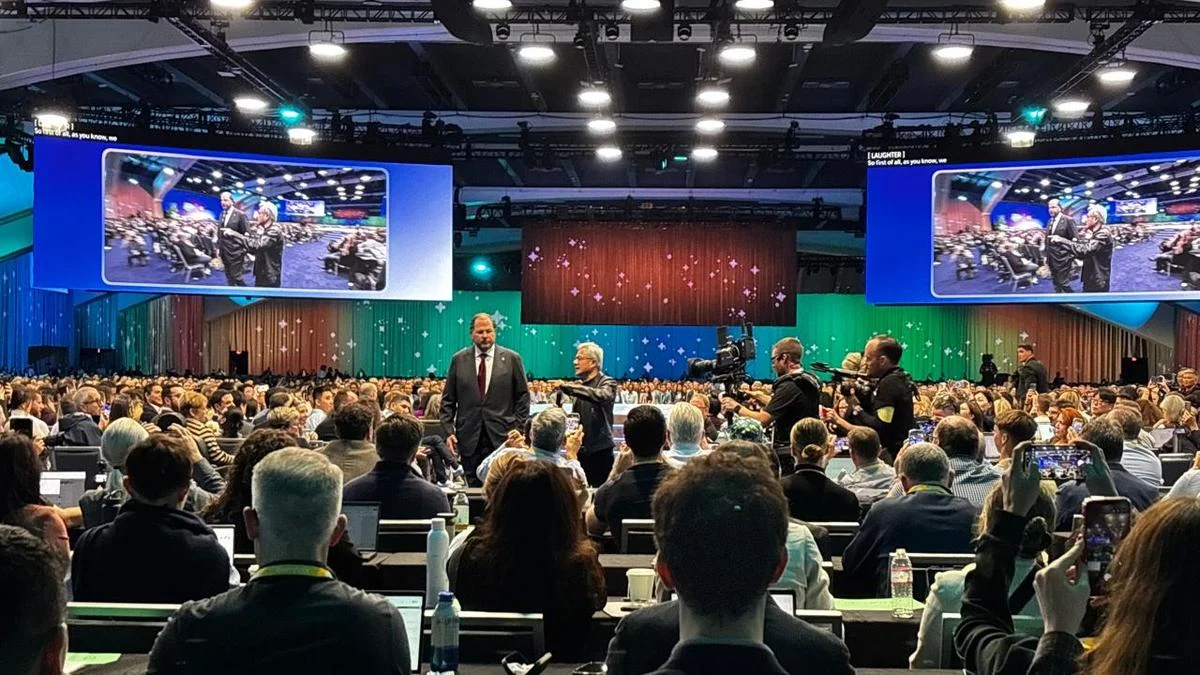
SAN FRANCISCO, California – September 15, 2026 – Salesforce, the global leader in customer relationship management (CRM) software, today unveiled "AIForce," its highly anticipated AI-powered live interface layer designed for enterprise users. The announcement, made during the keynote session of the company’s annual Dreamforce convention at the Moscone Center in San Francisco, marked a significant pivot in Salesforce’s artificial intelligence strategy, promising an "interface revolution" for businesses worldwide.
However, the tech giant’s celebratory launch was met with a stark counterpoint just outside the convention doors, where protesters demonstrated against Salesforce’s controversial contracts with the U.S. Immigration and Customs Enforcement (ICE), highlighting the persistent ethical dilemmas facing the technology industry. Inside, the star-studded event also became a platform for a deeply divided debate on the future of AI regulation, featuring contrasting viewpoints from Anthropic CEO Dario Amodei and Nvidia CEO Jensen Huang.
The Grand Unveiling: AIForce and the "Interface Revolution"
The atmosphere inside the Moscone Center was electric, a signature blend of cutting-edge technology, corporate spectacle, and celebrity wattage that has become synonymous with Dreamforce. Following a traditional Hawaiian blessing, attendees were treated to two high-production enterprise AI advertisements featuring Oscar-winning Hollywood actor Matthew McConaughey, known for his laid-back yet compelling presence. The energy further surged with a vibrant performance by multi-platinum singer Gwen Stefani, setting a celebratory tone before Salesforce CEO Marc Benioff took to the stage.
Benioff, clad in his characteristic casual attire, wasted no time in pitching AIForce as nothing short of an "interface revolution." He promised a new generation of AI interfaces that would be "dynamic, intelligent, composable, and live," fundamentally transforming how enterprises interact with their vast datasets and complex workflows.
"We believe that every company can become an agentic enterprise, and we’re going to show you the best way to do it by doing it ourselves," Mr. Benioff declared, outlining a vision where AI doesn’t just assist but actively drives business outcomes through autonomous, intelligent actions. The term "agentic enterprise" implies a future where AI systems act as proactive agents, anticipating needs, executing tasks, and learning from interactions to optimize operations across the board.

Beyond Models: The Core Philosophy of AIForce
Benioff’s keynote addressed a critical question in the burgeoning AI landscape: why AIForce, when a plethora of more basic AI products are already available? His response underscored a foundational belief that models, while powerful, are insufficient on their own to harness the full potential of enterprise AI.
"Models alone cannot run the enterprise. Models alone are not going to show us what’s possible. Models also are very probabilistic," Benioff asserted. This statement articulated Salesforce’s position that raw AI models, often prone to probabilistic outputs and lacking comprehensive business context, need a sophisticated overlay to become truly reliable and impactful for mission-critical enterprise operations. AIForce, therefore, is positioned as that essential layer, integrating AI models with the specific, structured knowledge of an enterprise.
A cornerstone of AIForce’s appeal to enterprise clients is its commitment to "zero data retention (ZDR)." This promise directly confronts growing concerns about data privacy and the potential misuse of proprietary client information in the development of AI products. Benioff explicitly refuted recent media reports suggesting that client data was being leveraged for such purposes, aiming to reassure businesses about the security and confidentiality of their most sensitive assets.
In an official company blog post detailing the release, Salesforce elaborated on AIForce’s profound capabilities: "With AIForce, Salesforce is bringing all the enterprise knowledge inside Salesforce – the data, workflows, business logic, semantics, permissions, security, and governance that already run the business – to any AI interface. The result: Companies can unlock tremendous value from all the business knowledge already inside Salesforce, bring Salesforce’s trusted context and governance into any agentic productivity tool, and drive entirely new levels of growth and productivity." This statement emphasizes AIForce’s role as a unifying layer that imbues AI with the specific context, rules, and security protocols inherent to each individual enterprise, moving beyond generic AI applications.
Strategic Partnerships: Anthropic and Nvidia in the Spotlight
The keynote also featured a segment highlighting Salesforce’s strategic alliances in the AI ecosystem, with Anthropic CEO Dario Amodei and Nvidia CEO Jensen Huang joining Mr. Benioff on stage for a joint interview. These partnerships underscore the collaborative nature of advanced AI development and the critical role of specialized AI model providers and hardware manufacturers.

During the session, Mr. Benioff also announced "Koa," Salesforce’s first CRM reasoning model specifically designed for AIForce. This proprietary model is built on NVIDIA Nemotron, a testament to the deep integration with Nvidia’s cutting-edge AI infrastructure and further solidifying the partnership between the two tech giants. Koa is expected to significantly enhance AIForce’s capabilities in understanding and processing complex CRM data, enabling more sophisticated and context-aware interactions for sales, service, and marketing functions.
Divergent Paths: The AI Regulation Debate
The presence of Amodei and Huang on the Dreamforce stage also brought to the forefront the pressing and often contentious debate surrounding AI safety and regulation. The two leaders, representing different facets of the AI industry, presented markedly contrasting philosophies.
Amodei’s Call for a Paced and Regulated Future:
Dario Amodei, CEO of Anthropic, a leading AI safety and research company, briefly touched upon his influential September 12 essay, "We Must Pace the Frontier," which advocated for a strategic slowdown in AI development. During the keynote, Amodei reiterated his stance on the critical importance of establishing global, industry-wide safety standards. He expressed a degree of surprise at the rapid acceleration of AI adoption among businesses, suggesting that many companies might only be tapping into a fraction – perhaps 5% or 10% – of the technology’s true potential value.
Amodei’s arguments stem from a precautionary principle, emphasizing the need for robust guardrails before AI technologies become too powerful or pervasive to control. "Let’s re-commit to transparency. Let’s invest more in safety. Then let’s organise the rest of the industry and say, ‘What can we do to set standards for everyone? What can we do to make everyone’s standards better?’ And then finally, there should be an international component to it," he urged, painting a vision of a collaborative, globally regulated AI development framework. His concerns reflect a broader sentiment within parts of the AI community that unchecked innovation could lead to unforeseen societal risks, from ethical biases to existential threats.
Huang’s Emphasis on Self-Regulation and Innovation Speed:
Jensen Huang, the charismatic CEO of Nvidia, offered a strikingly different perspective. As the head of the company providing the foundational computing power for much of the world’s AI, Huang championed an approach that prioritizes rapid innovation coupled with corporate self-regulation. He firmly rejected the notion that new laws or external regulations were necessary, placing the onus squarely on individual companies to ensure the safety of their products.

"The market forces are in there. We don’t need any new laws and we don’t need new regulations," Huang asserted, effectively inviting companies to innovate and iterate as quickly as possible. He posited that the choice between "innovation/speed and safe products" was a "false choice," arguing that both could be achieved simultaneously. "So run as fast as you can, but if you feel that at any given point in time, the company’s out of control or the product’s not gonna be safe, you know, take a pause and make sure you get it right," Mr. Huang advised. His philosophy underscores a belief in agile development, market-driven responsibility, and the inherent capacity of companies to manage risks without external governmental oversight. This contrast highlights a fundamental philosophical schism within the AI industry, between those who advocate for proactive, external governance and those who believe in industry-led, internal ethical frameworks.
The Shadow of Dissent: Protests Against ICE Contracts
As Salesforce celebrated its technological advancements inside the Moscone Center, a different narrative unfolded just outside. Dreamforce attendees entering the sprawling convention grounds were met by a vocal group of protesters, raising slogans and demanding an end to Salesforce’s long-standing contracts with the United States Immigration and Customs Enforcement (ICE). The protests cast a shadow over the otherwise festive atmosphere, reminding onlookers of the complex ethical landscape that large tech companies, including Salesforce, must navigate.
The demonstrations are not new; Salesforce has faced persistent criticism for its association with ICE, particularly in light of the agency’s controversial practices, including family separations at the border. Protesters distributed flyers outlining their grievances and calling for greater corporate accountability. "Salesforce has a history of showing up for our communities. As a Bay Area tech leader, Salesforce has an opportunity to use its influence to defend democracy, refuse to profit from family separation, & to push the tech industry to follow," read one part of a flyer handed out by a demonstrator. This sentiment reflects a growing demand from activist groups for tech companies to align their business practices with stated corporate values and broader societal ethics.
Beyond the ICE contracts, other protesters also held signs advocating for fair labor practices within the tech industry and calling for better AI safety protocols, echoing some of Amodei’s concerns but from a grassroots perspective. The presence of these diverse protest movements outside Dreamforce underscores the multifaceted expectations placed upon tech giants today – not just as innovators, but as socially responsible corporate citizens.
Implications and the Road Ahead
The launch of AIForce at Dreamforce 2026 marks a pivotal moment for Salesforce, signaling its aggressive entry into the advanced enterprise AI interface market. By promising a "live, dynamic, intelligent, and composable" AI layer with zero data retention, Salesforce aims to differentiate itself in a crowded field, offering enterprises a trusted and context-aware pathway to "agentic" operations. The integration of its CRM reasoning model, Koa, built on Nvidia’s powerful Nemotron, further solidifies its technological prowess and strategic partnerships.

However, the event also laid bare the complex challenges confronting the tech industry. The spirited debate between Amodei and Huang on AI regulation highlights the lack of consensus on how to responsibly govern a technology that promises both unprecedented progress and potential risks. This internal industry friction will undoubtedly shape future policy discussions and the trajectory of AI development.
Simultaneously, the persistent protests against Salesforce’s ICE contracts serve as a powerful reminder that technological innovation cannot exist in a vacuum, detached from its societal and ethical implications. As Salesforce pushes the boundaries of enterprise AI, it must also contend with increasing scrutiny over its corporate responsibility and the real-world impact of its business decisions.
Dreamforce 2026, therefore, was more than just a product launch; it was a microcosm of the tech world’s current state – a dazzling display of innovation, a passionate debate over its ethical stewardship, and a stark confrontation with the industry’s social responsibilities. Salesforce’s "interface revolution" has begun, but it navigates a landscape rich with opportunity, profound ethical questions, and the ever-present demand for accountability. The success of AIForce will not only be measured by its technical capabilities but also by Salesforce’s ability to lead responsibly in an increasingly complex and interconnected world.
