

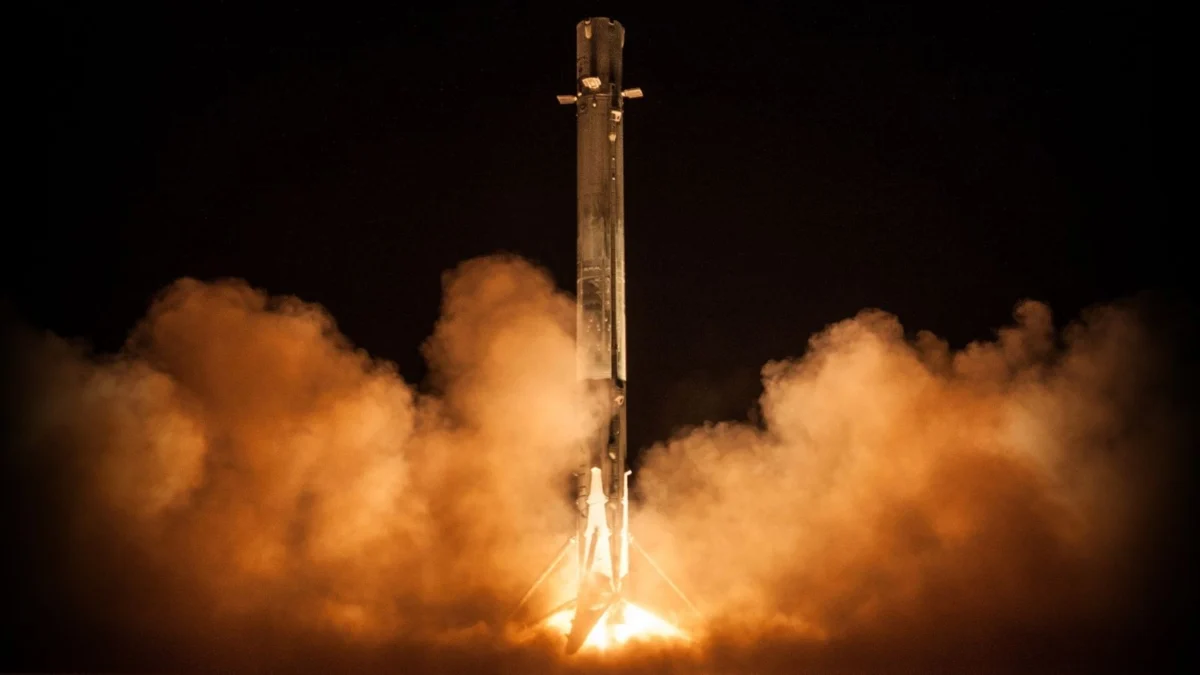
VANDENBERG SPACE FORCE BASE, CA – In a pre-dawn display of engineering precision and logistical dominance, SpaceX successfully launched its 100th Falcon rocket mission of 2026 on Saturday. The milestone, achieved less than eight months into the year, underscores the private aerospace giant’s unprecedented grip on the global launch market and its relentless pursuit of a fully connected planet.
The mission, which saw a Falcon 9 rocket carry 27 Starlink internet satellites into low-Earth orbit (LEO), blasted off from Space Launch Complex 4 East (SLC-4E) at Vandenberg Space Force Base at 3:25 a.m. EDT. This flight not only marks a numerical "century" for the company this year but also serves as a testament to the reliability of the Falcon 9 platform, which has become the workhorse of modern space exploration.
I. Main Facts: A Milestone Morning at Vandenberg
The Saturday morning launch was a textbook execution of SpaceX’s rapid-turnaround philosophy. The primary objective was the deployment of 27 Starlink satellites, part of the company’s ongoing effort to bolster its "megaconstellation."
The mission utilized a veteran Falcon 9 first-stage booster, designated B1100. Completing its ninth successful flight and recovery, the booster performed a precision landing on the autonomous drone ship Of Course I Still Love You, stationed in the Pacific Ocean, approximately eight and a half minutes after liftoff. Meanwhile, the rocket’s second stage continued its ascent, successfully deploying the satellite payload into its designated orbital plane roughly 62 minutes after launch.
Key statistics of the mission include:
- Mission Count: 100th Falcon launch of 2026 (99 Falcon 9 missions, 1 Falcon Heavy mission).
- Payload: 27 Starlink satellites.
- Launch Site: Vandenberg Space Force Base, California.
- Booster History: Ninth successful flight for B1100.
- Constellation Status: Over 11,000 Starlink satellites currently in orbit.
II. Chronology: The Road to 100 Launches in 2026
The journey to 100 launches by August 23rd reflects a significant acceleration in SpaceX’s operational tempo. To understand the scale of this achievement, one must look at the cadence of the preceding months.
The First Quarter: Setting the Pace
SpaceX began 2026 with a high-frequency schedule, primarily focused on filling out the Starlink "Shell 6" and "Shell 7" orbits. By the end of March, the company had already completed 38 launches, averaging one flight every 2.4 days. This period was characterized by "back-to-back" launch days, where rockets were launched from both Cape Canaveral, Florida, and Vandenberg, California, within hours of each other.
April: The Falcon Heavy Interlude
While the Falcon 9 handled the bulk of the manifest, April saw the year’s only Falcon Heavy launch. This mission carried the Viasat-3 F3 telecommunications satellite. The Falcon Heavy, which utilizes three Falcon 9 core stages strapped together, remains the most powerful operational rocket in SpaceX’s current fleet, reserved for massive payloads or high-energy geostationary orbits.
The Summer Surge
As the Northern Hemisphere entered the summer months, SpaceX increased its cadence even further. Between June and August, the company achieved several "triple-header" weekends—launching three rockets within a 48-hour window. This surge was necessary to keep pace with the internal goal of surpassing the 2025 record of 165 total launches.
August 23rd: The Century Mark
The Saturday launch of 27 Starlink satellites brought the total count for 2026 to exactly 100 Falcon missions. While the company still needs to maintain this high frequency to match or exceed last year’s record, reaching the 100-launch mark by late August suggests that SpaceX is operating at a level of efficiency previously thought impossible for orbital spaceflight.
III. Supporting Data: The Statistics of Dominance
The sheer volume of SpaceX’s activity is best understood through the data. Of the 99 Falcon 9 launches conducted so far this year, 76 have been dedicated solely to Starlink. This indicates that 76.7% of SpaceX’s 2026 manifest is dedicated to internal infrastructure, making the company its own most frequent customer.
Reusability Metrics
The success of the Falcon 9 is rooted in its reusability. The booster used in Saturday’s mission, B1100, is part of a fleet where some boosters have now flown more than 20 times.
- Average Turnaround: In 2026, the average time between flights for a single booster has dropped to under 30 days in some instances.
- Recovery Rate: SpaceX has maintained a near-perfect recovery rate for first-stage boosters in 2026, with drone ship landings becoming a routine industrial process rather than an experimental feat.
The Starlink Constellation
With the addition of these 27 satellites, the Starlink constellation now exceeds 11,000 operational spacecraft. To put this in perspective:
- Before Starlink, there were fewer than 3,000 active satellites in orbit from all countries and companies combined.
- SpaceX now operates more than 60% of all active satellites currently orbiting the Earth.
- The network currently serves millions of subscribers across seven continents, including maritime and aviation sectors.
IV. Official Responses: The Corporate Vision
While SpaceX rarely issues traditional press releases for routine Starlink launches, the company’s leadership has been vocal about the broader objectives. Following the 100th launch, social media channels associated with SpaceX and its CEO, Elon Musk, emphasized the "critical path" toward making life multi-planetary.
In previous statements, SpaceX Vice President of Build and Flight Reliability, Bill Gerstenmaier, has noted that the high launch cadence is not just about Starlink, but about refining the operations required for the Starship program. "Every Falcon 9 we launch and land teaches us something about rapid reuse," Gerstenmaier remarked during a recent industry symposium. "We are industrializing space access. The 100th launch of the year is a milestone, but it’s also just another step toward a future where daily orbital flights are the norm."
Regulatory bodies, including the Federal Communications Commission (FCC) and the Federal Aviation Administration (FAA), have also weighed in. While the FAA has praised SpaceX’s safety record, they continue to monitor the environmental impact of such frequent launches from both coasts. SpaceX has responded by working on "quieter" launch profiles and more sustainable recovery operations.
V. Implications: The Future of Orbital Infrastructure
The achievement of 100 launches by August carries profound implications for the aerospace industry, geopolitics, and the future of the internet.
1. The Transition to Starship and Starlink V3
Perhaps the most significant implication of the current launch pace is the looming transition to Starship. SpaceX has stated a desire to eventually launch 100,000 "Version 3" (V3) Starlink satellites. These next-generation spacecraft are significantly larger and more capable than the "V2 Mini" satellites currently being launched by Falcon 9.
Falcon 9 is limited by its fairing size; it can only carry 22 to 27 Starlink satellites at a time. Starship, once fully operational, is expected to carry over 100 V3 satellites per flight. The current Falcon 9 cadence is essentially "holding the line" until Starship can take over the heavy lifting.
2. Market Monopoly and Competition
SpaceX’s ability to launch 100 times in eight months has created a massive barrier to entry for competitors. United Launch Alliance (ULA), Blue Origin, and European providers like Arianespace are struggling to match even a fraction of this cadence. This dominance gives SpaceX significant leverage over satellite deployment pricing and orbital slot allocations.
3. Space Debris and Astronomy
The rapid expansion of the Starlink constellation to 11,000+ satellites continues to draw scrutiny from the astronomical community. "Megaconstellations" can interfere with ground-based telescopes, leaving streaks in long-exposure images of the cosmos. Furthermore, the sheer number of objects in LEO increases the risk of the "Kessler Syndrome"—a chain reaction of collisions that could render certain orbits unusable. SpaceX mitigates this with automated collision-avoidance systems and "darkening" technologies on satellites, but the sheer scale of 100,000 planned satellites remains a point of international debate.
4. Global Connectivity and Geopolitics
Starlink has moved from a luxury service to a critical piece of global infrastructure. From providing internet to remote schools in the Amazon to its well-documented use in conflict zones, the network has geopolitical weight. By reaching 100 launches this year, SpaceX is ensuring that its network remains the most resilient and high-capacity system in existence, further cementing its role as a key player in international communications.
Conclusion
The 100th Falcon mission of 2026 is more than a statistic; it is a signal that the "Space Age" has entered a new, high-velocity phase. As SpaceX continues to launch at a rate of nearly three times a week, the boundaries between Earth and orbit continue to blur. With the shadow of the massive Starship rocket looming over the next phase of the company’s development, the 100 launches of 2026 may one day be looked back upon as the modest beginnings of a truly spacefaring civilization.
