

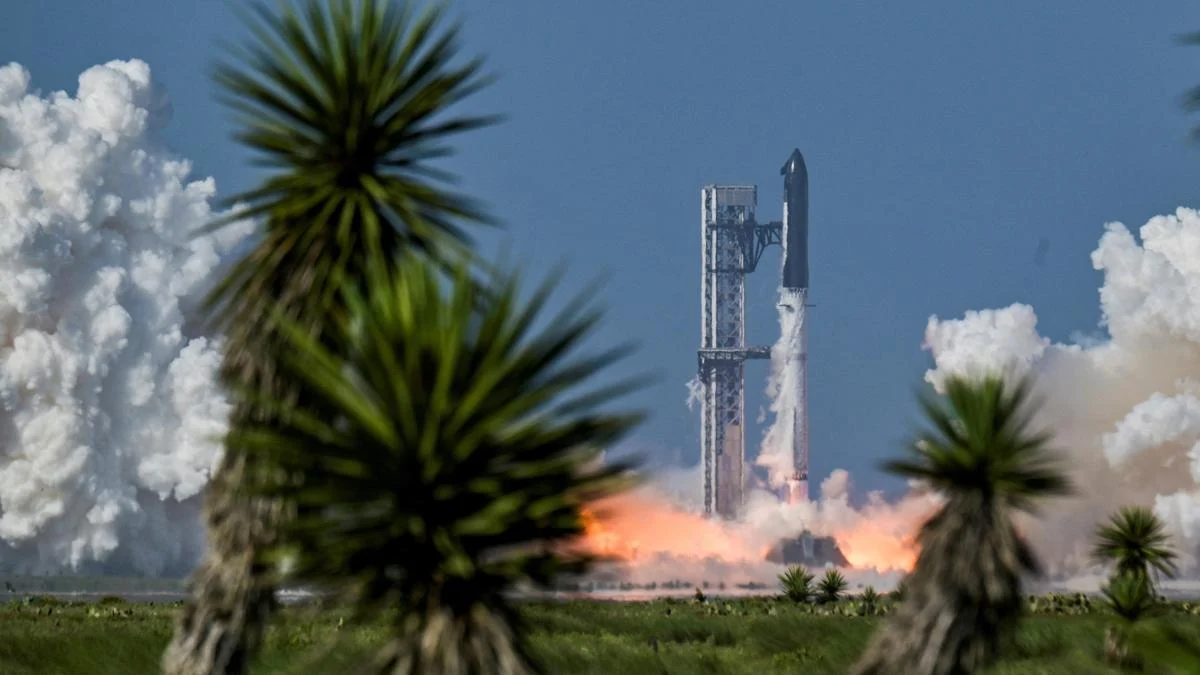
STARBASE, Texas – July 25, 2026 – In a spectacle of engineering prowess and an unwavering pursuit of interplanetary exploration, SpaceX’s colossal Starship and its Super Heavy v3 Booster successfully completed their 13th integrated test flight on July 24, 2026. This monumental launch from the company’s Starbase facility in Boca Chica, Texas, marked a significant stride in the development of the world’s most powerful rocket, carrying critical experiments and drawing a vigilant eye from NASA, which depends on Starship to ferry astronauts to the lunar surface.
The towering 407-foot (124-meter) Starship, an imposing stainless-steel behemoth, ascended majestically into the Texan sky, demonstrating improved reliability and advancing key technologies crucial for its future roles as a lunar lander for NASA’s Artemis missions and, ultimately, as the transport vehicle for humanity’s journey to Mars. This flight, the second of the enhanced V3 version this year, was meticulously monitored for data, even as both the booster and spacecraft were intentionally ditched into the sea as part of the rigorous testing protocol.
Main Facts of the Launch
A Towering Ascent from Starbase
The launch of Starship and its Super Heavy v3 Booster at 23:28 UTC (6:28 PM CDT) on July 24, 2026, was a testament to the iterative development philosophy championed by SpaceX. From the southern tip of Texas, the gargantuan rocket system roared to life, its 33 Raptor engines on the Super Heavy booster generating an unprecedented amount of thrust. The sheer scale of the vehicle, standing taller than many iconic skyscrapers, commanded global attention, underscoring its potential to revolutionize space travel. This 13th test flight was not merely a demonstration of raw power but a highly instrumented mission designed to gather invaluable data on structural integrity, propulsion performance, and critical re-entry systems.
The immediate significance of this successful flight resonates deeply within the space community, particularly for NASA. Starship is not just another rocket; it is the designated Human Landing System (HLS) for the Artemis program, tasked with returning humans to the Moon for the first time in over half a century. Every successful test brings NASA closer to its goal of establishing a sustainable lunar presence, making this launch a critical step in the agency’s timeline. Beyond lunar aspirations, this flight also served as a tangible advancement toward Elon Musk’s audacious vision of establishing a self-sustaining city on Mars, a long-term goal that hinges entirely on Starship’s capabilities.
A Test of Endurance and Innovation
Following a nominal ascent, the Super Heavy booster performed its intricate separation maneuver, beginning its descent towards a planned splashdown in the Gulf of Mexico. Meanwhile, the Starship upper stage continued its powered flight, eventually reaching an apogee of approximately 125 miles (200 kilometers). This particular flight was designed as a suborbital test, with the Starship itself tracing a vast arc across the globe, aiming for a controlled splashdown in the Indian Ocean, more than 10,000 miles (16,000 kilometers) from its launch site. The entire flight sequence, from liftoff to Starship’s planned termination, was anticipated to last roughly an hour.
A key innovation integrated into this flight was the deployment of a new batch of Starlink satellites. These advanced satellites, ejected from Starship’s innovative "Pez-like dispenser," were not merely intended to augment SpaceX’s already vast orbital internet constellation. Instead, they played a crucial diagnostic role. After a solo-flying time of no more than 20 minutes, these newly deployed Starlinks extended their solar wings and antennas, attempting to establish laser-based communication with older Starlink models already in orbit. This experiment aimed to validate the robustness of the inter-satellite laser links, a technology vital for high-speed, low-latency global internet coverage and potentially for future deep-space communication networks.
Furthermore, this test flight carried an array of sophisticated experiments focusing on Starship’s heat shield, arguably one of the most critical and complex components for its reusability. Six of the newly launched Starlinks were equipped with high-resolution cameras, meticulously positioned to photograph Starship’s exterior during the harrowing re-entry phase. The heat shield itself was riddled with sensors designed to measure the extreme pressures and temperatures placed upon the spacecraft. In a daring experimental twist, while most of the heat shield’s thermal tiles were the standard black, a deliberate section was painted white. This ingenious modification simulated the effect of missing or damaged tiles, allowing engineers to test the heat shield’s robustness and thermal resilience under compromised conditions, a crucial data point for ensuring astronaut safety during future missions.
A Chronology of Progress and Perseverance
Overcoming Pre-Launch Hurdles
The path to the July 24th launch was not without its challenges, reflecting the inherent complexities and risks associated with developing a next-generation launch system. The initial launch attempt, scheduled for July 16, was abruptly aborted at the last second. Investigations revealed that six of the 33 Raptor engines on the Super Heavy first-stage booster failed to ignite, prompting an immediate halt to the countdown for safety reasons. SpaceX engineers swiftly identified the issue, embarking on an intensive eight-day campaign to replace the faulty engines and conduct comprehensive system checks. This rapid turnaround underscored the agility and engineering capabilities of the SpaceX team, a hallmark of their iterative development approach.
This wasn’t an isolated incident of engine-related setbacks. The previous Starship flight in May also encountered significant engine trouble during its descent phase, which unfortunately prevented the Super Heavy booster from executing a controlled return and landing. These earlier experiences informed critical design and operational adjustments for the V3 version and this 13th flight, emphasizing the company’s commitment to learning from each test.
Adding another layer of complexity to the pre-launch preparations, the region around Starbase was impacted by Tropical Storm Bertha. Thick clouds and adverse weather conditions associated with the storm caused a further delay, pushing the launch from an earlier planned window on Thursday (July 24, 2026) to later that day. Such weather-related postponements are common in space launches, but the combination of technical and meteorological delays only heightened the anticipation and scrutiny surrounding this particular flight.
The Flight Profile: From Liftoff to Splashdown
The culmination of these efforts came on July 24th. At the designated launch window, the Starship and Super Heavy v3 Booster, a composite of cutting-edge materials and immense power, ignited its engines. A thunderous roar reverberated across the Texas coastline as the colossal rocket slowly lifted off its launch mount. The initial ascent was powerful and stable, with all 33 upgraded Raptor engines reportedly performing as expected.
As it climbed higher, the Super Heavy booster successfully separated from the Starship upper stage, a critical maneuver. The booster then began its controlled descent, executing a "flip" maneuver and a simulated landing burn before splashing down precisely in the designated area of the Gulf of Mexico. This test aimed to refine the booster’s re-entry and landing procedures, moving closer to the goal of catching the booster with the launch tower’s mechanical arms.
The Starship upper stage, now flying solo, continued its trajectory, reaching its programmed altitude of 125 miles. It was during this phase that the innovative Starlink deployment system was activated, releasing the diagnostic satellites into space. These new Starlinks then performed their brief but crucial mission of laser communication and photographic documentation of Starship’s heat shield. After its brief solo flight, the Starship then began its own descent. Tracing an intercontinental path, it aimed for a controlled splashdown in the vast expanse of the Indian Ocean, a journey of over 10,000 miles (16,000 kilometers) from its origin. The entire hour-long flight provided a treasure trove of telemetry and visual data, invaluable for engineers refining the vehicle for future operational missions.
Supporting Data and Technological Innovations
The Starship V3: A Giant Leap in Rocketry
The Starship V3 represents the latest iteration in SpaceX’s ambitious design for a fully reusable, super heavy-lift launch system. Standing at an astounding 407 feet (124 meters) when stacked with its Super Heavy booster, it dwarfs any rocket ever built, surpassing even the Saturn V of the Apollo era in terms of height and potential payload capacity. The Super Heavy booster alone is powered by 33 of SpaceX’s advanced Raptor engines, which burn a combination of liquid oxygen and liquid methane. This methalox propulsion system is chosen for its high performance, reusability potential, and the ability to be produced on Mars, a key factor for sustained off-world operations.
The "V3" designation signifies a host of improvements over previous versions. These enhancements likely include refined engine designs for increased reliability and thrust, structural reinforcements to withstand the immense stresses of launch and re-entry, and upgrades to avionics and flight control systems. Each iteration of Starship is a step in a rapid prototyping cycle, where lessons learned from previous failures or suboptimal performance are quickly integrated into the next build, a process that accelerates development but also inherently involves a higher risk tolerance for test flights.
Starlink’s Crucial Role in On-Orbit Diagnostics
The deployment of new Starlink satellites during this Starship flight was far from a routine constellation top-up. These particular satellites served a critical diagnostic function, pushing the boundaries of in-space data acquisition and communication. Released from Starship’s novel "Pez-like dispenser" mechanism – a simple yet effective way to deploy multiple satellites – these Starlinks had a specific, time-sensitive mission.
For approximately 20 minutes of solo flight, these new satellites extended their deployable solar wings and antennas, immediately attempting to establish laser-based communication with existing Starlink satellites already in orbit. This inter-satellite laser link technology is a cornerstone of the Starlink network, enabling satellites to communicate directly with each other in space, reducing reliance on ground stations and drastically lowering latency. Testing this capability from a newly deployed batch directly from Starship provided valuable validation of the deployment shock and initial operational readiness of the laser terminals.

Furthermore, six of these specialized Starlinks were outfitted with high-definition cameras. Their primary mission was to capture unprecedented visual data of Starship’s exterior, particularly its heat shield, during the critical phases of its flight and re-entry. This innovative approach leverages SpaceX’s existing satellite infrastructure to provide real-time, external views of the spacecraft, complementing the internal sensor data and offering a comprehensive understanding of Starship’s performance under stress. With over 10,000 Starlinks currently providing internet services globally, SpaceX operates the world’s largest satellite constellation, demonstrating their capability to integrate complex diagnostic missions into their commercial operations.
Engineering the Future: The Heat Shield Challenge
The integrity and performance of Starship’s heat shield are paramount to its design philosophy of full reusability, particularly for missions involving atmospheric re-entry from lunar or Martian velocities. The heat shield is composed of thousands of hexagonal ceramic tiles, engineered to withstand the extreme temperatures generated by atmospheric friction – temperatures that can reach thousands of degrees Celsius.
This particular test flight incorporated a highly innovative experiment regarding the heat shield. While the majority of the tiles were the standard black, designed for maximum thermal protection, a deliberate section of tiles was painted white. This seemingly minor aesthetic change served a profound engineering purpose: it was designed to simulate the thermal properties of missing or compromised tiles. In previous spacecraft, like the Space Shuttle, even minor damage to thermal protection systems proved catastrophic. By intentionally creating a "weak point" through differential thermal absorption, SpaceX engineers aimed to test the robustness and redundancy of the overall heat shield design. This provided critical data on how the surrounding tiles and underlying structure would cope if a section of the heat shield were to be damaged or lost during a real mission.
Accompanying this visual experiment, the heat shield was also densely instrumented with an array of sensors. These sensors were designed to measure not only temperature but also the extreme pressure exerted on the spacecraft during its supersonic and hypersonic re-entry through the Earth’s atmosphere. This comprehensive data, combined with the photographic evidence from the Starlinks, will enable SpaceX to refine the heat shield’s design, materials, and attachment methods, ensuring its reliability for the demanding re-entries required for future crewed and cargo missions.
The Vision of Full Reusability
At the heart of Starship’s design is the revolutionary concept of full and rapid reusability. Unlike traditional rockets that discard stages after use, Starship is engineered for both its Super Heavy booster and its upper stage to return to the launch site, be refueled, and flown again almost immediately. This paradigm shift aims to drastically reduce the cost of space access, making ambitious endeavors like Mars colonization economically feasible.
SpaceX has already demonstrated a critical component of this reusability with its Falcon 9 boosters, which perform propulsive landings back on Earth. However, Starship takes this a step further. The Super Heavy booster is designed to be caught mid-air by a pair of colossal mechanical arms extending from the launch tower – a maneuver that has been successfully tested with booster prototypes. The ultimate goal is to achieve the same with the Starship upper stage, allowing it to "land" directly back onto the launch tower for quick refurbishment. This "catch" method, while seemingly audacious, is central to minimizing turnaround times and infrastructure requirements, embodying Elon Musk’s vision of an airline-like operational cadence for space travel. The data from this flight’s heat shield experiments are crucial for validating the re-entry conditions necessary for such precise and rapid landings of the Starship upper stage.
Official Responses and Stakeholder Perspectives
NASA’s Vigilant Eye and Artemis Program’s Dependency
NASA’s monitoring of Starship’s test flights is far from passive; it is a direct and deeply invested observation. The agency views Starship as a linchpin for its ambitious Artemis program, which aims to return humans to the lunar surface and establish a sustained presence there. Specifically, Starship has been selected as the Human Landing System (HLS) for Artemis III, the mission slated to land the next American astronauts on the Moon.
The crew for Artemis III – comprising three American astronauts and one Italian astronaut – is scheduled to practice docking their Orion capsule with a Starship lunar lander in Earth orbit next year. This crucial training requires Starship to not only achieve orbital flight reliably but also to demonstrate the necessary rendezvous and docking capabilities. Therefore, NASA has a vested interest in Starship wrapping up its testing phase and achieving consistent orbital success as soon as possible. Any delays in Starship’s development directly impact the Artemis III timeline, highlighting the immense pressure on SpaceX to accelerate its progress while maintaining safety and reliability standards. This interdependency underscores a new era of public-private partnerships in space exploration, where government agencies rely heavily on commercial innovation to achieve national objectives.
SpaceX’s Ambition and Elon Musk’s Vision
For SpaceX and its founder, Elon Musk, each Starship test flight, regardless of its immediate outcome, is a step towards a monumental vision: making humanity a multi-planetary species. While the immediate goal is to perfect the system for Earth orbit and lunar missions, the ultimate ambition remains the colonization of Mars. Musk has repeatedly articulated his long-term plan to build a self-sustaining city on the Red Planet, a colossal undertaking that would require thousands of Starship flights to transport equipment, habitats, and people.
Beyond Mars, Starship is also positioned to facilitate extensive space tourism, with Musk already booking potential tourist trips to both the Moon and Mars. These commercial ventures, while futuristic, provide a financial impetus and a broader market for Starship’s capabilities. The iterative development philosophy, characterized by rapid prototyping, testing, and learning from failures, is central to how SpaceX operates. This latest test flight, with its specific experiments on reusability and Starlink integration, reflects this approach, systematically de-risking the complex technologies required for Starship to achieve its full potential and realize Musk’s grand interplanetary dreams.
Broader Implications for Space Exploration
Accelerating Lunar and Martian Timelines
The successful 13th test flight of Starship has profound implications for the future pace of space exploration. By validating key aspects of its design and operational procedures, it brings humanity significantly closer to realizing ambitious lunar and Martian timelines. Starship’s sheer capacity to carry over 100 metric tons to low Earth orbit, coupled with its potential for in-orbit refueling, makes it a game-changer for deep-space missions. This capability means that larger payloads, more complex habitats, and greater quantities of supplies can be transported to the Moon and Mars, significantly accelerating the establishment of permanent bases and ultimately, human settlements.
For the Artemis program, a fully operational Starship means not just landing astronauts but also delivering the necessary infrastructure for long-duration stays, scientific research, and resource utilization on the lunar surface. For Mars, Starship is the only vehicle currently under development with the scale and reusability concept that could realistically enable the mass transportation required to build a city. Each successful test moves the needle from theoretical possibility to tangible reality, influencing strategic planning for space agencies worldwide and potentially compressing decades of traditional space development into a much shorter timeframe.
The Commercialization of Space and Beyond Earth Orbit Economy
Starship’s development is a powerful catalyst for the burgeoning commercial space economy. Its unprecedented payload capacity and envisioned low launch costs due to full reusability promise to democratize access to space. This will not only facilitate the deployment of massive satellite constellations like Starlink but also open new avenues for space tourism, in-orbit manufacturing, asteroid mining, and the development of large space stations.
By drastically reducing the cost per kilogram to orbit, Starship could make previously economically unfeasible projects viable. This could spur innovation across numerous sectors, from advanced materials processing in microgravity to the development of new energy solutions using space-based solar power. The "beyond Earth orbit" economy, once a distant dream, could become a reality much sooner, driven by Starship’s ability to move vast quantities of cargo and people efficiently throughout the solar system. This test flight, by advancing the vehicle’s readiness, bolsters investor confidence and further fuels the commercialization trend that is reshaping the global space industry.
International Collaboration and Competition
The progress of Starship inevitably influences the strategic calculus of other space agencies and nations. While SpaceX is a private American company, its capabilities have direct implications for national space programs globally. The success of Starship puts pressure on other nations to develop their own heavy-lift launch systems or to increasingly rely on commercial providers for access to space.
This creates a dynamic interplay of collaboration and competition. On one hand, international partnerships, such as those with NASA and the European Space Agency, could leverage Starship’s capabilities for joint scientific endeavors and exploration missions. On the other hand, nations like China, Russia, and India are actively pursuing their own ambitious space programs, including lunar and Martian exploration. Starship’s rapid development could intensify this "new space race," driving further innovation and investment in space technologies worldwide. Ultimately, Starship’s journey from concept to reality is not just a SpaceX story, but a pivotal chapter in humanity’s collective narrative of venturing beyond Earth.
