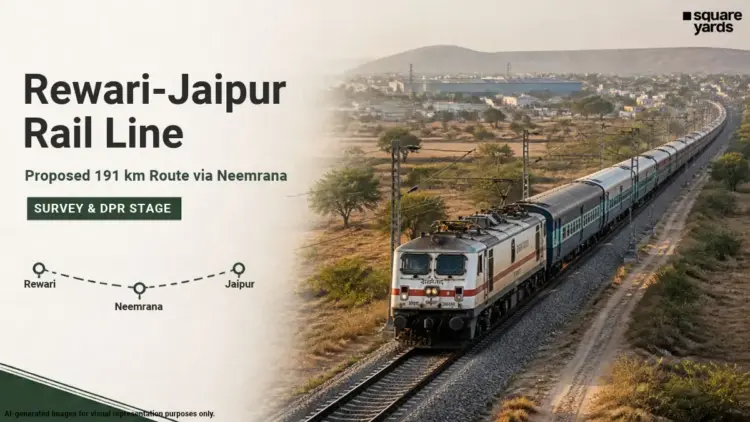
The landscape of North Indian infrastructure is on the cusp of a significant transformation as the Ministry of Railways advances plans for a new 191-kilometer railway corridor connecting Rewari in Haryana to Jaipur in Rajasthan. This proposed line, which aims to traverse the industrial heartlands of Neemrana, Behror, and Kotputli, represents more than just a new set of tracks; it is a strategic intervention designed to decongest existing routes, catalyze industrial growth, and drastically reduce travel time between the National Capital Region (NCR) and the "Pink City."
As the project enters the critical phase of the Final Location Survey (FLS) and the preparation of the Detailed Project Report (DPR), stakeholders across the government and private sectors are closely watching its progress. With the potential to shave up to 90 minutes off the current Delhi-Jaipur journey, the project is being hailed as a vital link in the regional transit network.
1. Main Facts: Defining the 191-Kilometer Corridor
The proposed Rewari-Jaipur railway line is a greenfield-heavy project spanning approximately 191 kilometers. While the final alignment is subject to the findings of the ongoing survey, the broad objective is to establish a more direct and efficient rail link between Rewari Junction and the Rajasthan capital.
Key Project Highlights:
- Total Length: Approximately 191 km.
- Primary Nodes: Rewari (Haryana), Neemrana, Behror, Kotputli, Shahpura, and Jaipur (Rajasthan).
- Current Status: Final Location Survey (FLS) sanctioned; Detailed Project Report (DPR) under preparation.
- Primary Objective: To provide a third alternative route between Delhi and Jaipur, bypassing the traditional bottlenecks of the existing Alwar and Ringus lines.
- Anticipated Impact: A reduction of 1.5 hours in travel time for express and superfast trains.
The project is strategically positioned to bridge the gap between the existing Delhi-Rewari-Alwar-Bandikui-Jaipur route and the Delhi-Rewari-Ringus-Jaipur route. By cutting through the middle of these two established corridors, the new line will serve a geographical "white space" that has long been dependent on road transport via the heavily congested National Highway 48 (NH-48).
2. Chronology: From Vision to Survey Sanction
The genesis of the Rewari-Jaipur line via Neemrana is deeply rooted in the broader vision of the Delhi-Mumbai Industrial Corridor (DMIC). For over a decade, planners have recognized that the industrial clusters emerging along the Haryana-Rajasthan border required high-capacity rail connectivity to complement the existing road network.
Timeline of Recent Developments:
- Early 2010s: Initial conceptualization under the DMIC framework, identifying the need for a "Bhiwadi-Neemrana-Jaipur" rail link to support freight and labor movement.
- March 10, 2026: The proposal gained renewed political momentum during a Lok Sabha session. Jaipur Rural MP Rao Rajendra Singh formally raised the necessity of reassessing the Delhi-Bhiwadi-Neemrana-Manoharpur-Jaipur alignment, emphasizing its role in regional industrialization.
- March 25, 2026: In a written reply to the Lok Sabha, the Ministry of Railways officially confirmed the proposal for the 191 km line and announced the sanctioning of the Final Location Survey.
- October 30, 2026: Current updates indicate that the survey teams are on the ground, and the DPR is being drafted to establish technical feasibility, land requirements, and cost estimates.
This chronological progression highlights a shift from a purely industrial freight-oriented concept to a multi-purpose corridor designed for both high-speed passenger travel and efficient logistics.
3. Supporting Data: Routing and Technical Complexity
The technical justification for the new line rests on the limitations of the current rail infrastructure. Currently, trains from Delhi to Jaipur must choose between two routes that are operating at near-maximum capacity.
Comparative Route Analysis:
- The Alwar Route: Traditionally the most popular, this route passes through Alwar and Bandikui. However, the high density of both passenger and freight traffic often leads to delays.
- The Ringus Route: This route serves the Shekhawati region but is longer and primarily serves different regional hubs.
The proposed 191 km line offers a more "as-the-crow-flies" approach. By integrating towns like Shahjahanpur, Behror, Kotputli, Paota-Pragpura, and Shahpura, the railway aims to tap into a population and industrial base that currently relies almost exclusively on the Delhi-Jaipur Highway.
The Survey Process:
The Final Location Survey (FLS) currently underway is a meticulous process involving:
- Topographic Mapping: Using modern tools like LiDAR or drone surveys to map the terrain.
- Soil Testing: Determining the load-bearing capacity of the earth to design bridges and embankments.
- Hydrological Studies: Ensuring the tracks are protected against the flash floods common in the Aravalli foothills.
- Land Acquisition Identification: Mapping out the private and government land required for the 191 km stretch.
4. Official Responses and Administrative Roadmap
The Ministry of Railways has maintained a cautious but optimistic tone regarding the project’s timeline. In official parliamentary communications, the Ministry has outlined a clear multi-stage approval process that must be completed before a single sleeper is laid.
The Approval Hierarchy:
- DPR Completion: The Detailed Project Report will serve as the foundational document, detailing the "Internal Rate of Return" (IRR)—a key metric for government investment.
- Stakeholder Consultation: Since the project spans two states (Haryana and Rajasthan), both state governments will be consulted regarding land acquisition and state-level clearances.
- NITI Aayog Appraisal: As a major infrastructure project, it must undergo a rigorous appraisal by NITI Aayog to ensure it aligns with national economic goals.
- Finance Ministry Sanction: Final financial approval will come from the Ministry of Finance after reviewing the cost-benefit analysis.
Ministry officials have clarified that "implementation timelines depend on the completion of the required approval process and the availability of funds." While no official budget has been disclosed, industry experts estimate a project of this scale—involving significant land acquisition in industrial zones—could run into several thousands of crores.
5. Industrial Implications: The "Mini Japan" Connection
Perhaps the most significant impact of the Rewari-Jaipur corridor will be on the Khushkhera-Bhiwadi-Neemrana (KBN) industrial belt. Often referred to as "Mini Japan" due to the high concentration of Japanese manufacturing firms, Neemrana is a cornerstone of Rajasthan’s industrial economy.
Boosting the Japanese Investment Zone:
The Rajasthan State Industrial Development and Investment Corporation (RIICO) has developed specialized zones in Neemrana that house global giants like Daikin, Nissin Brake, and Mitsubishi. Currently, these industries rely on trucks to move components and finished goods to the NCR or ports in Gujarat.
- Logistical Efficiency: A direct rail link would allow for the establishment of Inland Container Depots (ICDs), reducing logistics costs by 15-20%.
- Workforce Mobility: The corridor would facilitate the daily commute of technical experts and laborers from Jaipur or Rewari, expanding the talent pool available to these industries.
The Behror and Kotputli Factor:
Behror and Kotputli are emerging as hubs for cement and mining industries. Better rail connectivity will allow for the bulk transport of raw materials, which is currently a major strain on the NH-48 highway infrastructure.
6. Socio-Economic and Real Estate Implications
Beyond industry, the proposed railway line is expected to trigger a transformation in the socio-economic fabric of the region.
Real Estate and Urbanization:
The "announcement effect" of the railway line is already being felt in the local real estate markets.
- Residential Demand: Improved connectivity to Jaipur and Delhi makes towns like Neemrana and Kotputli viable for residential development. We may see a rise in integrated townships designed for the industrial workforce.
- Commercial Growth: Stations along the 191 km route will likely become kernels for new commercial activity, including warehouses, retail outlets, and hospitality services.
- Cautionary Note: While optimism is high, experts warn that property price appreciation will remain speculative until the first phase of land acquisition begins and the final station list is confirmed.
Travel and Tourism:
For the average traveler, the 1.5-hour reduction in travel time is the most tangible benefit. This could boost weekend tourism from Delhi to Jaipur, as the shorter commute makes rail travel more competitive against both air travel and personal vehicles. It also provides a more reliable alternative during the winter months when heavy fog often paralyzes road traffic on the highway.
7. Challenges and the Road Ahead
Despite the project’s promise, several hurdles remain. The alignment passes through the ecologically sensitive Aravalli range in certain sections, which will necessitate stringent environmental clearances. Furthermore, land acquisition in the high-value industrial zones of Haryana and Rajasthan is historically a complex and time-consuming process.
The Ministry of Railways has emphasized that the project is currently in the "planning and survey stage." The transition from a survey to actual construction will require political will, seamless interstate coordination, and a robust financial framework.
Conclusion
The proposed Rewari-Jaipur railway corridor via Neemrana is a forward-looking infrastructure project that addresses the dual needs of industrial logistics and passenger convenience. By linking the industrial powerhouses of the Haryana-Rajasthan border to the national rail grid, the Ministry of Railways is not just building a track; it is laying the foundation for a more integrated and economically vibrant North India.
As the DPR nears completion, the focus will shift to the administrative and financial hurdles that lie ahead. If successful, this 191 km corridor will stand as a testament to India’s commitment to modernizing its transport architecture, ultimately bringing the historic city of Jaipur and the industrial frontier of Neemrana closer to the heart of the nation.