

In the high-altitude, oxygen-thin landscape of Himachal Pradesh’s Upper Spiti, a new and unexpected predator is reshaping the ancient socio-ecological fabric of the Himalayas. For centuries, the snow leopard (Panthera uncia) and the Himalayan wolf (Canis lupus chanco) were the primary concerns for pastoralists guarding their herds. Today, however, a new study reveals that the domestic dog (Canis familiaris) has emerged as a more frequent and perhaps more dangerous threat to the region’s livestock and livelihoods.
As tourism booms and traditional agricultural practices shift, the rise of free-ranging dog populations is disrupting a delicate balance that has sustained mountain communities for generations. This phenomenon is not merely an animal welfare issue; it is a complex socio-economic crisis that threatens the future of agro-pastoralism in one of the world’s most sensitive environments.
Main Facts: An Unlikely Keystone Player
The traditional lifestyle of Upper Spiti is built on an agro-pastoral system where livelihoods are tethered to sheep, goats, cattle, yaks, and horses. These animals do more than provide wool, milk, and meat; their manure is the lifeblood of farming in this cold desert, enriching the soil for barley and, more recently, cash crops.
However, a study led by Dr. Chandrima Home, an assistant professor at the Srishti Manipal Institute of Art, Design and Technology, highlights a stark transformation. The research, which included interviews across 27 villages in eight panchayats, indicates that free-ranging dogs have become a "keystone player" in the landscape—a term usually reserved for species that hold an ecosystem together, but here used to describe a domestic species driving profound, often negative, change.
Key Findings of the Study:
- Widespread Livestock Decline: Approximately 72% of respondents reported a significant decline in livestock numbers between 2003 and 2013.
- The Dog Factor: Attacks by domestic dogs were cited by 66% of respondents as a primary reason for this decline, surpassing traditional predators.
- Perception of Risk: Nearly 48% of herders now consider free-ranging dogs a greater threat to their livelihoods than snow leopards or wolves.
- Demographic Shifts in Livestock: The population of small-bodied livestock has plummeted, with a 71% decline in sheep and a 68% decline in goats over the last two decades.
Chronology of Change: From Tradition to Transition
The crisis in Spiti did not emerge in a vacuum. It is the result of a series of interconnected socio-economic shifts that began decades ago.

1. The Opening of the "Middle Land" (1992–2000s)
Until 1992, Spiti was largely closed to outsiders. The easing of travel restrictions marked the beginning of a slow but steady influx of tourism. During this period, the region remained primarily dependent on traditional agro-pastoralism. However, the introduction of government development schemes began to provide alternatives to the arduous life of a herder.
2. The Cash Crop Revolution (2000s–2010)
The introduction of green peas and apples as lucrative cash crops offered higher financial returns with less physical risk than mountain herding. This shift began to alter the composition of livestock, as families required less wool and meat for subsistence and more manure for their new commercial fields.
3. The Tourism Boom and Waste Crisis (2016–Present)
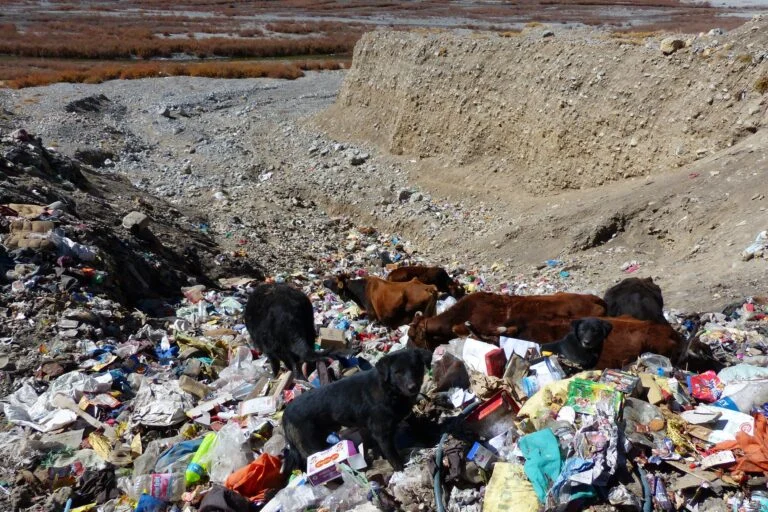
While tourism had been growing, it surged exponentially after 2016. This brought much-needed revenue but also led to a massive increase in organic waste. In the absence of sophisticated waste management systems, garbage dumps became a consistent, high-calorie food source for free-ranging dogs. This "subsidized" food source allowed dog populations to swell far beyond the natural carrying capacity of the environment.
4. The Emergence of the "Canine Predator"
As dog populations grew, they began to form packs and exhibit predatory behavior. Unlike snow leopards, which are elusive and typically hunt under the cover of darkness or in remote cliffs, free-ranging dogs are bold, habituated to humans, and hunt in packs during the day, making them a constant and unpredictable threat to livestock near human settlements.
Supporting Data: The Statistics of a Vanishing Lifestyle
The study provides a data-driven look at how the presence of dogs is forcing a retreat from traditional pastoralism. The decline in livestock is not just a loss of capital; it is a loss of ecological services.

Livestock Ownership Trends
The research found that in several villages, households had stopped rearing sheep and goats entirely. In villages that maintained their herds, the number of participating households often fell by 50% to 75%. While herding challenges (38%) and fodder shortages (28%) were significant, the predatory pressure from dogs (66%) was the most frequently mentioned catalyst for giving up the practice.
The Dog Population Problem
Quantifying free-ranging dogs in rugged terrain is difficult, but estimates suggest a worrying trend:
- 2013 Estimate: A minimum of 570 adult dogs in Upper Spiti.
- Subsequent Modeling: Total population (including juveniles) estimated at approximately 1,500.
- 2019 Estimate: Roughly 1,000 dogs across the wider Spiti region.
While these numbers may seem small compared to urban centers, in a landscape where human density is extremely low, a population of 1,000 to 1,500 highly active predators creates an immense "predation pressure" on both domestic and wild animals.
Official Responses and Expert Perspectives
Experts argue that the problem is not the dogs themselves, but the systemic failures in waste management and policy coordination that have allowed them to become a nuisance.
Dr. Chandrima Home, the study’s corresponding author, emphasizes the non-linear nature of the problem. "The policies brought into the landscape had an impact on livestock numbers and composition across different timescales," she notes. She describes the dogs as an "unlikely keystone player," highlighting that their impact is now central to how the entire ecosystem functions.

Priyanka Justa, Community Conservation Manager for the Spiti Snow Leopard Program at S.P.E.C.I.E.S., points out the ecological ripple effects. "If sheep and goat numbers continue to decline, competition for food is likely to intensify," she says. This could force native predators like snow leopards to target larger, more valuable livestock like yaks, or face starvation, thereby increasing human-wildlife conflict.
Neeraj Mahar, a Project Scientist at the Wildlife Institute of India (WII), argues that a single-track solution like sterilization is insufficient. "An animal birth control (ABC) program is not going to solve the issue alone," Mahar explains. "It must be managed through a combination of systematic capture-neuter methods, responsible ownership, community participation, and adoption drives."
Socio-Ecological Implications: A System in Peril
The rise of the free-ranging dog is a "wicked problem"—one where every solution reveals a new layer of complexity. The implications stretch across agriculture, labor, and biodiversity.
1. The Manure Crisis and Soil Health
Spiti’s farming is traditionally organic, relying on sheep and goat manure. As these herds vanish, 44% of respondents reported they now have to "import" manure from outside the landscape or rely on migratory Gaddi pastoralists. This increases the cost of farming and makes the local food system less self-sufficient.
2. Labor and Migration
The decline in local livestock has led to a labor crisis. To maintain the remaining herds, families must hire migrant workers from other states or Nepal. However, these hired herders often lack the traditional knowledge of rotational grazing. This leads to "localized degradation," where livestock are grazed too close to villages to avoid dog attacks, overusing small patches of land while distant pastures remain untouched.

3. Disease Transmission
Beyond physical attacks, free-ranging dogs pose a biological threat. They act as reservoirs for diseases such as canine distemper and rabies. In a landscape where they frequently interact with both livestock and wild carnivores, the risk of a catastrophic disease outbreak among the endangered snow leopard or Himalayan wolf population is a growing concern for conservationists.
4. The Future of the Snow Leopard
If the domestic dog continues to decimate the "buffer" prey (sheep and goats), the snow leopard is left with two choices: hunt the remaining high-value yaks or retreat further into the wilderness where wild prey may be scarce. Either scenario spells trouble for the long-term conservation of the "Ghost of the Mountains."
Conclusion: The Path Forward
The study by Dr. Home and her colleagues outlines two potential futures for Spiti. In the first, rising tourism wealth allows for better waste management and the hiring of professional herders who can protect livestock, potentially stabilizing the system. In the second, the burden of dog predation and the lure of easier income sources lead to the total abandonment of small-livestock pastoralism, turning Spiti into a landscape of cash crops and yaks, dependent on external inputs.
To avoid the latter, the researchers call for a bottom-up, integrated approach. This includes:
- Waste Management: Rigorous control of organic waste in tourist hubs to "de-subsidize" the dog population.
- Veterinary Intervention: Robust sterilization and vaccination programs.
- Policy Synergy: Ensuring that tourism, agriculture, and wildlife policies are not working at cross-purposes.
The domestic dog, once a guardian of the hearth, has become an accidental architect of ecological change in Spiti. Addressing this "canine catastrophe" is now as vital to the survival of the Himalayas as the protection of the snow leopard itself. Without coordinated action, the ancient song of the mountain herder may soon be silenced by the bark of the stray.
