

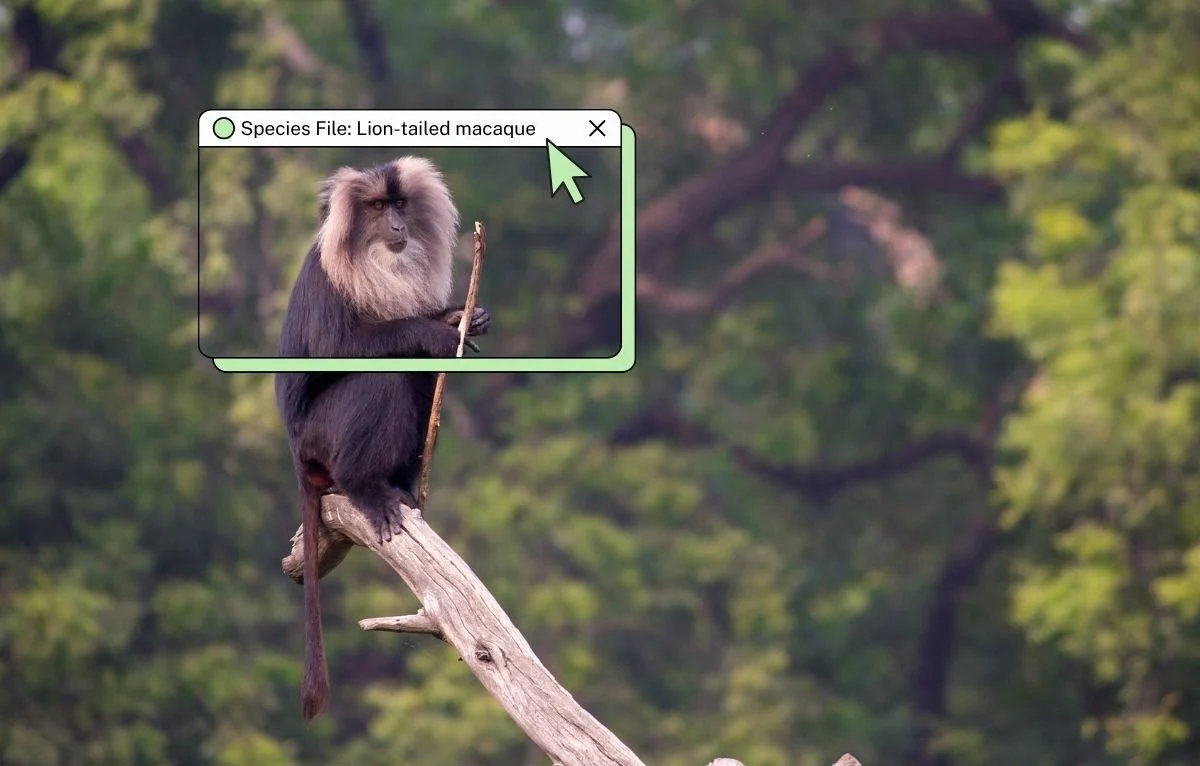
The Western Ghats of India, a UNESCO World Heritage site and one of the world’s eight “hottest hotspots” of biological diversity, is home to a creature that seems more like a myth than a primate. With a striking silver-white mane framing a jet-black face and a tail ending in a lion-like tuft, the lion-tailed macaque (Macaca silenus) is an icon of the Indian rainforest. Yet, this arboreal specialist, which historically spent its entire life in the high canopies of evergreen forests, is undergoing a forced and dangerous transition.
Recent studies and ecological monitoring have revealed a troubling trend: the lion-tailed macaque is descending from the trees and venturing into the treacherous world of human landscapes. Driven by the fragmentation of their ancestral homes, these endangered primates are now frequently found on roadsides, in tea plantations, and even inside human kitchens. This shift is not merely a change in scenery; it is a biological crisis that threatens the very survival of the species.
Main Facts: A Specialist in a Fragmenting World
The lion-tailed macaque (LTM) is endemic to the Western Ghats, meaning it is found nowhere else on Earth. Unlike many other macaque species—such as the ubiquitous rhesus or bonnet macaques that adapt easily to urban environments—the LTM is a dietary and habitat specialist. They are primarily frugivorous, relying on a diverse array of rainforest fruits, supplemented by insects and small vertebrates.
Their biology is intrinsically linked to the canopy. Their social structures, mating habits, and safety protocols are all designed for life 30 to 60 feet above the ground. However, the reality on the ground is changing. According to a recent long-term population monitoring study in the Anamalai Hills, nearly 800 individuals are now living within human-modified landscapes.
With a total global population estimated at only 2,400 to 2,500 mature individuals, having nearly a third of the population exposed to human-dominated environments is a conservation emergency. In these landscapes, the macaques face immediate existential threats:
- Road Mortality: As they cross highways to reach isolated forest patches, they are frequently victims of vehicular collisions.
- Electrocution: Power lines running through plantations often serve as "artificial vines," leading to fatal shocks.
- Conflict: Their presence in human homes leads to "problem animal" perceptions, often resulting in retaliation or relocation.
Chronology: From Continuous Canopy to Forest Islands
The crisis facing the lion-tailed macaque did not happen overnight. It is the result of over a century of land-use changes in the Western Ghats.
The Colonial Legacy (Late 1800s – 1947)
The fragmentation began during the British Raj. Vast tracts of pristine evergreen rainforests were cleared to make way for commercial plantations of tea, coffee, cinchona, and teak. This period saw the first major "islands" of forest created, as the once-contiguous canopy was broken by industrial-scale agriculture.
Post-Independence Expansion (1950s – 1980s)
Following India’s independence, the demand for infrastructure led to the construction of massive hydroelectric dams and an expanded road network. These projects further bisected the Western Ghats. For a species like the LTM, which is "arboreal-obligate" (meaning they are biologically programmed to stay in trees), a single 20-meter road can be an impassable barrier if the canopy does not meet overhead.
The Modern Fragmentation Crisis (1990s – Present)
In the last three decades, the intensification of tourism and the expansion of human settlements within the hills have exacerbated the problem. The Anamalai Hills, once a stronghold for the species, have become a patchwork of forest fragments. Recent decades of monitoring have shown that as these fragments become smaller and the food supply within them becomes less predictable, the macaques have no choice but to descend to the ground to travel between "islands" of safety.
Supporting Data: The Biological Toll of Displacement
The shift from forest to "human landscape" is more than a geographic move; it is a biological catastrophe. Data from ecologists, including the renowned animal behavior expert Mewa Singh, highlights a disturbing shift in the health and genetics of these primates.
The Nutritional Trap
In their natural habitat, LTMs spend hours foraging for specific seasonal fruits and insects. In human landscapes, they gain access to "anthropogenic food"—processed, high-calorie, and low-fiber human snacks. While this might seem like an easy meal, the physiological costs are high. Observations have recorded rising rates of:
- Obesity: High sugar and fat content in human food lead to metabolic issues.
- Skin Diseases: Changes in diet and exposure to human pollutants have led to unprecedented skin conditions among the macaques.
- Gut Microbiome Alteration: A study in Tamil Nadu revealed that the gut bacteria of macaques living near humans differ significantly from their wild counterparts, making them more susceptible to diseases.
The Parasite Spillover
One of the most alarming data points involves the transmission of parasites. When "urbanized" monkeys—those that have lived near human settlements—are released back into the wild or come into contact with forest-dwelling troops, they bring with them a load of parasites that the wild populations are not equipped to handle. This "spillover effect" can decimate entire troops that have had no prior exposure to these pathogens.

Population Vulnerability
With only 2,500 mature individuals remaining, the LTM is listed as Endangered on the IUCN Red List. Their slow reproductive cycle—females only reach sexual maturity at age five and give birth once every few years—means that any spike in mortality (from roadkill or disease) can lead to a local population collapse from which the species cannot easily recover.
Official Responses: Legal Protections and Conservation Efforts
The Indian government and international bodies have recognized the precarious state of the lion-tailed macaque, leading to several layers of legal and conservation frameworks.
The Wildlife (Protection) Act, 1972
In India, the LTM is afforded the highest possible legal protection. It is listed under Schedule I of the Wildlife (Protection) Act. This status puts it on par with the Bengal tiger and the Asian elephant. Harm to these animals or their habitat can result in severe legal penalties, including imprisonment.
IUCN Classification
The International Union for Conservation of Nature (IUCN) has maintained the LTM’s status as Endangered for decades. This classification helps direct international funding and research focus toward the Western Ghats.
Habitat Restoration Initiatives
In areas like the Anamalai Hills, the Tamil Nadu Forest Department, in collaboration with NGOs like the Nature Conservation Foundation (NCF), has pioneered "canopy bridges." These are literal bridges made of thick ropes or poles suspended over roads, allowing the macaques to cross without descending to the ground.
Furthermore, there are ongoing efforts to "re-wild" tea and coffee plantations by planting native fruiting trees. By creating "corridors" of native vegetation, conservationists hope to reconnect the isolated forest fragments, allowing troops to interbreed and maintain genetic diversity.
Implications: The Sentinel of the Western Ghats
The plight of the lion-tailed macaque carries implications that extend far beyond the survival of a single species. The LTM is considered a "sentinel species" for the health of the Western Ghats’ rainforests.
Ecological Domino Effect
As primary fruit-eaters, LTMs are vital seed dispersers. Many species of rainforest trees depend almost exclusively on these macaques to eat their fruit and deposit the seeds elsewhere, ensuring the forest’s regeneration. If the LTM disappears, the very composition of the Western Ghats rainforests will change, leading to a decline in tree diversity and, subsequently, a loss of other species that depend on those trees.
The Human-Wildlife Conflict Frontier
The transition of the LTM into human landscapes is a warning sign of the "urbanization of the wild." As we push deeper into natural habitats, we are not just displacing animals; we are forcing them to adapt in ways that create conflict. The LTM’s move into human homes is a precursor to a larger trend of human-wildlife friction that requires a rethink of how we design our hill stations and plantation economies.
The Call for Large-Scale Restoration
The survival of the lion-tailed macaque depends on a shift from "protection" to "restoration." Simply guarding the remaining forest is no longer enough because the remaining forest is too fragmented to support a viable population. The future of the species depends on:
- Corridor Protection: Ensuring that private lands between forest patches are managed in a way that allows for animal movement.
- Sanctuary Expansion: Increasing the boundaries of existing protected areas to include vital foraging grounds.
- Public Awareness: Educating tourists and residents in the Western Ghats about the dangers of feeding macaques, which is often the first step toward their "urbanization" and eventual demise.
The silver-maned "lion" of the canopy is at a crossroads. Its descent from the trees is a silent cry for help—a sign that the high-canopy world it once ruled is no longer enough to sustain it. Whether the lion-tailed macaque remains a symbol of India’s wild heritage or becomes a ghost of its former self depends entirely on our ability to mend the broken green thread of the Western Ghats.
