

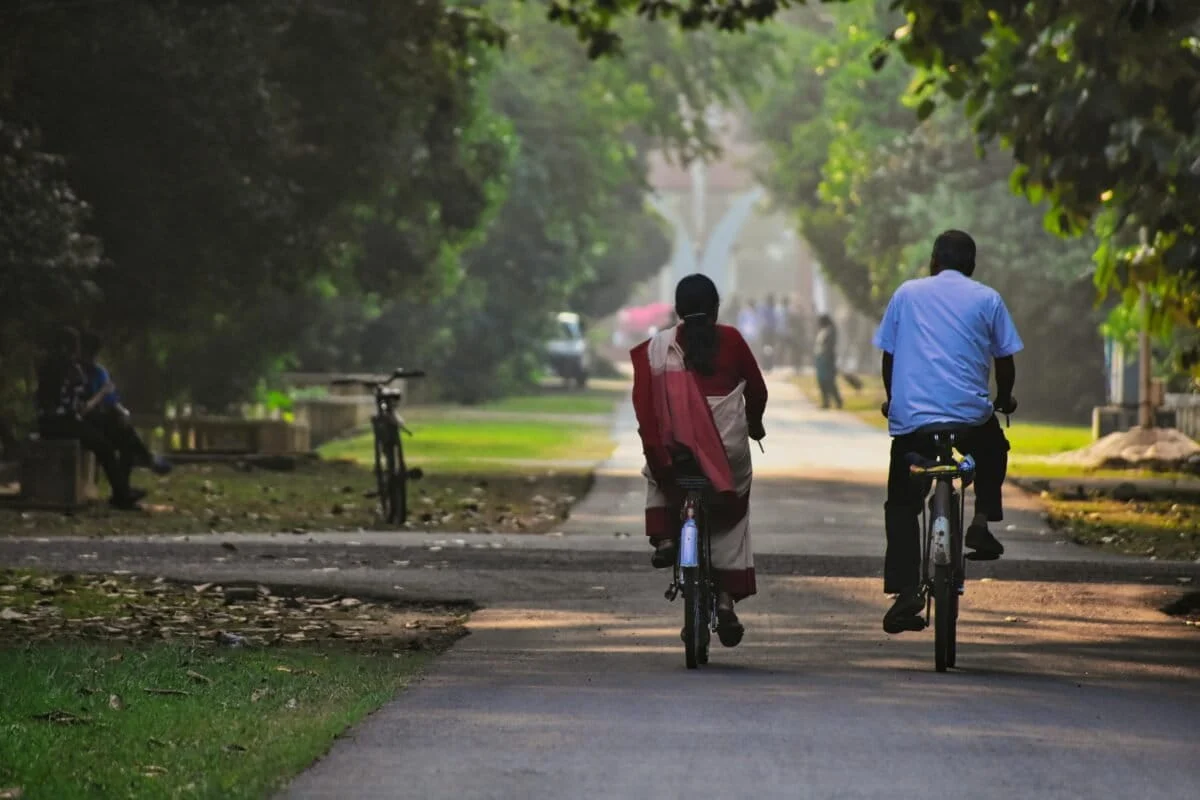
In a year marked by record-breaking pollution and escalating climate concerns, Indian officials have turned to a humble tool for salvation: the bicycle. Yet, while the rhetoric of "cycling for a green future" gains momentum in air-conditioned ministerial offices, a profound disconnect remains between policy aspirations and the precarious reality of the millions who pedal through India’s congested, hazardous streets.
As 2025 unfolded, a rare alignment of interests emerged. From grassroots advocacy groups to Union Ministers and district-level administrators, the narrative was singular: cycling is the silver bullet for India’s dual crises of public health and environmental degradation. However, a landmark study published in Nature Cities has cast a cold light on this optimism, revealing that for many in low- and middle-income countries, cycling is less a lifestyle choice and more a daily battle against systemic neglect, gender bias, and lethal infrastructure.
Main Facts: The Disconnect Between Policy and Pedals
The push for non-motorized transport (NMT) in India is driven by an increasingly dire environmental context. According to the 2025 World Air Quality Report by IQAir, India remains the sixth most-polluted country globally, with Delhi ranking as the fourth most-polluted city on Earth. In these urban centers, the transport sector is the fastest-growing contributor to greenhouse gas emissions, accounting for nearly 30% of the total urban carbon footprint.
Despite this, the transition to cycling is stymied by a series of "ironies," as described by experts. While the government advocates for cycling as a solution to smog, the actual conditions of the roads—characterized by a 600% increase in the motor vehicle fleet over the last two decades—actively discourage its use. The Nature Cities study, which examined Delhi and Chennai (India), Dhaka (Bangladesh), and Accra (Ghana), found that the barriers to cycling are not merely personal but structural, rooted in a lack of physical infrastructure, severe policy implementation gaps, and deep-seated gender inequality.

Chronology: A Year of Rhetoric and Research
The year 2025 served as a microcosm of the cycling advocacy movement in India, illustrating both the high-level support and the mounting pressure for change.
- January 2025: The year began with a push from the BYCS India Foundation, a prominent cycling advocacy group. They urged major political parties to include cycling safety and air quality in their election manifestos, framing Delhi’s transition to a "bicycle-friendly city" as a non-negotiable political necessity.
- February 2025: Residents of Gurgaon, a city often choked by dust and vehicular exhaust, took to the streets on foot and by cycle. This grassroots protest was a direct response to rising pollution levels, with participants taking public pledges to prioritize sustainable transport.
- August 2025: The momentum reached the federal level when Union Minister for Youth Affairs and Sports, Mansukh Mandaviya, publicly echoed these sentiments. He framed cycling not just as an athletic pursuit but as a "solution to pollution," signaling a top-down endorsement of the mode.
- December 2025: The year concluded with local leadership taking up the mantle. NTR District Collector G. Lakshmisha, based in Andhra Pradesh, emphasized that cycling is essential for building a "healthy, pollution-free future," linking personal fitness directly to national climate goals.
While these milestones suggest a growing consensus, the publication of the Nature Cities study during this same period provided a sobering academic counter-narrative, suggesting that the "solution" is currently built on a foundation of sand.
Supporting Data: The Statistics of Neglect
The push for cycling is backed by data from the Intergovernmental Panel on Climate Change (IPCC), which identifies a shift to low-carbon transport as the most effective way to reduce urban emissions. However, the data regarding the safety and feasibility of this shift in India is alarming.
The Safety Crisis
In 2023, the Ministry of Road Transport and Highways (MoRTH) reported 4,560 cyclist deaths on Indian roads. This figure highlights the lethal environment created by a transport strategy that prioritizes speed and motorized volume over the safety of vulnerable road users.

Infrastructure Gaps
Experts point out that while more than half of India’s working population travels by walking or bicycling, the lion’s share of infrastructure investment is funneled into projects for motorized vehicles. In Indian cities, approvals for flyovers, underpasses, and tunnels—which often make crossing roads more difficult for cyclists—are fast-tracked. In contrast, dedicated cycling lanes are frequently treated as "special projects" or "beautification" efforts rather than essential routine engineering.
The Dust and Heat Factor
Cyclists are the "first line of impact" for PM 10 pollution. Unlike car users or even bus passengers, cyclists spend more time on the road for the same distance and are directly exposed to vehicular fumes and "tyre friction dust." Furthermore, road maintenance often results in sand, construction debris, and fallen branches being pushed to the road edges—the exact space where cyclists are forced to ride.
Official Responses and Expert Critique
The government’s primary response to the cycling crisis has been the "Cycles4Change Challenge," launched in 2020 under the Smart Cities Mission. While the initiative aimed to help cities implement cycling-friendly interventions, the results have been underwhelming.
Sharif Qamar, Associate Director at The Energy and Resources Institute (TERI), notes that the initiative has not met expectations, particularly regarding the creation of dedicated, protected cycle tracks. "The big-ticket infrastructure projects that favor motorists are still given preference over solutions that are economical or impactful in reducing pollution," Qamar says.

Rahul Goel, an assistant professor at IIT Delhi and co-author of the Nature Cities study, highlights a fundamental irony in the government’s stance. "The government acts as an advocate, but nothing is done to improve the actual conditions that discourage use," Goel explains. He argues that bicycle infrastructure is not treated as a routine part of road engineering. When a road is upgraded, a bike lane is an afterthought, if it is included at all.
Sonal Shah, founder of The Urban Catalysts, adds that even where lanes exist, they are often rendered useless by a lack of enforcement. In cities like Bengaluru and Delhi, bicycle tracks are frequently encroached upon by parked cars, auto-rickshaws, and two-wheelers, leaving cyclists with no choice but to merge into dangerous, fast-moving traffic.
Implications: Socio-Economic and Gender Barriers
Perhaps the most significant finding of recent research is the socio-economic and gendered nature of cycling in India. The Nature Cities study reveals that cycling is currently a "mode of necessity" for the poor but is being marketed as a "mode of choice" for the elite.
The Gender Gap
The study found a stark gender imbalance. In cities like Delhi and Dhaka, cycling is almost exclusively the domain of low-income adult men. Smruthi Bala Kannan, the study’s lead author, observed that while women are often seen as pillion riders, very few are active cyclists on arterial roads.

The reasons are manifold:
- Resource Hierarchy: In low-income households with a single vehicle (often a cycle), men typically have priority use for long-distance commuting.
- Safety and Harassment: Zeenath M.A. of the SheCycling program points out that women face "eve-teasing" and inappropriate behavior on the road, creating a psychological barrier to cycling.
- Cultural Taboos: Prakash P. Gopinath, co-founder of SheCycling, notes that while boys are encouraged to ride, girls are often told to depend on men for their mobility needs.
The "Invisible" Cyclist
There is a profound irony in urban planning: the people who cycle the most—low-income workers—are the most "politically disempowered and invisible" to policymakers. Meanwhile, advocacy for cycling infrastructure often focuses on elite neighborhoods in hopes of "converting" car users. This mismatch ensures that the people who need safe lanes the most are the least likely to get them.
The Path Forward: Beyond Greenwashing
The consensus among urban transport experts is that cycling cannot be promoted in a vacuum. If it is to be a genuine climate solution, it requires a "vision of widespread adoption" and a fundamental shift in how cities are built.
1. Demand Management: Sonal Shah suggests that instead of just asking people to cycle, the government must make it more difficult and expensive to use private cars. This includes stricter parking policies and congestion pricing, alongside the development of a sustainable transport ecosystem.

2. Localized Solutions: Sharif Qamar emphasizes that India cannot simply "copy-paste" cycling models from the Global North. Solutions must account for India’s unique demographics, extreme heat, and high-density traffic.
3. Community-Led Initiatives: Programs like SheCycling in Kerala, which has taught over 800 women—including ASHA workers and domestic helpers—to ride, offer a blueprint for success. By targeting those for whom a bicycle provides economic independence, these programs create a sustainable base of users.
4. Integrated Engineering: For cycling to thrive, it must be moved from the "beautification" budget to the "essential infrastructure" budget. This means leveled paths, shaded routes, and safe intersections with "bicycle boxes" that allow cyclists to wait safely at red lights.
In conclusion, while the 2025 rhetoric around cycling is a welcome change from years of silence, it remains a hollow promise without a radical redesign of the Indian street. As Sonal Shah poignantly asks, "How do you ask people to cycle when the environment makes it harmful?" Until the government addresses the dust, the danger, and the deep-seated inequality on the roads, the bicycle will remain a symbol of missed opportunity rather than a vehicle for a cleaner future.
