

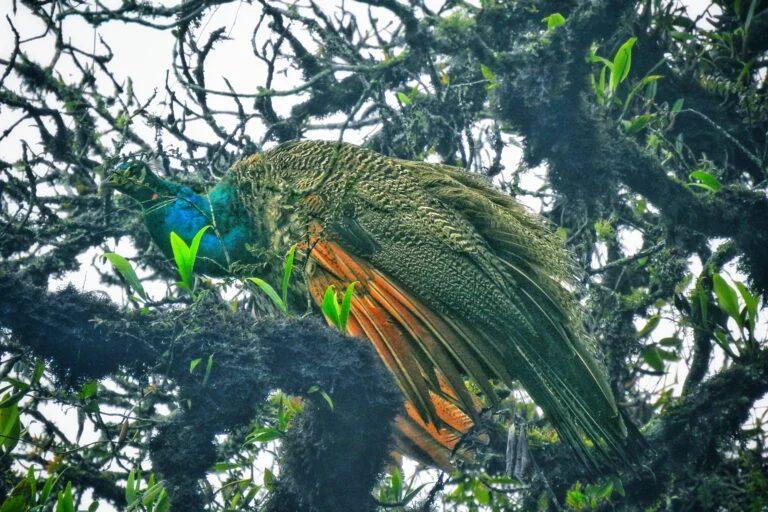
KALIMPONG, WEST BENGAL – In the emerald folds of the Eastern Himalayas, a creature once celebrated as the pinnacle of grace and a divine messenger is increasingly being viewed through a much darker lens. The Indian peafowl (Pavo cristatus), India’s national bird and a central figure in Hindu iconography, is undergoing a dramatic population surge and range expansion. While conservationists elsewhere might celebrate the thriving numbers of a protected species, for the subsistence farmers of the Darjeeling and Kalimpong hills, the bird has become an existential threat to their livelihoods.
The crisis highlights a widening chasm between national conservation policies—often drafted in urban centers or focused on plains-based ecosystems—and the lived realities of mountain communities. As the peafowl moves into higher altitudes where it was historically absent, it is transforming from a cultural icon into an ecological and economic disruptor.
Main Facts: A Protected Species in Conflict
The Indian peafowl enjoys the highest level of legal protection under Indian law. It is listed in Schedule I of the Wildlife (Protection) Act, 1972, placing it on the same legal pedestal as the Bengal tiger and the Asian elephant. This status makes any form of population control—be it relocation, culling, or even invasive research—a bureaucratic labyrinth involving federal approval.
However, unlike the tiger or the elephant, the peafowl is not an endangered species. On the contrary, the "State of India’s Birds" report indicates that its population is thriving and expanding across the subcontinent. In the Eastern Himalayas, this success has translated into a "nuisance" of unprecedented proportions.
The Geography of the Crisis
The conflict is most acute in the foothills and mid-hills of West Bengal and Sikkim. In villages like Ambiok Busty and Chota Suruk in the Kalimpong district, the birds have descended upon agricultural fields in flocks of ten to fifteen. Farmers report the destruction of staple crops such as paddy and maize, as well as high-value cash crops like dalley khursani (round chillies).
![Increasing numbers of the Indian peafowl worry farmers [Commentary]](https://imgs.mongabay.com/wp-content/uploads/sites/30/2026/08/17101028/Photo-2_%40Mingma-Tamang-1200x800.jpg)
Ecological Displacement
Beyond agriculture, the peafowl’s expansion into high-altitude zones—historically the domain of rare Himalayan pheasants like the Satyr Tragopan and various partridges—has raised alarms among ecologists. There are growing fears that the larger, more aggressive peafowl will outcompete native species for food and nesting sites, fundamentally altering the biodiversity of fragile ecosystems like the Singalila National Park.
Chronology: From Mythical Messenger to Modern Pest
The history of the peafowl in the Himalayas is one of recent and rapid colonization. To understand the current friction, one must look at the timeline of its arrival and the subsequent shift in human perception.
The Historical Context
For centuries, the peafowl was a bird of the Indian plains and deciduous forests. In Hindu mythology, it is the vahana (mount) of Lord Kartikeya, symbolizing wisdom and war. This cultural reverence ensured its safety even before formal laws were enacted. In the Himalayan foothills, older generations recall the bird’s call as a distant, rare sound—a symbol of the "exotic" plains.
The Turning Point (Late 19th Century to 2000s)
Historical records suggest the bird was not a permanent resident of the higher reaches. In neighboring Nepal, documented sightings were non-existent before 1877. Throughout the 20th century, sightings in the Darjeeling hills remained sporadic. However, the last two decades have seen a vertical migration. Residents of Sirikhola-Gurdum, located at 2,300 meters, report that the bird was virtually unknown in their forests until very recently.
The Modern Surge (2010–Present)
In the last 15 years, the frequency of sightings has reached a fever pitch. In 2017, a study conducted on the outskirts of the Kitam Bird Sanctuary in Sikkim officially categorized the Indian peafowl as an "intolerable species." This was the first formal acknowledgment that the bird’s presence had reached a tipping point where farmers were considering abandoning their lands. By 2024, forest guards reported sightings as high as Sandakphu, the highest point in West Bengal at 3,636 meters—an altitude previously thought to be climatically unsuitable for the species.
![Increasing numbers of the Indian peafowl worry farmers [Commentary]](https://imgs.mongabay.com/wp-content/uploads/sites/30/2026/08/17105705/Photo-3_%40Mingma-Tamang-768x512.jpg)
Supporting Data: Climate Change and Economic Loss
The peafowl’s march up the mountains is not a random event; it is backed by shifting climatic and environmental data.
The Climate Catalyst
The Eastern Himalayas have seen a significant rise in temperature—approximately 0.57°C between 1881 and 1997. This warming trend, coupled with erratic monsoon patterns, has transformed previously cold, damp mountain slopes into drier, warmer habitats that mimic the peafowl’s native range in the plains.
Furthermore, local environmental practices may be inadvertently aiding this migration. The seasonal burning of broom-grass (Amriso) fields in lower altitudes during March and April creates a "push factor," forcing the birds to seek refuge and food in higher, cooler forested areas and agricultural clusters.
The Economic Toll
While comprehensive regional data on the exact monetary loss is still being gathered, anecdotal evidence from the Teesta and Relli river valleys is staggering.
- Labor Loss: Farmers in Sittong report that they must now guard their fields from dawn until dusk. This "guarding duty" pulls able-bodied adults away from other economic activities, effectively creating a "hidden tax" on rural households.
- Crop Devastation: A single flock can ruin a week’s worth of labor in a matter of hours. The birds do not merely eat the grain; their size and weight mean they trample young stalks, rendering the remaining crop unharvestable.
- Livelihood Alteration: The 2017 Sikkim study highlighted that the peafowl threat is forcing farmers to alter their cropping patterns, moving away from traditional nutritious staples toward crops that the birds might find less palatable, though often at a lower market value.
Official Responses: A Fragmented Bureaucracy
The management of the peafowl crisis is currently hamstrung by what experts call an "institutional mess." Unlike other high-conflict species, there is no unified National Human-Wildlife Conflict Mitigation Strategy specifically for the peafowl.
![Increasing numbers of the Indian peafowl worry farmers [Commentary]](https://imgs.mongabay.com/wp-content/uploads/sites/30/2026/08/17110932/Photo-4_%40Mingma-Tamang-768x512.jpg)
The Silo Effect
Responsibility for the bird is scattered across several agencies:
- The Forest Department: Tasked with protecting the bird under Schedule I but lacks the mandate or funds to compensate farmers for crop loss caused by birds (compensation is usually reserved for "big game" like elephants or leopards).
- The Agriculture Department: Focused on yield and productivity but possesses no authority over wildlife management.
- Panchayati Raj & Biodiversity Boards: These local bodies are often the first to receive complaints but lack the legal teeth to implement population control measures.
The "Peacock Park" Paradox
In a striking example of policy disconnect, while farmers in Kalimpong are pleading for population control, some state governments are still funding "Peacock Parks" to promote ecotourism. In Sikkim, the government attempted a unique mitigation strategy by acquiring fields destroyed by peafowl to turn them into bird-watching hubs. While innovative, critics argue this is not scalable across the entire Himalayan range due to the massive land-acquisition costs involved.
The Legal Barrier
Because the peafowl is a Schedule I species, local foresters are often just as "handcuffed" as the farmers. "People are too afraid of the forest department to even throw a stone to chase them away," noted one farmer from Sittong. This fear stems from the stringent penalties associated with harming a national symbol, creating a vacuum where no proactive management can occur.
Implications: The Future of Mountain Agriculture and Conservation
The "Peacock Problem" in the Himalayas is a precursor to the types of conservation challenges India will face in an era of climate change. The implications are three-fold:
1. The Erosion of Local Support for Conservation
Conservation is most effective when it has the "buy-in" of local communities. When a protected species becomes the primary cause of a family’s hunger, the romanticized narrative of wildlife protection collapses. If the government does not address the economic losses, there is a risk of retaliatory measures or a general hardening of attitudes against all wildlife forestry initiatives.
![Increasing numbers of the Indian peafowl worry farmers [Commentary]](https://imgs.mongabay.com/wp-content/uploads/sites/30/2026/08/17110554/Singalila_national_park-768x512.jpg)
2. The Threat to Native Biodiversity
The "generalist" nature of the peafowl—its ability to eat almost anything and survive in various conditions—makes it a formidable competitor. Its presence at 3,600 meters is an ecological red flag. If the peafowl displaces the Satyr Tragopan or the Blood Pheasant, India may lose its rare high-altitude specialists in favor of a common species that is already abundant elsewhere.
3. The Need for Adaptive Policy
The crisis underscores the need for "ecosystem-based" rather than "species-based" legislation. A bird that is a "conservation priority" in a depleted forest in the plains may need to be managed as a "pest" or "invasive" when it moves into a fragile mountain ecosystem where it doesn’t belong.
Conclusion
The vibrant plumage of the Indian peafowl, once a source of joy for Himalayan villagers, has become a "vivid reminder of ruined harvests." As the bird continues its ascent into the clouds, the Indian government faces a difficult question: How do you protect a national symbol without sacrificing the people who live alongside it?
The answer, according to conservation biologists at ATREE and local leaders, lies in a more just and enduring approach—one that acknowledges that conservation cannot succeed if it is built on the economic ruin of the rural poor. Until policy catches up with the changing climate, the farmers of the foothills remain in a state of agricultural siege, caught between the laws of the land and the hunger of a national icon.
