

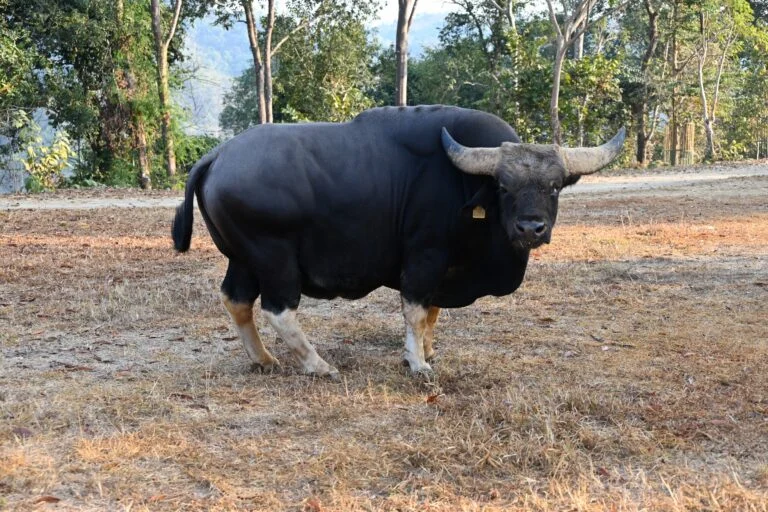
In the misty, verdant hills of Arunachal Pradesh, the measure of a man’s worth is not found in his bank balance or the make of his car, but in the slow, rhythmic breath of a semi-wild bovine. For the indigenous communities of Northeast India, the mithun (Bos frontalis) is more than livestock; it is a living currency, a symbol of ancestral pride, and a cornerstone of cultural identity.
However, a quiet crisis is unfolding across the high-altitude pastures. While the state remains the global stronghold for the species, the genetic fabric of the mithun is fraying. A landmark whole-genome study has recently pulled back the curtain on the genetic health of these animals, revealing that behind the impressive census numbers lies a shrinking breeding pool that demands urgent intervention.
Main Facts: The Bovine of Prestige and the Science of Survival
The mithun occupies a singular biological niche. Neither fully domesticated like the cow nor truly wild like the gaur, it is a semi-free-ranging bovine that roams the community forests of Arunachal Pradesh, Nagaland, Manipur, and Mizoram. In Arunachal Pradesh alone, home to nearly 70% of India’s 384,000 mithuns, the animal is central to customary law, marriage dowries, and ritual sacrifices.
Despite its importance, the species has long been a "black box" to modern genetics. Previous studies focused on small fragments of DNA, leaving scientists in the dark regarding the population’s overall health. This changed earlier this year with the publication of India’s first population-level whole-genome analysis of the Arunachali mithun in the International Journal of Molecular Sciences.
The study, led by scientists from the ICAR-National Research Centre (NRC) on Mithun, has achieved two critical milestones:

- Identification of the Siangmi Breed: The discovery of a genetically distinct population in the Siang region, likely the oldest mithun breed in the world.
- Genomic Baseline: The establishment of a comprehensive map of genetic diversity, inbreeding levels, and demographic history to guide future conservation.
The findings are bittersweet. While the "Siangmi" population is large in number—estimated at over 20,000 individuals—its "effective population size" (the number of individuals actually contributing to the next generation’s gene pool) is alarmingly small, estimated at just 160.
Chronology: From Ancestral Herds to Genomic Mapping
The transition of the mithun from a purely cultural icon to a subject of intense genomic scrutiny has followed a clear trajectory over the last several decades.
The Era of Abundance
For generations, families like that of John Pei Cander, a resident of Arunachal Pradesh, maintained massive herds. "During my father’s time, our family had around 30," Cander recalls. In those days, the forest was an open pantry, and the genetic pool was naturally refreshed as bulls moved between vast, contiguous village territories.
The Shift to Modernity
As the state modernized, the logistics of mithun rearing changed. Land use patterns shifted, and many owners moved into government jobs or urban businesses. While individuals like Cander became economically successful—owning SUVs and two-storied concrete houses—their mithun herds dwindled. Cander now owns only four. This "wealth paradox" where economic success correlates with a loss of mithun-based status has become a common narrative in the region.
The Scientific Turning Point (2023–2024)
Last year, the ICAR-NRC on Mithun achieved a breakthrough by registering the world’s first recognized mithun breed, the "Nagami" mithun. This set the stage for "Project Siangmi." Scientists began collecting blood samples from 11 unrelated mithuns across the Siang, East Siang, and Lepa Rada districts.

By early 2024, high-throughput whole-genome sequencing had generated 30 gigabases of DNA sequence per animal. This data allowed researchers to identify five million high-quality single nucleotide polymorphisms (SNPs)—the tiny genetic variations that tell the story of a species’ past and future.
Supporting Data: The Hidden Dangers of the Semi-Free-Ranging System
The whole-genome study provides a granular look at the risks inherent in traditional rearing practices. In Arunachal Pradesh, mithuns are left to roam and mate naturally. While this preserves their "wild" character, the lack of human-managed breeding leads to "genetic erosion."
Inbreeding and ROHs
The research analyzed "Runs of Homozygosity" (ROHs)—long stretches of the genome where an individual has inherited identical genetic material from both parents. The study found that 93% of these ROHs were short (between 100 and 250 kilobases).
"This pattern suggests that historical demographic events, rather than recent intensive inbreeding, have largely shaped the genomes," explains Harshit Kumar, a scientist at NRC-Mithun. However, the presence of these markers indicates that without new breeding bulls being introduced to herds, the population is at risk of "inbreeding depression," which can lead to reduced fertility and higher susceptibility to disease.
The "Effective Population" Gap
Perhaps the most startling data point is the "Effective Population Size" (Ne). While the census population of the Siangmi breed is approximately 20,000, the Ne is estimated at 160.

- Census Population: 20,000 (Total animals on the ground).
- Effective Population (Ne): 160 (The genetic equivalent of the breeding population).
When the Ne falls this low, rare genetic variants are lost at an accelerated rate. The scientists warn that while the population has not yet reached a stage of irreversible genetic decay, it is at a critical "tipping point."
Official Responses: Breed Recognition as an Economic Shield
For the experts at the ICAR-National Research Centre on Mithun, the goal is to bridge the gap between indigenous knowledge and federal policy.
Girish Patil S, Director of ICAR-NRC on Mithun and leader of Project Siangmi, emphasizes that scientific recognition is a prerequisite for financial support. "Unless a population is recognized as a breed, farmers cannot effectively avail the benefits of many Central Sector schemes, like the National Livestock Mission and the Rashtriya Gokul Mission," Patil explains. These programs provide subsidies and infrastructure that are currently locked away from mithun farmers because the "Siangmi" is not yet an officially registered breed.
The local response has been one of eager collaboration. Tadang Tamut, chairman of the Jomlo Mongku Mithun Farmers’ Federation in Siang, notes that the tribes—specifically the Adi and Galo—were unaware that their animals were a unique lineage. "According to the scientists, this is probably the oldest mithun breed in the world," Tamut says.
The federation has already taken proactive steps, signing a Memorandum of Understanding (MoU) with the NRC-Mithun. In the last 24 months, they have ear-tagged and vaccinated over 16,000 Siangmi mithuns, creating the first-ever database of individual animals in the region.

Implications: A New Era of Evidence-Based Conservation
The findings of the whole-genome study suggest that the future of the mithun depends on a transition from "observational management" to "evidence-based genetic management." The implications for the region are three-fold:
1. The Necessity of Identification
The tradition of "anonymous" herds must end. Researchers are advocating for ear-tagging or biometric identification. Without knowing which bull fathered which calf, it is impossible to prevent mating between close relatives. The genomic tools developed in this study now allow for cost-effective parentage verification, a process that was previously impossible in the thick jungles of the Northeast.
2. Economic Protection through GI Tags
With breed recognition comes the opportunity for a Geographical Indication (GI) tag. For the farmers of Siang, a GI tag would be a powerful legal tool to prevent crossbreeding with other bovine species and to market mithun meat and milk as premium, heritage products. This could reverse the trend of shrinking herds by making mithun rearing a more lucrative enterprise for the younger generation.
3. Evolutionary Resilience
By maintaining genetic diversity, the Siangmi breed will be better equipped to survive the challenges of climate change and emerging tropical diseases. As the effective population size is currently low, the immediate introduction of "bull exchange programs" between distant villages is essential to refresh the gene pool.
Conclusion
The story of the mithun is a reminder that conservation is not just about counting heads; it is about protecting the invisible code that allows a species to adapt and thrive. For John Pei Cander and thousands like him, the scientific recognition of the Siangmi breed offers a path back to pride. It ensures that the answer to "How many mithuns do you own?" will once again be a source of status rather than a quiet apology. Through the lens of the whole-genome study, the people of Arunachal Pradesh are not just looking at their past—they are securing the genetic blueprint of their future.
