

Introduction
Ask five different urban planners what a "smart city" means, and you will likely receive five distinct definitions. For some, it is the ubiquity of high-speed internet and mobile applications; for others, it is the integration of Internet of Things (IoT) sensors, advanced CCTV surveillance, or optimized road networks. While these perspectives differ, they are all partially correct. At its fundamental core, a smart city is not merely a collection of gadgets, but a systemic paradigm shift. It is the strategic use of technology and modernized infrastructure to ensure that a city operates more efficiently, sustainably, and, most importantly, remains livable for its residents.
In a world rapidly urbanizing, the "Smart City" concept has moved from a futuristic buzzword to an essential framework for survival. India, facing one of the most significant urban migrations in human history, has embraced this concept through its ambitious Smart Cities Mission (SCM). By blending global technological trends with local socioeconomic realities, the mission represents a departure from traditional top-down urban planning, favoring a decentralized, data-driven approach.
Main Facts: The Anatomy of a Smart City
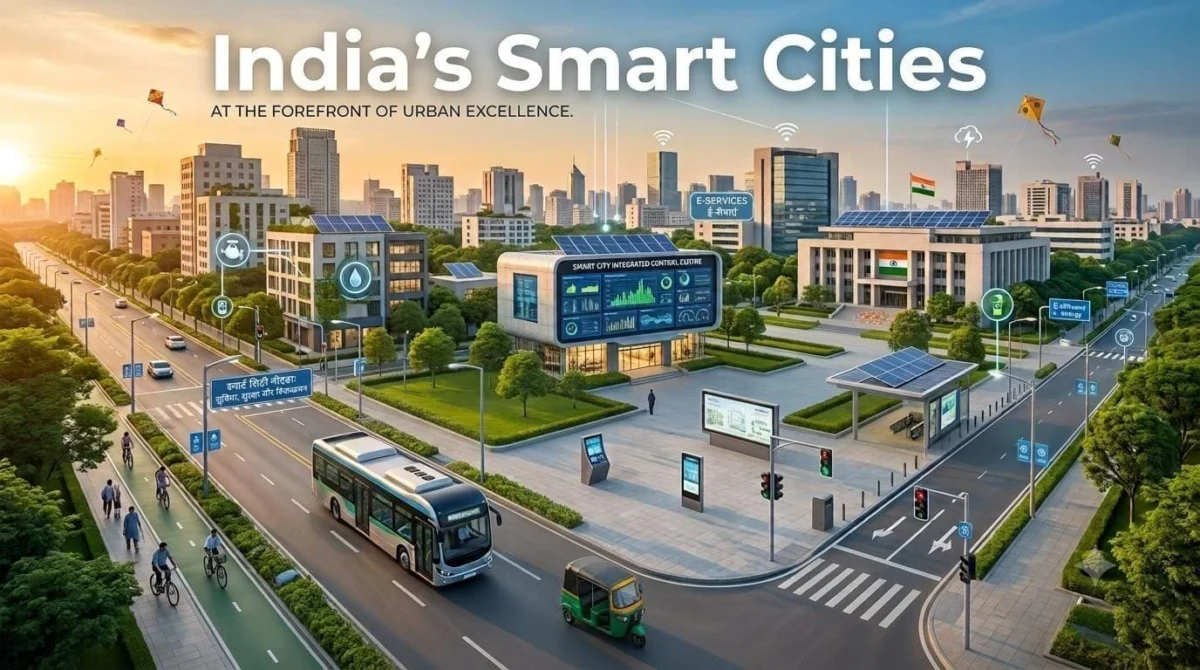
The essence of a smart city lies in the management of fundamental urban utilities—water, electricity, waste management, transport, and public safety—using data-driven insights rather than traditional guesswork. In a conventional city, a water leak might only be detected after a significant drop in pressure or a visible flood. In a smart city, acoustic sensors detect vibrations in pipes to identify leaks before they burst, saving millions of liters of treated water.
A smart city is comprised of several interconnected layers:
- The Physical Layer: This includes the "hard" infrastructure—roads, pipes, and buildings—but retrofitted with intelligence. It involves smart meters for real-time power usage and automated waste collection systems.
- The Digital Layer: This is the nervous system of the city. It consists of the sensors, cameras, and connectivity (4G/5G/Fiber) that collect and transmit data.
- The Service Layer: This is where the citizen interacts with the city. It includes online portals for government services, reducing the need for physical queues, and apps that provide real-time bus locations or report broken streetlights.
- The Cognitive Layer: Perhaps the most vital, this involves the "Integrated Command and Control Centers" (ICCCs). These are the "brains" where data from various departments is synthesized to make real-time decisions, such as adjusting traffic signal timings based on current congestion levels.
The goal of these systems is not to look impressive on a marketing brochure; it is to quietly reclaim the time citizens lose to inefficiency. By optimizing a commute by ten minutes or digitizing a permit process that once took weeks, the smart city enhances the collective productivity and well-being of its population.
Chronology: The Journey of India’s Smart Cities Mission
The trajectory of India’s smart urbanism can be traced through a series of strategic milestones:
- June 2015: The Launch. Prime Minister Narendra Modi officially launched the Smart Cities Mission under the Ministry of Housing and Urban Affairs (MoHUA). The objective was to promote cities that provide core infrastructure, a clean and sustainable environment, and a "smart" solution to urban problems in 100 cities across the country.
- January 2016 – 2018: The Selection Rounds. Unlike previous urban schemes, the SCM utilized a "City Challenge." Cities had to compete for funding by submitting rigorous proposals. The first 20 winners were announced in early 2016, followed by subsequent rounds that eventually brought the total to 100 cities.
- 2017 – 2019: The Implementation Phase. This period saw the establishment of Special Purpose Vehicles (SPVs) in each city—limited companies created to plan, appraise, approve, and release funds for projects. This was a crucial structural shift to bypass the bureaucratic delays often associated with municipal corporations.
- 2020 – 2021: The Pandemic Pivot. During the COVID-19 pandemic, the ICCCs in various cities were repurposed as "War Rooms" for monitoring infections, managing hospital bed availability, and coordinating the distribution of essential supplies. This provided a real-world proof of concept for the utility of smart infrastructure.
- 2023 – 2024: The Completion and Extension Phase. As of mid-2023, a significant majority of projects reached completion. However, recognizing the complexity of large-scale infrastructure, the Union Government extended the mission’s deadline to June 2024 to ensure that the remaining 10% of projects—often the most complex—were fully integrated and operational.
Supporting Data: Investment and Impact
The scale of the Smart Cities Mission is reflected in the financial and project data released by the Ministry of Housing and Urban Affairs:
- Financial Commitment: The total proposed investment for the 100 cities is approximately ₹2,05,018 crore (roughly $25 billion). This funding is a mix of Central Government grants, State Government contributions, and Public-Private Partnerships (PPP).
- Project Volume: As of the latest reports, over 7,900 projects have been tendered, with more than 6,000 projects completed. This represents an execution rate that significantly outpaces many previous urban renewal programs.
- The Nerve Centers: All 100 cities have operationalized their Integrated Command and Control Centers. These centers have been credited with improving traffic compliance by up to 20% in cities like Surat and Ahmedabad through automated number plate recognition (ANPR).
- Sustainability Metrics: Under the "ClimateSmart Cities Assessment Framework," over 100 cities are now actively tracking their carbon footprints. In Indore—repeatedly voted India’s cleanest city—the smart waste management system processes 100% of the city’s waste, generating bio-CNG that powers public buses.
One of the most significant data points is the "Lighthouse Effect." The mission was designed so that the 100 smart cities would serve as beacons for the other 4,000+ urban local bodies in India, demonstrating how localized technology can solve universal problems.
Official Responses and Governance Framework
The Ministry of Housing and Urban Affairs (MoHUA) has maintained that the flexibility of the mission is its greatest strength. Official statements emphasize that the SCM is not a "top-down" directive but a "bottom-up" evolution.
The SPV Model:
To ensure professional management, each smart city is governed by a Special Purpose Vehicle (SPV), headed by a full-time CEO. This model was designed to provide the operational independence necessary to execute multi-billion rupee projects without being bogged down by local political cycles. While this has faced some criticism regarding democratic accountability, officials argue it was necessary for the speed of execution required.
Citizen Engagement:
A unique feature of the official process was the "Citizen Consultation" phase. Before a city could even apply for the mission, it had to demonstrate that it had consulted its residents. Over 15 million citizens participated in the initial proposal stages through surveys, social media, and town halls. MoHUA officials have noted that this "skin in the game" for local governments and residents alike ensured that the plans were grounded in reality rather than being "copy-pasted" templates from Western cities.
Implications: The Future of Urban Living
The implications of the Smart Cities Mission extend far beyond better roads and faster internet. They signal a fundamental change in the relationship between the citizen and the state.
1. Economic Resilience:
Smart cities are designed to be economic hubs. By improving mobility and reducing the "cost of living" (in terms of time and health), these cities become more attractive to global investors and a high-tech workforce. This is particularly relevant for Tier-2 and Tier-3 cities, which are now competing with metros like Bengaluru and Mumbai for talent.
2. Environmental Sustainability:
As climate change accelerates, smart cities offer a path toward resilience. Smart grids reduce energy waste, and sensor-based water management mitigates the effects of urban droughts. The data collected allows cities to react to environmental shifts in real-time, such as adjusting air purification efforts or managing flood risks during monsoons.
3. The Challenge of Data Privacy:
With the rise of "surveillance" technology like CCTV and facial recognition, the smart city model raises significant questions about data privacy and civil liberties. The implication for the future is the need for a robust legal framework that protects citizen data while allowing the city to use that data for the public good.
4. Bridging the Digital Divide:
The ultimate success of a smart city will be judged by its inclusivity. If "smart" services are only accessible to those with the latest smartphones, the digital divide will widen. Therefore, the next phase of urban evolution must focus on "frugal innovation"—ensuring that technology serves the person at the end of the line as effectively as it serves the tech-savvy elite.
Conclusion
India’s approach to smart cities is a testament to the belief that technology, when paired with practical, ground-level thinking, can solve the most stubborn urban challenges. As these 100 projects reach full maturity, they provide a blueprint for a future where city living is defined by shorter commutes, cleaner air, and government services that are proactive rather than reactive. Knowing what a smart city really involves makes it clear: we are not just building better cities; we are building a more responsive and resilient civilization.
Disclaimer: This report provides information based on a synthesis of industry data, government reports, and urban planning analysis. Urban development is a dynamic field, and readers are encouraged to verify specific project statuses through official municipal portals.
