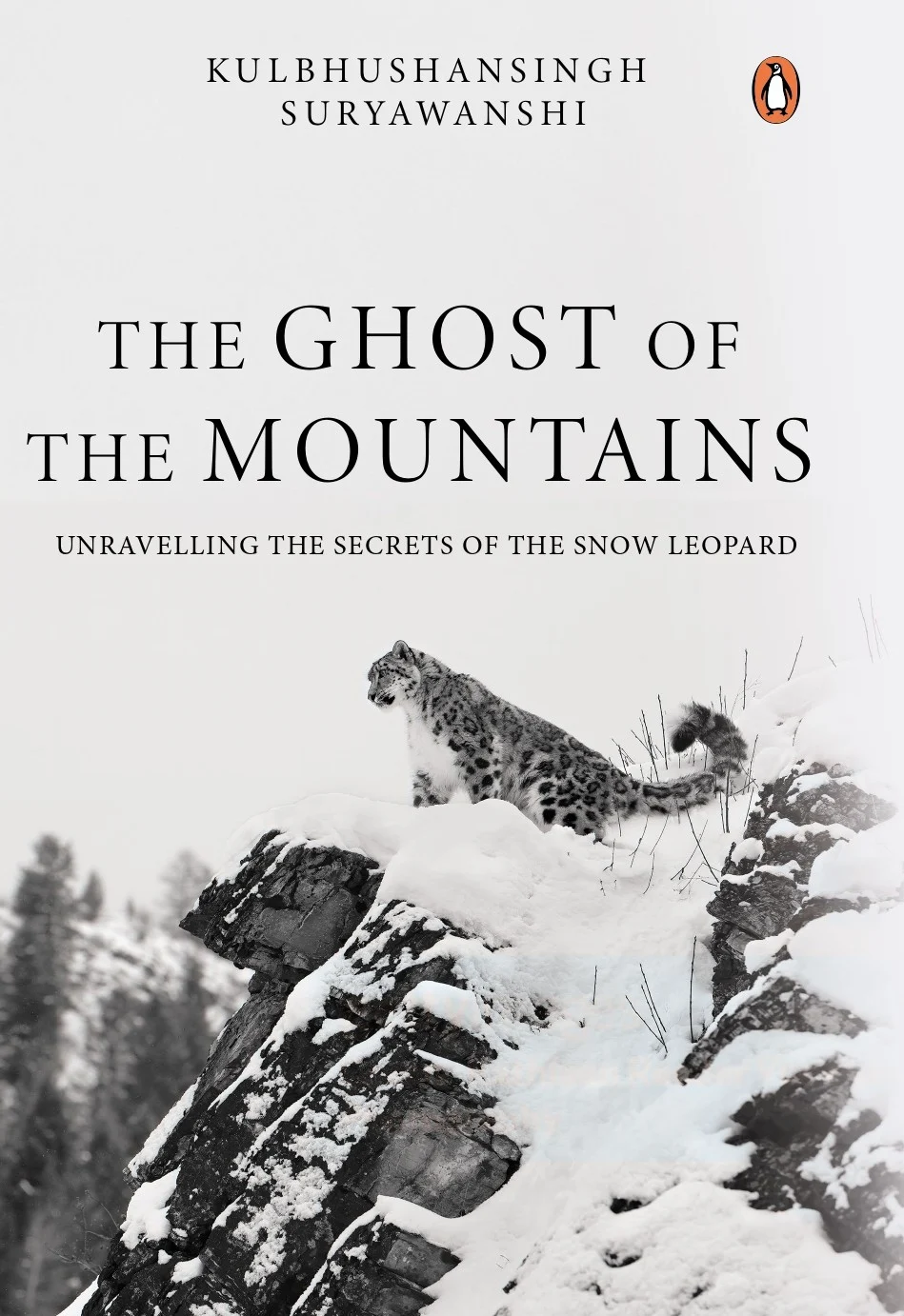
NEW DELHI / BENGALURU — In the rarefied air of the high-altitude mountain ranges that span 12 countries across Central and South Asia, there exists a predator so elusive it has earned the moniker "The Ghost of the Mountains." For decades, the snow leopard (Panthera uncia) remained a biological enigma, a creature of myth and shadow. However, a seminal new work by Kulbhushansingh Suryawanshi, titled The Ghost of the Mountains (Penguin Allen Lane, 2026), provides one of the most comprehensive accounts of this flagship species to date.
Suryawanshi, a scientist at the Nature Conservation Foundation (NCF) in Bengaluru and the director of the India programme for the Snow Leopard Trust, has synthesized twenty years of field research into a narrative that blends rigorous science with the visceral beauty of the world’s most inhospitable landscapes. The book arrives at a critical juncture as climate change and infrastructure development threaten the delicate balance of the mountain steppe ecosystems.
Main Facts: The Biology of a High-Altitude Specialist
The snow leopard is a masterclass in evolutionary adaptation. Living in terrains where temperatures plummet far below freezing and oxygen is scarce, every facet of the cat’s physiology is designed for survival.
According to Suryawanshi’s research, the leopard’s silvery-brown and white coat, punctuated by dark rosettes, acts as a "magic cloak," providing near-perfect camouflage against the granite and limestone of the Himalayas. Their tails, the longest relative to body size of any felid, serve a dual purpose: they act as a balancing pole for navigating vertical cliffs and as a thick, furry muffler wrapped around the body during sleep to retain heat.
![Snow leopards and their survival in changing times [Book Review]](https://imgs.mongabay.com/wp-content/uploads/sites/30/2026/09/08142945/DSC_0942-1200x800.jpg)
Physiologically, the snow leopard possesses unusually large nostrils to warm the frigid mountain air before it reaches the lungs, and small, rounded ears to minimize heat loss. Their wide, fur-lined paws function as natural snowshoes, allowing them to traverse deep drifts without sinking. Despite their formidable reputation, they are relatively small, weighing between 35 and 40 kg. Yet, their strength is disproportionate to their size; they are documented taking down prey as large as 500 kg Bactrian camels and sturdy mountain horses.
Chronology: From Mountaineer to Conservation Scientist
The trajectory of Suryawanshi’s career mirrors the evolution of snow leopard conservation in India. His journey began in earnest after 2006, when, equipped with mountaineering training, he joined the Wildlife Biology and Conservation course at NCF.
The Spiti Breakthrough (2006–2010):
Suryawanshi moved to the Spiti Valley in Himachal Pradesh to study the blue sheep (Bharal), the primary prey of the snow leopard. At Kibber village—situated at an altitude of 3,500 metres—he achieved a rare feat: spotting a mother snow leopard, later named "Sunshine," and her cub, "Shadow." This period was transformative, as it proved that even in areas with human presence, these cats could persist if the prey base was protected.
The Doctoral Expansion (2010–2015):
Recognizing that isolated sightings were insufficient for a regional conservation strategy, Suryawanshi launched a multi-site Ph.D. study. This took him across the Zanskar mountains of Ladakh and into the Gobi Desert of Mongolia. His mission was to solve the "menu" mystery: what exactly were snow leopards eating in different terrains, and how did the presence of livestock affect their diet?
The Era of Population Estimates (2021–2025):
The last five years have seen a global push to move from anecdotal evidence to hard data. Suryawanshi’s work contributed to a series of landmark population surveys across the range:
![Snow leopards and their survival in changing times [Book Review]](https://imgs.mongabay.com/wp-content/uploads/sites/30/2026/09/08140810/The-Ghost-of-the-Mountsains-Cs-Revised_page-0001.jpg)
- 2021: Mongolia reported a population of 953 individuals.
- 2022: Bhutan estimated 134 snow leopards within its borders.
- 2024: India released a comprehensive estimate of 718 cats.
- 2025: The Sanjiang region of the Tibet-Qinghai plateau reported a robust population of approximately 1,000.
Supporting Data: The "Keystone" Relationship
A central theme of Suryawanshi’s research is the "complex web of interactions" between predators, prey, and humans. Using "double observer surveys"—a method borrowed from New Zealand’s Tahr management—scientists minimized human error in counting wild herbivores.
The data revealed a striking correlation: snow leopard density is almost entirely dependent on the density of wild herbivores like the blue sheep and ibex. In the Tost Mountains of Mongolia, scat analysis confirmed that snow leopards preferred wild ibex over livestock, even when domestic animals were more numerous.
However, the "Cashmere Threat" remains a significant data point in the study of habitat degradation. In Mongolia, the domestic goat population exploded to 60 million by 2012 to satisfy the global demand for cashmere. This led to a 100-to-1 ratio of domestic goats to wild herbivores, placing immense pressure on the grasslands and forcing a shift in the snow leopard’s hunting patterns, often leading to retaliatory killings by herders.
Official Responses and Conservation Strategies
Conservation, as Suryawanshi argues, cannot exist in a vacuum away from the people who share the landscape with the "Ghost." The book highlights several successful "official" and community-led interventions:
1. The Shen Enterprise:
In the Spiti Valley, the "Shen" (the local name for snow leopard) program was established. This initiative empowered local women through handicraft production, allowing them to earn upwards of $3,000 annually. By linking economic prosperity to the presence of the snow leopard, the program shifted local attitudes from hostility to stewardship.
![Snow leopards and their survival in changing times [Book Review]](https://imgs.mongabay.com/wp-content/uploads/sites/30/2026/09/08143506/DSC_2588-768x512.jpg)
2. The Tost-Tosonbumba Nature Reserve:
In Mongolia, the Snow Leopard Trust collaborated with semi-nomadic herders to fight mining interests. After a prolonged struggle, the Mongolian government cancelled 37 mining licenses and designated 7,500 sq km as a protected nature reserve, prioritizing ecological integrity over mineral extraction.
3. The Hunting Concession Contrast:
In Kyrgyzstan, Suryawanshi observed a stark contrast in management styles. The Sarychat-Ertash Nature Reserve, which prohibits hunting, supports a herbivore density three to eight times higher than the adjacent Koiluu Reserve, where trophy hunting of argali and ibex is permitted. The data suggests that strictly protected "core zones" are essential for maintaining the high density of prey required to support viable snow leopard populations.
Implications: The Future of the High Mountain Landscape
The findings presented in The Ghost of the Mountains have profound implications for future environmental policy.
Climate Change and Altitudinal Shift:
As the Himalayan landscape warms, the "treeline" is moving higher, and the alpine meadows—the primary habitat of the snow leopard—are shrinking. This "squeeze" between the rising forests and the permanent snow line reduces the available hunting grounds for the cat.
The Blue Sheep as a Keystone:
Suryawanshi, along with colleagues Dr. Manvi Sharma and Munib Khanyari, posits that the non-descript blue sheep may actually be the "keystone species" of the mountain steppe. Their success or failure dictates the health of the entire ecosystem. Conservation efforts must, therefore, pivot toward protecting these "movers and shakers" of the mountain world rather than focusing solely on the predator.
![Snow leopards and their survival in changing times [Book Review]](https://imgs.mongabay.com/wp-content/uploads/sites/30/2026/09/08143510/DSC_9565-768x512.jpg)
Coexistence over Conflict:
The book concludes with a powerful message of hope. Despite the "fast-changing pace of development," the snow leopard has proven remarkably resilient. Suryawanshi’s narrative of the courtship of two snow leopards in the Spiti Valley—witnessed across a deep gorge—serves as a reminder of the "delight and tentativeness" of a species that continues to survive against all odds.
For policymakers, the message is clear: the survival of the snow leopard depends on a holistic approach that includes DNA-based monitoring, the mitigation of livestock-carnivore conflict through economic incentives, and the protection of vast, contiguous corridors that span international borders.
The Ghost of the Mountains is not merely a book about a cat; it is a blueprint for high-altitude conservation in the 21st century. It challenges the world to preserve the "austere, delicate ecosystem" of the Himalayas, ensuring that the silvery smoke of the mountains does not vanish forever.