

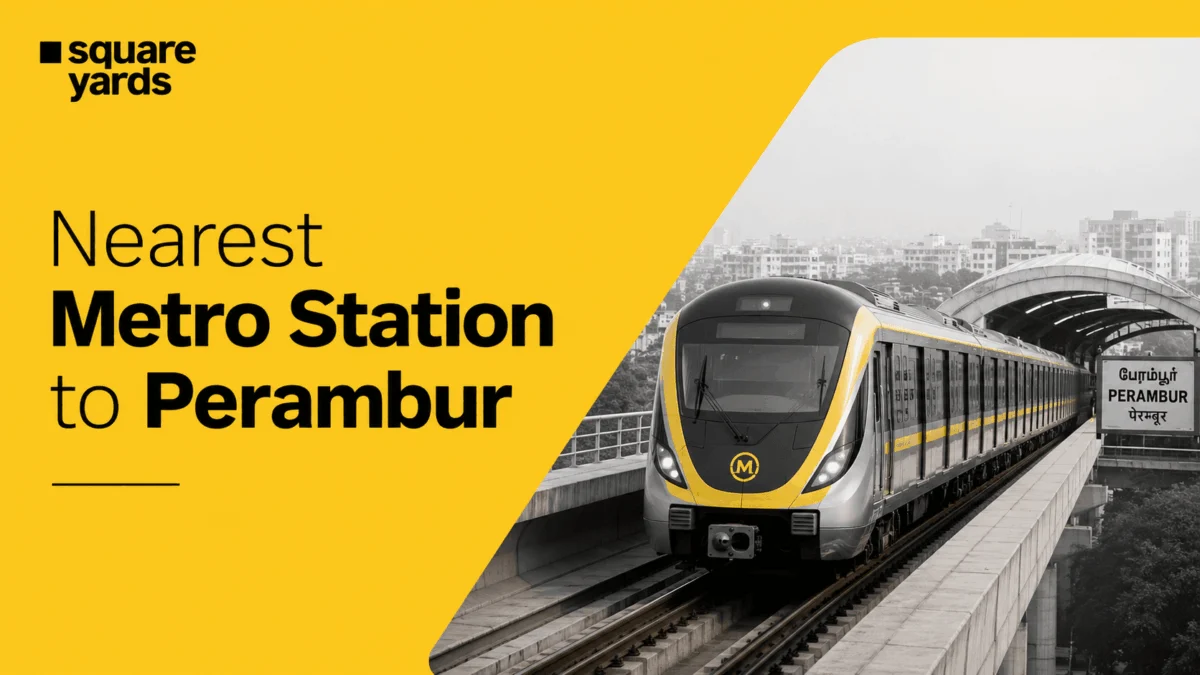
CHENNAI – In the sprawling urban fabric of North Chennai, few neighborhoods possess a legacy as deeply intertwined with the tracks as Perambur. Established in the mid-19th century as a hub for the Southern Railway’s locomotive and carriage workshops, Perambur has served as the city’s industrial heartbeat for over 160 years. However, as Chennai undergoes a massive subterranean transformation via the Chennai Metro Rail Limited (CMRL) Phase 2 project, Perambur finds itself in a peculiar "transit paradox."
While the neighborhood is the birthplace of the prestigious Vande Bharat Express and houses one of the city’s busiest suburban railway stations, it remains, for now, a "metro desert." Residents are currently caught between a storied past of steam and steel and a future of high-speed automated transit that is currently mired in construction delays and geological hurdles.
I. Main Facts: The Current Connectivity Landscape
For the average commuter in Perambur, the search for "the nearest metro station" often yields frustratingly inconsistent results. Digital transit applications and map services frequently conflate operational stations with those still under construction as part of the ambitious Purple Line (Corridor 3).
The Operational Reality
Currently, there is no metro station within the immediate boundaries of Perambur. Commuters wishing to access the Chennai Metro network must travel south to the Green Line (which connects Chennai Central to St. Thomas Mount). The two most viable options are:
- Nehru Park Metro Station: Located approximately 2.5 to 3 kilometers from central Perambur.
- Kilpauk Medical College (KMC) Metro Station: Situated roughly 2 to 3 kilometers away, serving as a more convenient entry point for those living in southern Perambur or near the Ayanavaram border.
Neither of these stations is within comfortable walking distance. Reaching them requires a secondary leg of travel—typically a 10-to-15-minute auto-rickshaw or MTC bus ride—adding both cost and time to the daily commute.
The Purple Line Promise
The "transit paradox" will eventually be resolved by the completion of Corridor 3 of CMRL Phase 2. This 45.8-kilometer line, stretching from Madhavaram Milk Colony to Siruseri SIPCOT, will finally bring the metro directly into the heart of Perambur via two dedicated stations:
- Perambur Market: Strategically placed to serve the dense commercial pockets.
- Perambur Metro: Designed as an underground facility that will reportedly integrate with the existing Perambur Railway Station, creating a seamless multi-modal hub.
II. Chronology: From 1860s Steam to 2020s Subterranean Boring
To understand Perambur’s transit significance, one must look at the chronological evolution of its infrastructure, which has dictated the pace of its modern development.
- 1860s: The British administration establishes the Southern Railway’s locomotive workshops. Perambur Railway Station opens, becoming the city’s second-oldest station after Royapuram. The neighborhood grows as a residential colony for railway employees.
- 1952: The Integral Coach Factory (ICF) is established. Perambur becomes a global name in railway manufacturing.
- 2015–2018: Chennai Metro Phase 1 begins operations. While the Blue and Green lines revolutionize travel in South and Central Chennai, North Chennai—specifically the Perambur-Ayanavaram belt—is left out of the initial phase, relying instead on the aging but efficient suburban rail network.
- 2021: Construction officially commences on CMRL Phase 2, Corridor 3. The promise of "Perambur Metro" becomes a tangible reality as barricades go up along major thoroughfares.
- 2023–2024: The project encounters significant geological and technical headwinds. Tunnel Boring Machines (TBMs) face challenges in the North Chennai soil, leading to a revised timeline.
- 2026–2028: The current projected window for the phased opening of Corridor 3. While some sections (like Porur to Vadapalani) are expected earlier, the underground stretch through Perambur is slated for a later stage.
III. Supporting Data: A Multi-Modal Breakdown
Despite the lack of a metro, Perambur remains a high-volume transit zone. The following data highlights the scale of movement within the locality and the economic gap the metro is expected to fill.
Suburban Rail: The Heavy Lifter
Perambur Railway Station is not merely a local stop; it is the fifth-busiest station in the Chennai suburban network.
- Daily Footfall: Approximately 40,000 commuters.
- Service Frequency: 140 suburban services and 29 long-distance trains stop here daily.
- Connectivity: It provides a direct, low-cost (₹5–₹20) link to Chennai Central in under 15 minutes, a feat the metro will struggle to beat in terms of price.
The Real Estate Value Gap
The delay in metro connectivity is starkly reflected in property valuations. A comparison with neighboring Kilpauk, which already enjoys metro access, reveals a significant "infrastructure premium":
| Locality | Approx. Price per Sq. Ft. | Metro Status |
|---|---|---|
| Kilpauk | ₹15,100 – ₹15,600 | Operational (Green Line) |
| Perambur | ~₹8,850 | Under Construction |
| Ayanavaram | ~₹8,000 | Under Construction |
Market analysts suggest that while Perambur is currently "undervalued" compared to Kilpauk, the price appreciation has already begun. The current rate of ₹8,850 reflects a 10–12% increase over the last 24 months as investors bet on the eventual completion of the Purple Line.
Last-Mile Connectivity Costs
Currently, Perambur residents pay a "hidden tax" in the form of last-mile connectivity to reach the Green Line:
- Auto-rickshaw: ₹40–₹120 (Subject to negotiation and peak demand).
- Share Auto: ₹15–₹30 (High frequency along Perambur High Road).
- MTC Bus: ₹10–₹25 (Routes 46, 142, and 29 series).
IV. Official Responses and Project Hurdles
The CMRL has been transparent about the difficulties in bringing the Purple Line to North Chennai. The stretch between Ayanavaram and Perambur has been flagged as one of the most technically demanding segments of Phase 2.
The TBM Challenge
According to CMRL progress reports, the underground section in North Chennai involves navigating through a mix of hard rock and soft soil, which has slowed the progress of Tunnel Boring Machines. In 2023, officials noted that certain TBMs were "waiting for breakthroughs" at planned station sites, including Perambur. These delays have pushed the completion of the Madhavaram-to-Taramani section back by at least 12 to 18 months from the original 2025 targets.
The Integration Plan
To address the "paradox," CMRL officials have confirmed that the Perambur Metro station is being designed with "intermodal integration" as a priority. Unlike Phase 1, where some metro stations were criticized for being too far from railway terminals, the Perambur Purple Line station will feature direct underground or skywalk links to the existing suburban station platforms. This is intended to transform Perambur into a "Northern Hub," rivaling the connectivity of Alandur in the south.
V. Implications: What the Future Holds for Perambur
The arrival of the metro is more than just a convenience; it represents a socio-economic shift for North Chennai.
1. The End of North-South Isolation
For decades, the "OMR-IT Corridor" in South Chennai has felt like a different city to Perambur residents. The Purple Line will provide a direct, air-conditioned link from the industrial north to the tech-heavy south (Taramani/Siruseri). This will likely trigger a demographic shift, as young professionals may choose the (currently) more affordable housing in Perambur while commuting to the south via metro.
2. Commercial Gentrification
Perambur’s local markets—historically dense and chaotic—are expected to undergo gentrification. The areas surrounding the Perambur Market and Perambur Metro stations are already seeing interest from organized retail chains and commercial developers who anticipate the surge in footfall that a metro station brings.
3. Preserving the "Rail Identity"
There is a cultural implication as well. Perambur is home to the Chennai Rail Museum and the ICF. The metro’s arrival completes the circle of railway history. However, urban planners warn that the "historic charm" of this 1860s neighborhood—its narrow lanes and colonial-era bungalows—could be threatened by the high-rise redevelopment that typically follows a metro corridor.
Conclusion: A Lesson in Patient Urbanism
Perambur today is a case study in patient urbanism. It is a neighborhood that already works—thanks to a century-old railway network—but is waiting to be "upgraded" to the 21st-century standard.
For residents, the advice remains to look past the "wildly different numbers" provided by transit apps. The reality is that the Green Line is your current gateway, the suburban rail is your reliable workhorse, and the Purple Line is a looming, albeit delayed, promise. As tunnel boring continues beneath the historic streets of North Chennai, Perambur remains on the cusp of a transformation that will eventually bridge the gap between its 19th-century industrial roots and its future as a modern multi-modal powerhouse.
Until then, the "nearest station" remains a short auto ride away, and the construction barricades serve as a daily reminder that the future is coming—just not as fast as the trains manufactured in Perambur’s own backyard.
