

BHOPAL — In the heart of Jharkhand’s industrial belt lies the Jharia coalfield, a region synonymous with India’s energy history and its notorious underground fires. However, beneath the smoke and soot, a team of researchers from the Indian Institute of Science Education and Research (IISER) Bhopal has uncovered a mathematical secret hidden within the microscopic cracks of the coal itself.
By developing a region-specific mathematical model that predicts gas flow based on the width of microscopic fractures, these researchers have bypassed one of the most significant hurdles in geological engineering. Their findings, which suggest that gas flow in Jharia’s coal follows a "power of five" relationship rather than the globally accepted "cubic law," could revolutionize both the extraction of clean-burning fuel and the permanent underground storage of planet-warming carbon dioxide.
Main Facts: Redefining Fluid Dynamics in Coal Seams
The Jharia coalfield is the primary source of India’s high-quality coking coal, essential for steel production. Yet, the region also holds vast reserves of Coal-Bed Methane (CBM), a form of natural gas trapped within the solid matrix of the coal. As the world pivots toward a low-carbon economy, CBM has emerged as a vital "bridge fuel"—it burns significantly cleaner than coal or oil, offering a way to reduce immediate emissions while renewable infrastructure is built.
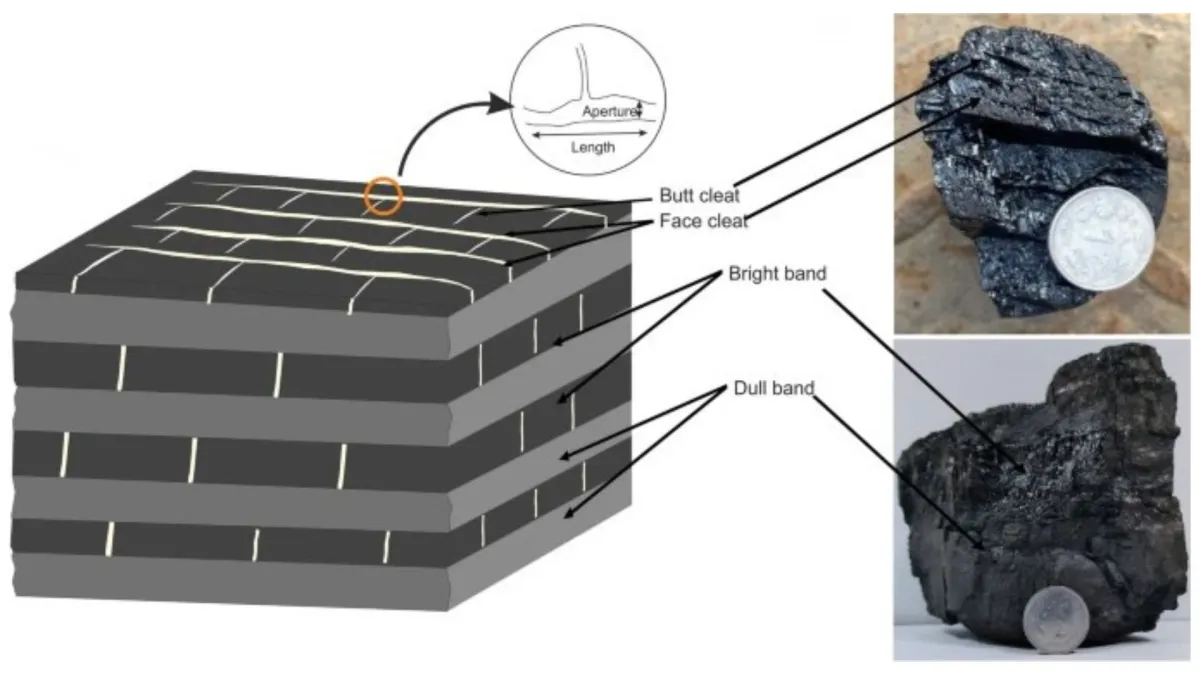
The challenge, however, has always been the "plumbing" of the earth. Coal is what geologists call a "dual porosity system." Gas is stored in the solid bulk of the coal but can only move through a complex, web-like network of natural fractures known as "cleats." To extract methane or to pump carbon dioxide (CO2) back into the ground for storage (a process known as Carbon Capture and Storage, or CCS), engineers must accurately predict how fast these fluids will move.

For decades, the industry standard has been the "cubic law," which posits that the amount of fluid flowing through a fracture is proportional to the cube (the power of three) of its width, or aperture. The IISER Bhopal study, however, reveals that in the stressed and tectonically active environment of Jharia, this law fails. Instead, the researchers discovered that the flow scales with a power exponent ranging from 4.38 to 5.08. This suggests that gas flow is far more sensitive to the width of these microscopic cracks than previously understood, a discovery that fundamentally changes how engineers will model the basin’s potential.
Chronology: From Field Sampling to Mathematical Breakthrough
The journey to this discovery began with extensive fieldwork across the Jharia basin. The research team sought to capture a representative "snapshot" of the coalfield’s diverse geological conditions.
- Site Selection and Sampling: Researchers collected coal samples from a variety of environments, ranging from deep underground mines to expansive open-cast pits. This variety was crucial, as it allowed the team to study coal subjected to different levels of lithostatic pressure (the weight of overlying rock) and tectonic stress.
- Microscopic Analysis: Once back in the laboratory, the samples underwent rigorous examination using advanced microscopy. The team focused on identifying "cleats"—the natural fractures that act as the highways for gas movement.
- The 1D Scanline Method: To quantify these fractures, the researchers employed the "1D scanline method." This involves measuring thousands of individual fractures along a linear path across the coal surface. They meticulously recorded the width (aperture) and the frequency of these cracks.
- Identifying the Scaling Relationship: As the data was analyzed, a pattern emerged. The researchers noticed a distinct correlation between the width of the fractures and their length, shaped by the region’s specific tectonic history.
- Mathematical Derivation: By integrating these regional observations into fluid dynamics equations, the team derived a new model. They realized that by accounting for the specific way Jharia’s coal had been "squeezed" over millions of years, they could create a formula that relied solely on fracture width—a measurable variable—to predict flow, effectively removing the need for fracture length measurements which are notoriously difficult to obtain.
Supporting Data: The Physics of "Power of Five"
The core of the IISER Bhopal research lies in the deviation from the classical cubic law. To understand the significance, one must look at the geometry of the fractures.
In a perfect, theoretical world, a fracture is like two parallel plates. In such a scenario, the cubic law holds true. However, Jharia is not a theoretical vacuum. The region has been subjected to intense tectonic activity, including the folding and faulting of the Earth’s crust during the formation of the Indian subcontinent.

The Geometry of Stress
The researchers found that in Jharia, the tectonic forces have created a "scaling relationship" where the width of a crack is intrinsically linked to its length. Because the fractures grow and deform in a specific way under pressure, the mathematical exponent for flow increases. The study’s data showed that:
- Primary Cleats: These larger, more continuous fractures showed a flow sensitivity near the power of 4.5.
- Secondary Cleats: Smaller, interconnected fractures showed sensitivity reaching the power of 5.08.
The Problem with Traditional Core Sampling
The study also addresses a major "sampling bias" in geology. When engineers drill into a coal seam, they extract a cylindrical "core." These cores are typically only a few inches in diameter. Because fractures can be many feet long, a core sample almost never captures the full length of a crack. This makes "length" an unreliable metric for field engineers.
By proving that flow can be predicted using only the "aperture" (width), which is easily visible and measurable even in a small core sample, the IISER Bhopal team has provided a tool that is both more accurate and significantly more practical for industrial application.
Official Responses and Expert Synthesis
While the research is primarily academic, its implications have resonated with geoscientists and energy policy experts. The consensus among the research community is that this model represents a shift toward "precision geology."

Lead researchers at IISER Bhopal have noted that the "one-size-fits-all" approach to geological modeling is no longer sufficient for India’s unique coal basins. They emphasize that the Jharia basin’s unique evolutionary history—its "tectonic fingerprint"—means that models developed for North American or European coal fields often lead to inefficiencies when applied in India.
Industry experts suggest that this research provides a scientific "roadmap" for the Ministry of Coal and private energy firms. By using this region-specific model, companies can better estimate the "recoverable reserves" of methane, potentially increasing the commercial viability of CBM projects that were previously deemed too high-risk or unpredictable.
Implications: Energy Security and the Path to Net-Zero
The broader implications of the "Power of Five" model extend far beyond the laboratory, touching on India’s national energy security and its international climate commitments.
1. Enhanced Fuel Extraction
India remains heavily dependent on energy imports. Maximizing the extraction of domestic natural gas like CBM is a strategic priority. The new model allows for more precise placement of extraction wells. By knowing exactly how gas will migrate through the cleat network, engineers can design "drainage" patterns that extract more gas in less time, reducing the cost of production and increasing the domestic supply of cleaner fuel.

2. Carbon Capture and Sequestration (CCS)
Perhaps the most critical application of this research is in the fight against climate change. To reach "Net-Zero" emissions by 2070, India must find ways to deal with the CO2 produced by its heavy industries.
Unmineable coal seams in the Jharia basin are ideal candidates for carbon storage. Coal has a natural affinity for CO2; it "sticks" to the coal surface more readily than methane. By injecting CO2 into these seams, the gas can be permanently sequestered. The IISER Bhopal model allows scientists to predict the "migration plume" of injected CO2. This ensures that the gas stays trapped in the deep earth and does not leak back into the atmosphere, turning old coal mines into permanent "vaults" for carbon waste.
3. Economic Revitalization of Mining Hubs
As the world moves away from burning coal, regions like Jharia face economic uncertainty. However, by transitioning from coal mining to CBM extraction and carbon storage, these regions can remain central to India’s energy economy. This research provides the technical foundation for a "Just Transition," where traditional mining expertise is repurposed for high-tech, green-energy applications.
4. A Global Template for Tectonically Active Basins
While the model is specific to Jharia, the methodology used by the IISER Bhopal team provides a template for other countries with complex geological histories. From the coal fields of China to the basins of Australia, the realization that tectonic stress changes the fundamental laws of fluid flow will prompt a re-evaluation of how the world manages its underground resources.
In conclusion, the tiny, microscopic cracks in Jharia’s coal are no longer just geological curiosities. They are the keys to a more efficient, predictable, and sustainable energy future. Through the "Power of Five," IISER Bhopal has bridged the gap between abstract mathematics and the urgent, real-world need for climate action.
