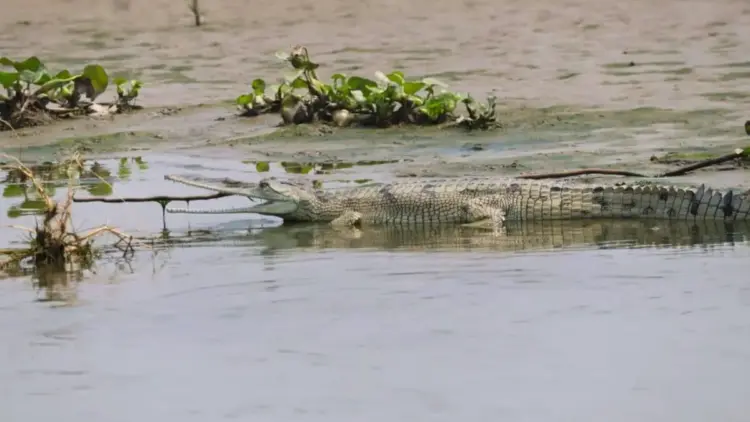
The Gangetic gharial (Gavialis gangeticus), with its distinctively long, thin snout and prehistoric appearance, is one of the world’s most specialized crocodilians. For millennia, these ancient reptiles have followed a strict biological clock dictated by the sun. As ectotherms, they rely on external heat to regulate their internal physiology, a process known as thermoregulation. However, a groundbreaking new study suggests that the "alarm clock" triggering their daily activities may not be the heat of the sun, but its light—a discovery that carries grave implications in an increasingly electrified world.
A recent research project conducted on captive gharials has revealed that light intensity is a more dominant cue than ambient temperature for morning basking movements. While this might seem like a minor behavioral nuance, scientists warn that the rise of light pollution across India’s river basins could disrupt this delicate evolutionary balance, leading gharials to leave the safety of the water at suboptimal times, potentially exposing them to lethal cold and increased predation.
Main Facts: The Primacy of Light over Heat
For most of biological history, light and heat have been inextricably linked. When the sun rises, light levels increase, followed shortly by a rise in temperature. Gharials have evolved to use these cues to transition from the water to sandbanks, where they bask to reach the body temperatures necessary for digestion, immune function, and growth.
The study, led by Megha Khanduri, a postdoctoral researcher at the University of Helsinki, challenges the long-held assumption that temperature is the primary driver for this behavior. By observing 382 captive gharials at the Deori EcoCentre in Madhya Pradesh, researchers found that the animals—particularly hatchlings and juveniles—responded to light intensity with remarkable sensitivity.
Key Findings:
- Light Sensitivity: Gharials initiated basking movements based on light levels even when the air temperature remained lower than the water temperature.
- Age Variance: Younger gharials (less than a year old) showed a much higher sensitivity to light than their older counterparts, often emerging from the water significantly earlier in the morning.
- The "Wrong-Time" Risk: Because light is the dominant cue, artificial light at night (ALAN) or premature morning light from human sources can "trick" gharials into basking when the air is still dangerously cold, leading to hypothermia.
- Predation Vulnerability: Hatchlings that leave the water too early due to light cues are more vulnerable to terrestrial predators during the twilight hours.
Chronology: From Nesting Grounds to Research Enclosures
The path to these findings began with a multi-year effort to bolster the gharial population, which remains critically depleted with a species recovery score of only 19%.

2021–2023: Egg Collection and Rearing
Between 2021 and 2023, eggs were collected from various nesting sites within the National Chambal Sanctuary, one of the last strongholds for the species. These eggs were transported to the Deori EcoCentre, where they were hatched and reared in a controlled environment. This provided researchers with a unique opportunity to study a large cohort of individuals across different age groups.
June 2023: The Observation Window
The core data for the basking study was collected over a ten-day period between June 20 and June 30, 2023. Researchers divided the 382 gharials into 12 distinct groups based on age to observe how developmental stages influenced behavioral responses to environmental cues.
2012–2022: Mapping the Glow
Parallel to the behavioral study, Khanduri and her team analyzed satellite data to track changes in artificial lighting across India’s major river basins. This decade-long retrospective revealed a startling trend: a three-fold increase in light radiance along the Chambal River and other critical gharial habitats, marking the transition of light pollution from a metropolitan nuisance to a significant ecological threat.
Supporting Data: Measuring the Rhythm of the River
To ensure the accuracy of their observations, the research team implemented a rigorous monitoring protocol at the Deori EcoCentre. The methodology focused on the relationship between three variables: light intensity, air/water temperature, and the physical movement of the gharials.
Observational Sessions
The researchers conducted three one-hour observation sessions every morning and evening. During these windows, they performed a "census" of the basking platforms, counting how many individuals had transitioned from the water to the land.

Thermal and Radiant Mapping
- Surface Temperatures: Digital thermometers were used to record the temperature of the air and the water surface within the enclosures.
- Body Temperatures: Using infrared thermometers, the team measured the body temperatures of up to 10 gharials per group. Specifically, they targeted the head region, as it is the first part of the animal to emerge and react to the sun.
- Light Intensity: Infrared thermometers also helped quantify the natural light intensity hitting the enclosures. To maintain the integrity of the "natural" cue experiment, all artificial lights at the center were switched off during the night.
The data showed a clear trend: the youngest gharials were "early risers" triggered by the faintest morning light. Even when the morning air was brisk and uninviting, the visual cue of dawn was enough to pull them onto the sandbanks. In a natural, dark environment, this serves as an efficient way to maximize basking time. However, in an environment with light pollution, this efficiency becomes a liability.
Official Responses: Scientific Debate and Methodological Critiques
While the study has been praised for highlighting a neglected aspect of gharial ecology, it has also faced scrutiny from veteran herpetologists regarding its methodology and the applicability of captive data to wild populations.
The Question of Thermal Measurement
Jailabdeen A, the Project Director of the Gharial Ecology Project at the Madras Crocodile Bank Trust, raised concerns regarding how body temperature was recorded. "Measuring temperature at the head region may not provide an accurate estimate of core body temperature," Jailabdeen noted. He explained that because the head is smaller and often more exposed, it heats up much faster than the torso. Consequently, the data might overrepresent how "warm" the gharials actually were when they began basking.
Seasonal Timing
Another point of contention is the timing of the study. Jailabdeen pointed out that June is the height of summer in India. During this time, water temperatures remain high, and the biological necessity for intensive basking is reduced. "Winter is the ideal time to observe basking behaviors," he argued, suggesting that a 10-day window in June is too short to capture the full spectrum of the gharial’s seasonal thermoregulatory needs.
Captivity vs. The Wild
Khanduri herself acknowledged that captive behavior might not perfectly mirror the wild. In enclosures, social densities are higher, and competition for prime basking spots might force some individuals to move earlier than they otherwise would. However, she maintains that the underlying sensitivity to light remains a fundamental biological trait that conservationists must account for.

Implications: Conservation in the "Age of Radiance"
The discovery that light is a primary behavioral driver for gharials adds a new layer of complexity to the conservation of a species already on the brink of extinction. The implications stretch from the management of captive breeding centers to the legislative protection of riverine corridors.
1. Management of Captive Facilities
Captive rearing is a cornerstone of gharial conservation, intended to bypass the high mortality rates of hatchlings in the wild. Khanduri emphasizes that these facilities must now manage "photoperiods" as strictly as they manage water temperature. Enclosures equipped with heaters must also ensure that light sources do not inadvertently trigger basking movements when heaters are off, or vice versa.
2. Light Pollution as a Habitat Threat
The study’s finding of a three-fold increase in light radiance in the Chambal region is particularly alarming. While much of the National Chambal Sanctuary remains relatively dark, the encroachment of infrastructure—bridges, riverside roads, and township expansion—is creating "light bridges" that fragment the dark sky.
- Hastinapur Case Study: In the Hastinapur Wildlife Sanctuary along the Ganga, the area under a truly dark night sky plummeted from 92% to 67% in just six years (2015–2021). This rapid urbanization of the riverbank suggests that the gharial’s preferred "dark habitats" are vanishing.
3. The Hierarchy of Threats
Despite the emerging concern of light pollution, experts like Jailabdeen urge that it should not distract from more immediate, "lethal" threats.
- Sand Mining: Illegal sand mining destroys the very sandbanks gharials need for basking and nesting.
- Water Management: Dams and barrages alter the flow of rivers, often leaving gharials stranded in suboptimal pools or destroying the deep-water channels they require for survival.
- River Interlinking: These massive engineering projects threaten to permanently alter the ecology of the river systems that have supported gharials for millions of years.
Future Outlook
The study concludes that further research into the "nocturnal ecology" of gharials is essential. Much like sea turtles, whose hatchlings are famously disoriented by beachfront lighting, gharials may be suffering from a "silent disruption" of their internal clocks.

To ensure the survival of the species, conservation efforts must move beyond simply protecting the water and the land; they must also protect the sky. Ensuring that riverine sanctuaries remain "dark corridors" may be just as vital as stopping the nets of poachers or the shovels of sand miners. As Megha Khanduri’s research suggests, for the Gangetic gharial, the light of dawn is a life-giving signal—but only if it comes at the right time.