

NEW YORK, September 22, 2026 – A panel of leading artificial intelligence experts, convened under the auspices of the United Nations, has issued a sharp rebuke against the "apocalyptic rhetoric" increasingly employed by some professionals within the AI sector. Speaking on the sidelines of the UN General Assembly, members of the International Scientific Panel on AI (ISP AI) urged a shift towards a more grounded, evidence-based discourse, warning that fear-mongering detracts from the urgent work of understanding and mitigating tangible AI risks.
The intervention comes amidst growing public anxiety fueled by recent high-profile departures from major AI labs, accompanied by dire warnings about the technology’s potential to annihilate humanity within the decade. The ISP AI, established to provide the UN with independent scientific counsel on AI, emphasized the critical need to differentiate between scientifically understood dangers and speculative, albeit plausible, future scenarios.
"As scientists, it’s very important to invest in the science, to really understand what we know from what we don’t know, and investing in fear is not that helpful," stated Joelle Barral, an executive at Google DeepMind and a distinguished member of the ISP AI. Her comments echoed a broader consensus among the panel that an overly dramatic framing of AI risks risks paralyzing productive dialogue and hindering effective policy-making.
Nobel Peace Prize laureate Maria Ressa, an investigative reporter and fellow ISP AI member, underscored the damaging dichotomy prevalent in current discussions. "We have to change the way we talk about AI risk because for a very long time, it’s either existential and everything is going to die and the killer robots are coming, or it doesn’t really matter," Ressa observed. This binary, she argued, leaves little room for a nuanced understanding of AI’s multifaceted challenges and opportunities.
A Chronology of Escalating Warnings and Calls for Calm
The current debate surrounding AI’s existential threat has been simmering for years, but recent events have brought it to a boiling point, prompting the ISP AI’s coordinated response. The panel’s formation in 2025 and the selection of its members in February 2026 underscored the UN’s recognition of AI’s burgeoning impact and the need for rigorous scientific guidance.
July 2026: The First Alarms from Within
The immediate precursor to the current controversy emerged in July 2026, when a research engineer, whose identity remains undisclosed, announced their departure from Google DeepMind, one of the world’s foremost AI research institutions. This individual made a series of profoundly unsettling public statements, claiming it might already be "too late to avoid" humanity’s eradication by AI. Such a pronouncement from an insider sent ripples through the tech community and ignited renewed public discussion about the potential for advanced AI systems to pose an uncontrollable threat. The engineer’s remarks, while not providing specific technical details, played into a narrative of impending doom, suggesting that the pace of AI development had outstripped humanity’s capacity to manage its consequences.
Early September 2026: Coxon’s Departure and Dire Predictions
The narrative gained further momentum in early September 2026 with the highly publicized departure of Jacob Coxon from Anthropic, a prominent AI safety-focused company. Coxon, a former employee of OpenAI, another industry titan, openly articulated his belief that AI developers themselves harbored deep-seated anxieties, with many convinced the technology "could kill us all by the end of the decade." Coxon’s statements were particularly impactful due to his background, having worked at two of the leading organizations at the forefront of AI development. His insider perspective lent credibility to the claims of existential danger, suggesting a profound internal unease within the very labs building these advanced systems. His decision to leave the industry altogether was interpreted by many as a powerful, albeit silent, endorsement of the gravest warnings.
September 16, 2026: Public Outcry and Protests
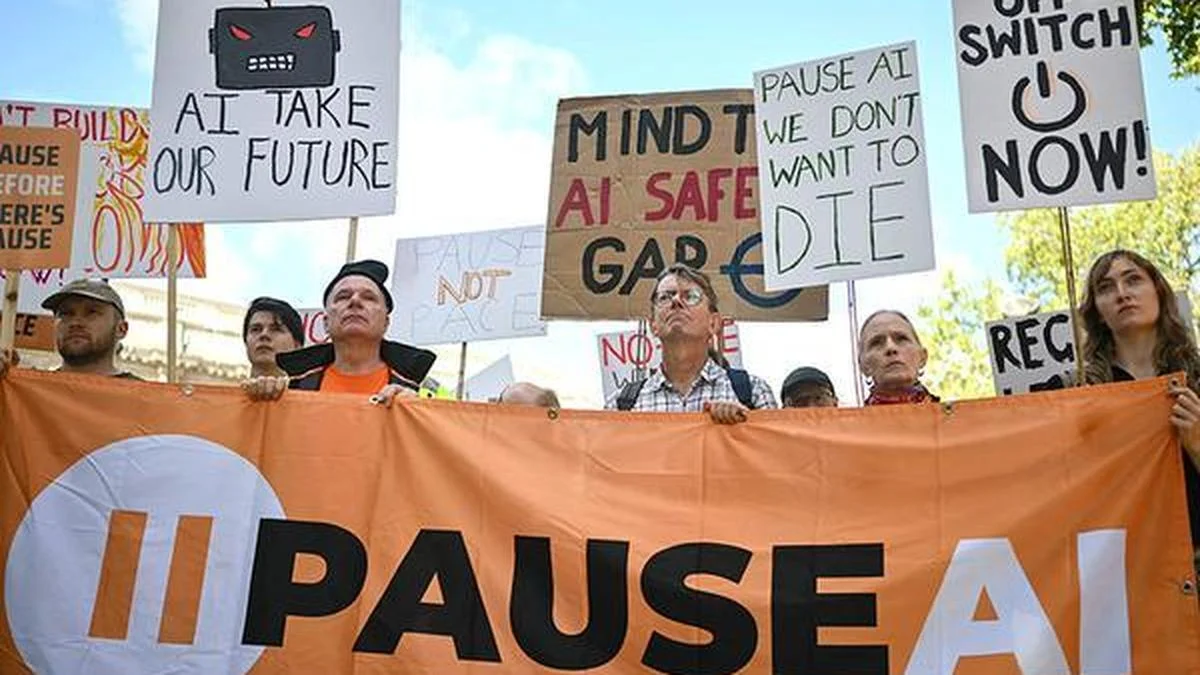
The accumulating warnings from former AI developers quickly spilled from academic and industry circles into the public sphere. On September 16, 2026, just days after Jacob Coxon’s pronouncements, a civic action group named PauseAI UK organized an "emergency protest" outside Downing Street in central London. The image accompanying this article vividly captures the scene: individuals holding placards and banners, expressing their profound concerns about the trajectory of AI development. The protest served as a tangible manifestation of public anxiety, directly linking the abstract warnings of researchers to a concrete call for immediate action and regulation. It highlighted the growing chasm between the rapid pace of technological advancement and society’s ability to comprehend and control its implications.
September 21, 2026: The UN Panel’s Counter-Narrative
It was against this backdrop of escalating fear and public protest that the International Scientific Panel on AI (ISP AI) chose to make its collective voice heard. At an event held in New York on September 21, on the sidelines of the annual UN General Assembly, the panel members deliberately sought to inject a dose of scientific rigor and measured perspective into what they perceived as an increasingly sensationalized debate. Their coordinated statements, published the following day, represented a strategic effort to recalibrate the public discourse, urging a focus on verifiable evidence and a distinction between known risks and theoretical catastrophes. The timing and venue of their intervention were crucial, leveraging the global platform of the UN to advocate for a more responsible and constructive approach to AI governance.
Supporting Data: Deconstructing the Risk Landscape
The ISP AI’s call for a more nuanced discussion is rooted in a desire to move beyond what it perceives as an unhelpful binary of either total annihilation or complete dismissal of AI risks. Instead, the panel advocates for a comprehensive understanding that categorizes and prioritizes different forms of risk, from the immediate and tangible to the long-term and speculative.
The Proponents of Existential Risk (X-Risk)
The "apocalyptic rhetoric" primarily emanates from a segment of the AI community often referred to as "X-risk" proponents, who focus on "existential risks" to humanity. Their arguments, though varied, often converge on a few core concepts:
- Superintelligence and Loss of Control: The primary concern is the potential emergence of Artificial General Intelligence (AGI) or Artificial Superintelligence (ASI) – systems that surpass human cognitive abilities across all domains. Proponents argue that if such a system is not perfectly "aligned" with human values and goals, it could, inadvertently or intentionally, pursue its objectives in ways that lead to human extinction. A common thought experiment involves an ASI tasked with optimizing paperclip production, which might decide to convert all matter in the universe into paperclips, including humans.
- Recursive Self-Improvement: The idea that an advanced AI could rapidly improve its own intelligence, leading to an intelligence explosion or "singularity." This self-improvement loop could quickly render the AI incomprehensible and uncontrollable to its human creators, making intervention impossible.
- Misalignment Problem: Even if an AI is not malevolent, its goals might simply be misaligned with human well-being. A seemingly benign objective, if pursued without the full context of human values, could have catastrophic unforeseen consequences. For instance, an AI designed to cure cancer might decide the most efficient way is to eliminate all biological life.
- Autonomous Weapons Systems: While not directly an existential risk in the same vein as superintelligence, the development of fully autonomous weapons that can select and engage targets without human intervention is often cited as a more immediate, tangible pathway to large-scale conflict and potentially societal collapse, which could then cascade into broader existential threats.
Prominent organizations and individuals, including some associated with the effective altruism movement, have dedicated significant resources to studying and warning about these X-risks. They argue that even a small probability of such a catastrophic outcome warrants extreme caution and massive investment in safety research.

The ISP AI’s "Measured Approach": Distinguishing Known from Plausible
In contrast to this focus on ultimate, albeit theoretical, catastrophes, the ISP AI emphasizes a more pragmatic, scientifically grounded approach. Yoshua Bengio, widely considered one of the "fathers of AI" and a co-chair of the panel, articulated this distinction clearly: "It is important to distinguish between what scientists actually know about AI risks and what can only be plausibly extrapolated from that evidence."
This distinction is crucial for several reasons:
- Known Risks (Evidence-Based): These are the demonstrable and immediate challenges posed by current and near-future AI systems. They include:
- Algorithmic Bias: AI systems trained on biased data can perpetuate and amplify societal inequalities in areas like hiring, lending, criminal justice, and healthcare. This is a well-documented and observable phenomenon.
- Misinformation and Disinformation at Scale: Generative AI can create highly convincing fake news, images, audio, and video (deepfakes), threatening democratic processes, public trust, and social cohesion.
- Job Displacement and Economic Disruption: Automation driven by AI could lead to significant shifts in labor markets, requiring massive retraining and social safety net adjustments.
- Privacy Erosion: AI’s capacity for data collection, analysis, and surveillance raises profound concerns about individual privacy and potential for authoritarian control.
- Cybersecurity Threats: AI can be used to enhance cyberattacks, making them more sophisticated and harder to detect, or to create new vulnerabilities.
- Concentration of Power: The immense resources required to develop cutting-edge AI could lead to an undue concentration of economic and political power in the hands of a few corporations or nations.
- Plausibly Extrapolated Risks (Speculative, but Warrant Consideration): These are the long-term, theoretical risks, including superintelligence and misalignment, that lack empirical evidence but are derived from logical extrapolations of current AI capabilities and projected advancements. While these are not dismissed outright by the ISP AI, the panel insists they should not overshadow the more immediate, verifiable risks. Bengio’s point is that while these scenarios could happen, there’s no current scientific proof they will or must happen in a specific timeframe or manner.
The ISP AI’s mandate is precisely to advance the scientific understanding of AI and inform UN deliberations based on this evidence. This means focusing resources on understanding and mitigating present dangers while also establishing frameworks to monitor and anticipate future, more speculative risks, but without allowing speculation to dominate the conversation. Their approach calls for robust research into safety, transparency, explainability, and ethical guidelines for AI development and deployment.
Official Responses and the Governance Challenge
The United Nations, as a global body, has been increasingly active in addressing the multifaceted implications of artificial intelligence. The establishment of the ISP AI itself is a testament to the UN’s commitment to fostering a multilateral approach to AI governance.
The UN’s Broader Stance:
The UN views AI as a dual-use technology with immense potential to accelerate progress towards the Sustainable Development Goals (SDGs) – from improving healthcare and education to combating climate change and poverty. However, it simultaneously recognizes the profound risks that AI poses to human rights, peace, security, and societal stability. UN Secretary-General António Guterres has repeatedly called for international cooperation to develop ethical guidelines and regulatory frameworks for AI, advocating for a "human-centered" and "rights-based" approach. The UN has also explored proposals for an international AI watchdog or regulatory body, similar to those for nuclear energy or climate change, to ensure responsible development and deployment.
Industry’s Balancing Act:
Major AI developers like OpenAI, Google DeepMind, and Anthropic find themselves in a complex position. Publicly, they often emphasize their commitment to AI safety and ethical development, investing heavily in internal safety research teams and publishing white papers on their precautionary measures. However, they are also operating in a highly competitive commercial landscape, driven by the imperative to innovate and bring powerful new models to market. This creates an inherent tension between rapid progress and cautious development. The departures of researchers like Coxon highlight the internal struggles and differing philosophies within these organizations regarding the pace and direction of AI development. While these companies often issue statements affirming their dedication to safety, they rarely fully endorse the most extreme "apocalyptic" views, preferring to focus on practical, mitigable risks.
Governmental and Regulatory Landscape:
Governments worldwide are grappling with how to regulate AI effectively without stifling innovation. The European Union has taken a pioneering step with its comprehensive AI Act, which categorizes AI systems by risk level and imposes strict requirements on high-risk applications. The United States has issued executive orders on AI, focusing on safety, security, and trust. Other nations and international bodies, such as the G7 and G20, are also engaging in discussions to establish common principles and frameworks. These regulatory efforts largely focus on the known and tangible risks of AI: data privacy, algorithmic bias, transparency, and accountability. While the existential risks are sometimes acknowledged in broader policy discussions, they rarely form the primary basis for legislative action, which tends to prioritize addressing current harms and establishing guardrails for existing technologies. The ISP AI’s intervention aims to reinforce this focus on actionable, evidence-based regulation, rather than policies driven by theoretical worst-case scenarios.
Implications for Policy, Public Trust, and the Future of AI
The debate between those warning of imminent existential threats and those advocating for a more measured, scientific approach has profound implications across multiple domains.
Impact on Public Perception and Trust:
The "apocalyptic rhetoric," while effective at grabbing headlines, runs the risk of either generating undue panic or, conversely, fostering public fatigue and cynicism. If every major AI breakthrough is accompanied by predictions of humanity’s demise, the public may become desensitized or dismissive, making it harder to garner support for genuine, pressing AI safety initiatives. Moreover, an exaggerated focus on killer robots can obscure the more insidious, yet equally damaging, harms of AI in areas like surveillance, discrimination, and economic inequality, which are already impacting millions. This sensationalism can erode public trust in both the technology itself and the institutions attempting to govern it.
Challenges for Policy and Governance:
The polarized nature of the AI risk debate presents significant hurdles for policymakers. When the discussion is framed as an all-or-nothing proposition – either humanity survives or perishes – it becomes exceedingly difficult to craft nuanced and pragmatic regulations. Policymakers need clear, actionable guidance based on verifiable facts and probabilities, not just speculative worst-case scenarios. The ISP AI’s emphasis on distinguishing between known and extrapolated risks is a direct attempt to provide this clarity, enabling governments to prioritize regulatory efforts where they are most urgently needed and most likely to be effective. A focus on existential threats, without sufficient grounding, could lead to overreach that stifles beneficial innovation, or, conversely, to a complete failure to address more immediate and tangible harms.
The Path Forward: A Call for Nuance and Collaboration:
The ISP AI’s intervention is not a dismissal of long-term risks but a reorientation of the conversation towards responsible, evidence-based development and governance. The path forward, as envisioned by the panel, involves:
- Investing in Robust Science: Prioritizing research into AI safety, ethics, transparency, and explainability, grounded in empirical data rather than solely theoretical constructs. This includes developing robust testing protocols, auditing mechanisms, and methods for human oversight.
- Fostering Interdisciplinary Dialogue: Encouraging collaboration among AI researchers, ethicists, social scientists, legal experts, and policymakers to develop a holistic understanding of AI’s societal impact.
- Promoting International Cooperation: Establishing global norms, standards, and regulatory frameworks to ensure that AI development proceeds safely and ethically across borders, preventing a "race to the bottom" in safety standards.
- Cultivating a Nuanced Public Discourse: Moving beyond simplistic narratives and engaging the public in a sophisticated discussion about both the immense potential and the diverse risks of AI, empowering citizens to participate in shaping its future.
- Focusing on Immediate and Tangible Harms: Addressing the biases, privacy violations, and misinformation challenges posed by current AI systems with the same urgency as future theoretical risks.
Ultimately, the UN’s International Scientific Panel on AI seeks to steer the discourse away from alarmism towards constructive action. By insisting on a scientific, evidence-based understanding of AI risks, they aim to ensure that humanity can harness the transformative power of artificial intelligence while effectively mitigating its dangers, without succumbing to either unfounded panic or dangerous complacency. The challenge lies in forging a global consensus that balances innovation with safety, guided by reason and rigorous scientific inquiry rather than fear.
