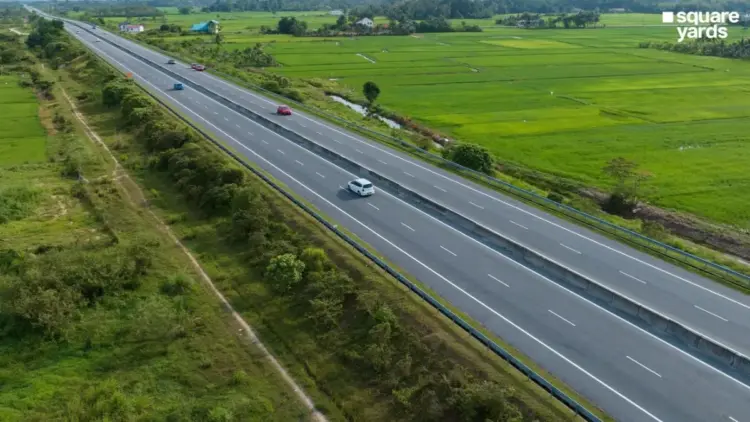
LUCKNOW – In a move aimed at solidifying its status as India’s "Expressway State," the Uttar Pradesh Cabinet, chaired by Chief Minister Yogi Adityanath, has officially sanctioned the development of four major link expressway projects. Spanning a cumulative distance of approximately 322 kilometers, these projects represent a massive capital investment of ₹17,542.06 crore.
The initiative, spearheaded by the Uttar Pradesh Expressways Industrial Development Authority (UPEIDA), is designed to bridge the gaps between existing high-speed corridors, integrate the upcoming Noida International Airport at Jewar into the state’s primary road network, and stimulate economic growth in the historically underserved Bundelkhand and central regions. With a completion target set for the next three years, the projects are poised to redefine the logistics and real estate landscape of northern India.
1. Main Facts: A Strategic Expansion of the Expressway Network
The Cabinet’s approval marks a strategic shift from building standalone "mega-expressways" to creating a sophisticated, interconnected web of roads. The four approved links are:
- The Farrukhabad Link Expressway: Connecting the Agra-Lucknow Expressway with the under-construction Ganga Expressway.
- The Agra-Lucknow to Purvanchal Link: A 50.94-km stretch designed to create a seamless transit point between the state’s western and eastern backbones.
- The Jhansi Link Expressway: A 106-km corridor aimed at deepening connectivity within the Bundelkhand region.
- The Jewar Link Expressway: A 74-km artery connecting the Noida International Airport (NIA) with Bulandshahr and the wider expressway grid.
The projects will be executed under the Engineering, Procurement, and Construction (EPC) model. This model shifts the burden of design and construction risks to the private contractor while ensuring the government maintains oversight on quality and timelines. By utilizing the EPC framework, the state aims to bypass the delays often associated with traditional tendering, ensuring that these "missing links" are operational by late 2027 or early 2028.
2. Chronology: From Isolated Corridors to a Unified Grid
To understand the significance of these four links, one must look at the timeline of Uttar Pradesh’s infrastructure evolution over the last decade.
- 2012–2017: The completion of the Yamuna Expressway and the Agra-Lucknow Expressway established the first high-speed links between Delhi and central UP.
- 2018–2021: The inauguration of the Purvanchal Expressway (341 km) opened up the eastern districts, followed closely by the Bundelkhand Expressway (296 km) in 2022.
- 2023–Present: Construction began on the ambitious Ganga Expressway (594 km), intended to connect Meerut in the west to Prayagraj in the east.
While these massive projects successfully reduced travel times between major cities, the regions between the expressways remained relatively isolated. The Cabinet’s latest decision serves as the "Phase 2" of this master plan. By linking the Agra-Lucknow Expressway to the Ganga Expressway and the Purvanchal Expressway, the state is effectively creating a "grid" rather than a series of parallel lines. This allows freight and passenger traffic to switch between corridors without exiting onto congested local state highways.
3. Supporting Data: Real Estate and Economic Indicators
The infrastructure push is already reflecting in the real estate data provided by Square Yards (September 2026). The announcement of these links has acted as a catalyst for property valuation across various hubs.
The Jewar and Yamuna Expressway Surge
The Jewar Link Expressway is perhaps the most anticipated project due to its proximity to the Noida International Airport.
- Jewar Local Market: Average villa prices in Jewar are currently pegged at ₹2,200 per square foot (psf).
- Yamuna Expressway Corridor: The wider market has seen a significant uptick. The average asking price stands at ₹9,850 psf as of September 2026, a notable increase from ₹9,250 psf in December 2025.
- Locality Variance: Within the Yamuna Expressway region, micro-markets show distinct trends. Sector 22D commands a higher premium at ₹8,950 psf, while Sector 23D follows at ₹8,050 psf.
The East-West Connectivity Premium
The 50.94-km link between the Agra-Lucknow and Purvanchal expressways is expected to impact the urban markets of its anchor cities:
- Lucknow: The state capital remains a high-value hub with average apartment prices at ₹7,550 psf.
- Agra: The tourism-heavy city of Agra maintains a more accessible entry point for investors, with average apartment prices at ₹3,600 psf.
Industry analysts suggest that as the link reduces the transit time between these two major cities and the eastern borders of the state, Lucknow’s peripheral regions could see a "satellite town" effect, driving up land prices in areas previously considered too remote for residential development.
4. Official Responses and Implementation Strategy
The Uttar Pradesh Expressways Industrial Development Authority (UPEIDA) has been designated as the nodal agency for all four projects. Officials from UPEIDA have emphasized that these links are not merely for transport but are intended to be "Economic Corridors."
UPEIDA Spokesperson Statement:
"Our objective is to ensure that no major district in Uttar Pradesh is more than an hour away from an expressway. These four links are strategically designed to connect industrial clusters, agricultural mandis (markets), and the upcoming global aviation hub at Jewar. The EPC model will allow us to partner with top-tier construction firms to ensure these projects are world-class in terms of safety and durability."
The state government has also highlighted that the Farrukhabad Link will be a game-changer for the "One District One Product" (ODOP) initiative. By providing the potato-growing belt of Farrukhabad and Kannauj with direct access to the Ganga and Agra-Lucknow Expressways, the government expects a significant reduction in post-harvest losses and a boost in exports.
Furthermore, the Jhansi Link Expressway is being touted as a vital artery for the UP Defense Industrial Corridor. By improving connectivity between Jhansi and Jalaun, the state hopes to attract more private defense manufacturers who require robust logistics for moving heavy machinery and finished components.
5. Regional Implications: A Deep Dive
I. The Jewar Link: The Global Gateway
The 74-km Jewar Link Expressway will serve as the primary umbilical cord between the Noida International Airport and the rest of the state. It will facilitate the movement of cargo from the industrial heartlands of Bulandshahr and western UP directly to the airport’s integrated cargo terminal. For the real estate sector, this link transforms Jewar from a rural outpost into a legitimate extension of the National Capital Region (NCR).
II. The Farrukhabad Link: Bridging Central UP
This corridor will pass through Etawah, Kannauj, Mainpuri, Farrukhabad, and Hardoi before culminating in Shahjahanpur. This region is the agricultural backbone of the state. The link will allow farmers and local manufacturers to choose between the Agra-Lucknow Expressway (for Delhi/Lucknow bound traffic) and the Ganga Expressway (for Meerut/Prayagraj bound traffic), effectively doubling their market reach.
III. The Jhansi Link: Revitalizing Bundelkhand
Bundelkhand has long struggled with logistical isolation. The 106-km Jhansi Link, divided into two construction packages, will integrate the region into the national mainstream. This is expected to spur interest in low-cost housing and industrial warehousing, as land prices in Bundelkhand remain competitive compared to the NCR or the Lucknow-Kanpur zone.
IV. The Agra-Lucknow to Purvanchal Connection
By bridging these two massive expressways, the state is creating a high-speed bypass that avoids the congestion of inner Lucknow. This is critical for long-haul freight moving from Bihar and Eastern UP toward Delhi and Rajasthan.
6. Challenges and the Road Ahead
While the Cabinet approval is a landmark step, several challenges remain.
- Land Acquisition: Although UPEIDA has a successful track record of land pooling, acquiring 322 km of right-of-way through fertile agricultural land in districts like Kannauj and Farrukhabad will require delicate negotiation and timely compensation.
- Environmental Impact: The projects will necessitate the clearing of certain green belts and the management of water bodies along the routes.
- Timeline Pressure: A three-year completion target is ambitious for 322 km of expressway. It will require simultaneous work across multiple packages and seamless coordination between state and central environmental agencies.
Conclusion: The Trillion-Dollar Vision
These four link expressways are more than just roads; they are the physical manifestation of Uttar Pradesh’s ambition to become a $1 trillion economy. By investing over ₹17,000 crore in connectivity, the state is betting on a "multiplier effect"—where improved infrastructure leads to industrialization, which in turn drives urban demand and real estate appreciation.
As the first shovels hit the ground, the eyes of investors, developers, and residents will be on the "Expressway Grid." If successful, this project will not only reduce travel times but will also bridge the economic divide between the prosperous west and the developing east and south of India’s most populous state.
Source Credits: Data regarding property pricing and market trends provided by Square Yards (September 2026). Official project details sourced from the Uttar Pradesh Cabinet Briefing and UPEIDA project reports.