

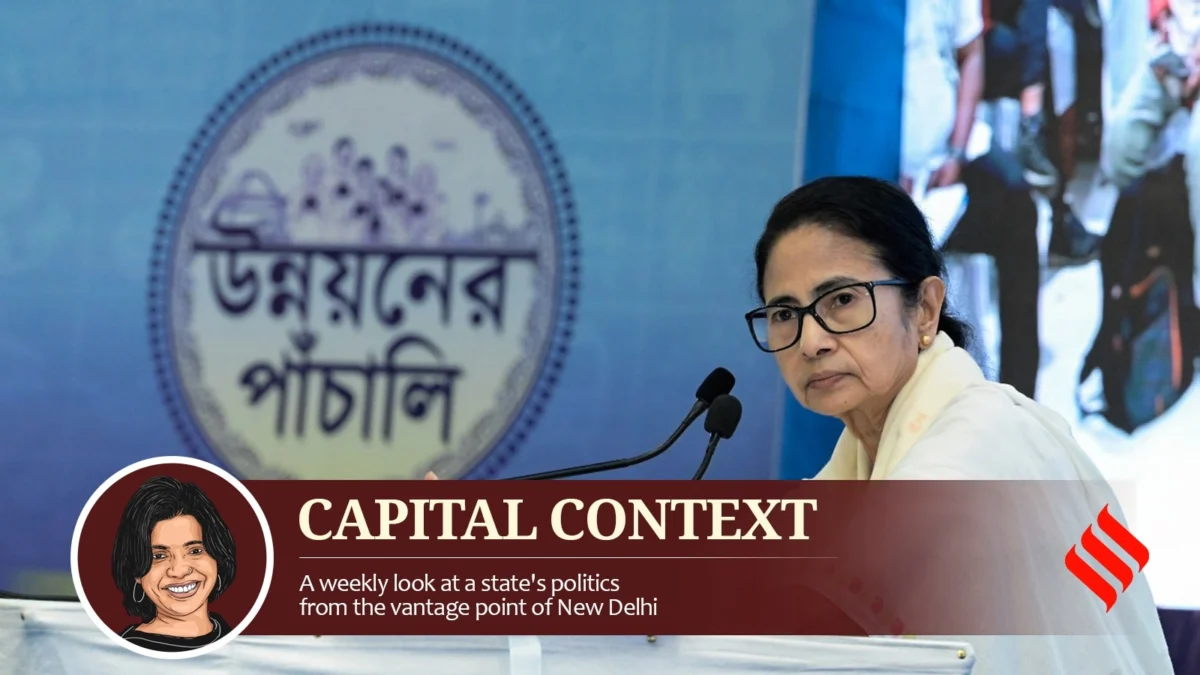
Kolkata/Delhi – The political landscape of West Bengal is experiencing a seismic shift as the Trinamool Congress (TMC), once a formidable regional powerhouse, grapples with an unprecedented internal crisis. Its rapid fragmentation, marked by significant defections of both legislative and parliamentary members, presents the Bharatiya Janata Party (BJP) with a complex strategic dilemma: immediate parliamentary advantage versus long-term ideological and electoral liabilities. While the ruling BJP stands to gain a crucial edge in pushing its legislative agenda in Parliament, a palpable sense of unease pervades sections of its leadership regarding the "bad optics" and potential strategic pitfalls of facilitating the TMC’s collapse.
The unfolding drama highlights the ruthless pragmatism of Indian politics, where short-term gains often clash with foundational principles. As the TMC, led by its embattled supremo Mamata Banerjee, struggles to contain the rebellion within its ranks, the BJP finds itself navigating a tightrope walk, weighing the tactical benefits of a weakened opposition against the risk of diluting its own political identity and alienating its core electorate.
The Unfolding Crisis: A Party in Disarray
The Trinamool Congress, which swept to power in West Bengal on a wave of anti-Left sentiment and charismatic leadership, now faces an existential threat from within. What began as murmurs of discontent has escalated into a full-blown revolt, challenging Mamata Banerjee’s iron grip on the party and, crucially, her chosen successor, nephew Abhishek Banerjee. This internal strife has provided an unexpected opening for the BJP, which has been steadily consolidating its position in the state, albeit without achieving a majority in the recent assembly elections.
The immediate and most tangible advantage for the BJP lies in the national Parliament. With the TMC currently holding a significant bloc as the third-largest opposition party, its fragmentation would critically weaken the opposition benches. This erosion of opposition strength could significantly bolster the ruling party’s ability to navigate parliamentary hurdles, easing the passage of key legislative bills and potentially reducing the intensity of debates and scrutiny. In a political climate often marked by legislative logjams, a diminished opposition provides a clearer path for the government’s agenda.
However, beneath this veneer of strategic triumph, a current of apprehension runs through certain echelons of the BJP. The manner of the TMC’s rapid disintegration, perceived by many as actively engineered by the BJP, has triggered concerns about its long-term ramifications. The party, known for its disciplined cadre and ideological moorings, finds itself at a crossroads, questioning whether opportunistic gains outweigh the potential erosion of its carefully cultivated image.
A Timeline of Disintegration: From State Assembly to Parliament
The current crisis within the TMC did not erupt overnight but has been brewing for months, fueled by internal power struggles, allegations of corruption, and growing dissent against the party’s top leadership. The rebellion has manifested in two distinct but interconnected fronts: the state legislature in Kolkata and the national Parliament in Delhi.
May 30, 2024: The First Cracks in Kolkata
The initial public sign of widespread dissent emerged from the state Assembly. A group of 58 out of the TMC’s 80 MLAs openly challenged the party’s central leadership. This faction, rallying behind Ritabrata Banerjee, whom the organisational leadership had previously expelled, declared him as their preferred Leader of the Opposition (LoP) in the state Assembly. This move was a direct defiance of Mamata Banerjee’s choice of veteran loyalist Sovandeb Chattopadhyay for the role. Ritabrata Banerjee’s challenge was a powerful symbolic blow, indicating a deep schism within the legislative wing. He subsequently claimed the support of at least 64 MLAs and confidently declared readiness for a floor test in the coming week, a move that, if realized, could plunge the state government into unprecedented instability. The notion that the "state government has chosen the Opposition" underscores the unprecedented nature of this internal revolt, signaling a complete breakdown of party discipline and central authority.
June 4, 2024: BJP Voices First Concerns
As the MLA rebellion gained momentum, prominent BJP leaders in West Bengal began to articulate their reservations about indiscriminately embracing TMC defectors. Newly appointed Finance Minister Swapan Dasgupta, a respected intellectual voice within the party, took to X (formerly Twitter) to express his concerns. "I shed no tears for the TMC’s self-destruction," Dasgupta posted, "My only hope is that the political culture of the vandals doesn’t start contaminating the W Bengal BJP. We in the BJP have to be always wary of false friends who are today cosying up to us because they need to wash away their past sins. The detox of Bengal cannot be left incomplete." His statement reflected a significant segment of BJP leaders who prioritize ideological purity and the party’s unique cultural identity over short-term electoral gains.
June 8, 2024: The Delhi Front Opens
The rebellion escalated dramatically when several TMC rebel MPs converged in Delhi. A critical meeting took place at the residence of Union Minister and BJP’s West Bengal poll in-charge Bhupender Yadav. Adding further weight to the optics, West Bengal Chief Minister Suvendu Adhikari, a former TMC stalwart himself, made a point of dropping in to meet the rebel parliamentarians. He later met some of them again at the home of TMC MP Satabdi Roy, signaling active engagement from the BJP’s state leadership in the unfolding defection saga.
TMC MP Kakoli Ghosh Dastidar, a prominent figure among the rebels, confirmed to The Indian Express that the faction, claiming a strength of 20 MPs, had "decided to be with the NDA, giving it full support." She added a caveat, "Later, we (rebel MPs) will sit together and decide what kind of support it should be," leaving open the possibility of formal merger or continued external support. Sources within the BJP indicated that more TMC MPs were expected to "jump ship," attributing this to Mamata Banerjee’s "precarious" position, particularly regarding the growing demand from even her loyalists to sideline her nephew and heir apparent, Abhishek Banerjee. This factor emerged as a significant catalyst for the defections, highlighting the deep-seated resentment against the perceived dynastic succession.
June 9, 2024: BJP State President Draws a Line
Following the high-profile meetings in Delhi, BJP state president Samik Bhattacharya publicly reinforced the concerns about "Trinamool-isation." He emphatically stated that his party’s doors were closed to leaders and cadre of the Mamata-led party. "Trinamool-isation of the BJP will never happen. Our doors are closed to the TMC. We reached the number 208 without importing anyone. People voted against TMC leaders. Our strategy this time started from the grassroots. How can we include those who are tainted?" Bhattacharya’s remarks underscored the internal conflict within the BJP, with the state unit advocating for a purist approach, wary of diluting the party’s appeal to voters who had explicitly rejected the TMC’s alleged corruption and high-handedness.
BJP’s Calculated Gains and Lingering Doubts
The BJP’s strategic playbook often involves weakening opposition parties through defections, a tactic that has yielded success in various states. In the immediate term, the fragmentation of the TMC, particularly in Parliament, offers tangible benefits:
H3: Parliamentary Leverage
The prospect of 20 or more TMC MPs aligning with the NDA, even as external supporters, significantly alters the arithmetic in Parliament. This additional support can prove crucial in passing contentious legislation, especially in the Rajya Sabha where the BJP-led NDA often faces a tougher challenge. It also weakens the collective strength of the INDIA alliance, further isolating Mamata Banerjee on the national stage. A fragmented opposition, lacking a unified voice or substantial numbers, becomes less effective in scrutinizing government policies or stalling legislative processes.
H3: Weakening Regional Rivals
From a broader strategic perspective, the collapse of a strong regional party like the TMC in a crucial state like West Bengal is seen as a significant win for the BJP’s national expansion ambitions. It creates a power vacuum that the BJP hopes to fill, further solidifying its presence in the eastern part of India where it has historically faced challenges.
However, these gains come with significant caveats, fueling the "unease" among BJP leaders.
H3: The Optics Dilemma and Voter Perception
The most immediate concern is the "bad optics" of the BJP’s overt role in engineering the split. The visual of Union Ministers and BJP Chief Ministers openly meeting rebel MPs from an opposition party creates a perception of political opportunism. For a party that campaigned aggressively against the TMC’s alleged corruption and misgovernance, welcoming defectors, many of whom have faced accusations of impropriety, risks undermining its own anti-corruption narrative. Voters who rejected the TMC based on its "arrogance," "alleged corruption," and "high-handedness" might view the BJP’s association with breakaway groups as a cynical maneuver. The fear is that a BJP rule populated by former TMC leaders might be perceived as a "cosmetic change," merely an extension of the previous regime under a new banner, rather than a genuine transformation. This could lead to voter disillusionment and a sense that their mandate for change has been betrayed.
H3: Ideological Erosion and Party Culture
Perhaps the most profound concern articulated by senior BJP functionaries is the potential for ideological erosion. The BJP prides itself on being a cadre-based, disciplined party with a distinct ideology, a stark contrast to many other parties perceived as dynastic or personality-driven. The repeated induction of leaders from other parties, especially those with vastly different political cultures, raises fears of "Trinamool-isation" or, more broadly, "Congress-yukt party" syndrome. As one BJP functionary lamented, "We wanted to have a Congress-mukt Bharat (Congress-free India), but now the BJP is becoming Congress or Opposition-yukt party (party that has inducted Congress or Opposition leaders)." This sentiment highlights a deeper anxiety about the dilution of the BJP’s foundational culture, its emphasis on discipline, and its unique identity. Such a strategy, driven by short-term electoral gains, could, in the long run, create deep vulnerabilities and fundamentally alter the character of the party.
The Abhishek Banerjee Factor
A significant underlying factor in the TMC’s internal turmoil is the contentious issue of Abhishek Banerjee’s ascendancy. Mamata Banerjee’s nephew, widely seen as her chosen heir, has faced increasing opposition from within the party, including from long-time loyalists. This internal pushback against perceived dynastic politics has been a major trigger for the defections. Many rebels reportedly demand that Abhishek be sidelined, reflecting a broader dissatisfaction with his leadership style and the power dynamics within the party. For the BJP, exploiting this fissure is a clear tactical move, but it also underscores the personal and factional nature of the TMC’s collapse, rather than a purely ideological shift.
The Spectre of the Left’s Revival
Beyond the immediate political calculations, the BJP leadership grapples with a second, more strategic long-term concern: the potential revival of the Left Front in West Bengal. The BJP is acutely aware that the TMC, despite its current woes, still commands substantial popular support, evidenced by its 40.8% vote share in the recent elections – only about 5 percentage points behind the BJP. If this significant vote base fragments, there is a distinct possibility that a major chunk could gravitate towards the Communist Party of India (Marxist) (CPI(M)) and its allies, giving the Left a fresh lease of life.
In the recent election, the CPI(M) received a mere 4.45% of the votes, a shadow of its former dominance. However, a political vacuum, particularly if created by the perceived opportunism of the BJP, could provide fertile ground for the Left to regain relevance.
At least three prominent BJP leaders, including an MP and an MLA from the state, have privately expressed this concern. They argue that the TMC, being a party "without an ideology," is inherently "easier for the BJP to deal with" compared to a strengthened Left, which possesses a deeply entrenched ideological base and cadre network. "But a vacuum in the Opposition space could revive the Left parties," one leader cautioned. This sentiment reflects a pragmatic assessment that a weakened but extant TMC might be a more manageable opponent than a resurgent Left. The same leader also posed a critical question: "how the Adhikari government would act against the ‘corrupt and criminals’ from the TMC years if most of its leaders come over to the BJP’s side," highlighting the inherent contradiction in their anti-corruption stance.
Not all within the BJP agree with the Left revival theory. Another leader confidently ruled out such a possibility, stating, "The Left becoming an alternative is not possible as it has no relevance in today’s politics." This divergence of opinion underscores the complexity of political forecasting in West Bengal, a state with a unique electoral history.
Mamata Banerjee and the INDIA Alliance: A Long Shot?
Amidst the internal turmoil, Mamata Banerjee is reportedly attempting to rally the INDIA alliance, hoping to leverage the national opposition bloc to stabilize her party. In theory, a united front comprising the Mamata-led TMC, the Congress, and the Left could pose a formidable challenge to the BJP in the future. However, this appears to be a long shot at present, given the deep-seated historical and contemporary divisions among these parties on the ground in Bengal.
While national Congress leaders have shown public support for both Mamata and Abhishek Banerjee, the Left leaders in West Bengal have adopted a more cautious "wait-and-watch" approach. The bitterness of past electoral battles and ideological clashes runs deep. A Left leader explicitly stated, "There are no plans as of now to go soft on the TMC," indicating that any grand alliance at the national level might not translate into ground-level cooperation in Bengal. The internal contradictions within the INDIA bloc, particularly in a state where its constituents are fierce rivals, make a unified opposition against the BJP a distant prospect.
Implications: A Shifting Political Landscape
The crisis within the TMC and the BJP’s response carry profound implications for both West Bengal and national politics.
H3: For West Bengal Politics
The state faces a period of intense political flux. If Ritabrata Banerjee’s faction successfully challenges the existing LoP, it could lead to further instability within the Assembly. The BJP’s strategy of accepting defectors, despite internal dissent, suggests a calculated gamble to establish dominance in a state where it has been steadily gaining ground. However, the risk of alienating core voters who sought genuine change remains. The future of the TMC as a cohesive political force hangs in the balance, and its potential fragmentation could usher in a new era of multi-polar politics, with the BJP and a potentially revived Left vying for influence.
H3: For National Politics and Parliamentary Dynamics
The weakening of the TMC as the third-largest opposition party significantly alters the national parliamentary equation. It provides the BJP with a freer hand to push its legislative agenda, potentially making the process smoother and reducing the need for extensive negotiations with a fragmented opposition. This could impact the pace and nature of governance, allowing the ruling party to implement its policy priorities with less resistance.
H3: For BJP’s Internal Cohesion and Identity
The internal debate within the BJP regarding the induction of TMC defectors highlights a crucial ideological struggle. The party’s leadership must weigh the immediate benefits of weakening an opponent against the long-term risk of diluting its core principles, alienating its dedicated cadre, and potentially being perceived as just another opportunistic political entity. How the BJP manages this internal tension will define its character and strategic direction in the coming years.
H3: For the Opposition Landscape
The TMC’s crisis underscores the broader challenges faced by regional parties and the national opposition. While the BJP gains, the fragmentation of a strong regional voice further weakens the overall opposition against the ruling party. The potential for the Left’s revival, though debated, adds another layer of complexity to the opposition’s future strategy. The ability of the INDIA alliance to coalesce into a truly effective counter-force against the BJP will be tested by these internal state-level dynamics.
In conclusion, the collapse of the Trinamool Congress presents the BJP with a tempting, yet fraught, opportunity. While the immediate parliamentary advantages are clear, the strategic liabilities, including concerns over optics, voter perception, and ideological dilution, are equally significant. As West Bengal’s political landscape continues to evolve, the BJP’s choices in navigating this crisis will not only shape the future of the state but also profoundly impact its own identity and trajectory on the national stage. The delicate balance between political pragmatism and principled governance will be the ultimate test for the ruling party in the months and years to come.
