

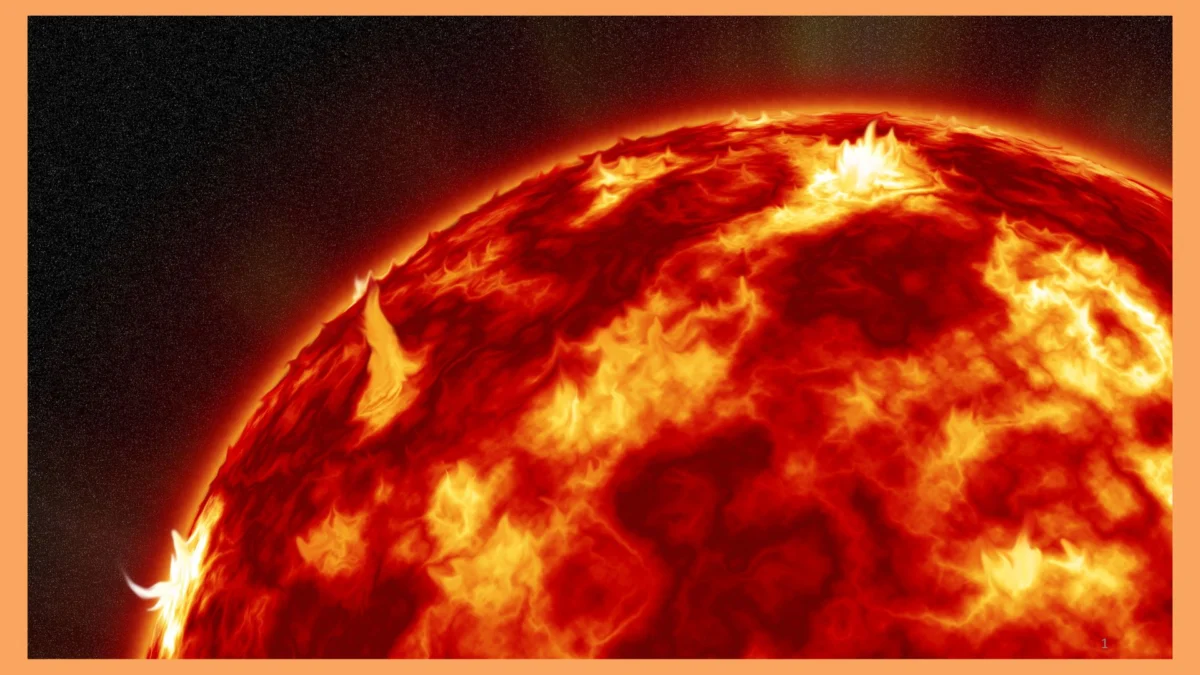
NEW DELHI — In the silent, vacuum-sealed expanse of space, the Sun is far from a static orb of light. It is a violent, roiling nuclear furnace that periodically exhales massive clouds of magnetized plasma into the solar system. When these clouds, known as Coronal Mass Ejections (CMEs), collide with Earth, they trigger geomagnetic storms that can illuminate the skies with auroras or, more dangerously, cripple the digital nervous system of our modern civilization.
Recent groundbreaking research has revealed that the destructive potential of these solar tempests is not merely a product of their raw power. Instead, a team of Indian scientists has discovered a crucial, often overlooked variable: timing.
According to a study conducted by researchers from the CSIR-National Physical Laboratory (NPL), the Academy of Scientific and Innovative Research (AcSIR), and SASTRA Deemed University, the local time at which a solar storm strikes Earth is just as critical as the storm’s intensity in determining how severely it disrupts the ionosphere—the electrically charged layer of our atmosphere vital for global communication and navigation.
The Core Discovery: Beyond Raw Power
For decades, space weather forecasting has focused primarily on the "magnitude" of solar events—measuring the speed of solar winds and the density of the plasma clouds hitting our magnetic shield. However, the new findings, based on observations from Thanjavur, Tamil Nadu, suggest that the state of the local atmosphere at the moment of impact acts as a "preconditioning" factor.
The researchers tracked three intense geomagnetic storms between March 2023 and May 2024. Their data revealed a startling paradox: the most physically intense storm (the historic event of May 2024) did not necessarily cause the most localized atmospheric turbulence. Instead, a storm in April 2023, though technically less powerful in global solar indices, triggered a massive 78% collapse in electron density because it struck during the sensitive evening hours of the Indian subcontinent.

"This research highlights how local-time preconditioning dictates whether a storm will swell or shrink the atmospheric plasma," the study notes. It suggests that a "weaker" storm hitting at sunset might be more disruptive to local GPS and aviation than a "superstorm" hitting at noon.
Chronology of the Onslaught: March 2023 to May 2024
The study period coincided with the Sun approaching its "solar maximum," a phase in its 11-year cycle characterized by increased sunspot activity and frequent CMEs. The researchers focused on three distinct windows:
1. The April 2023 Anomaly
During this event, the main phase of the geomagnetic storm developed during the local evening hours in India. As the sun set, the ionosphere was already undergoing its natural transition. The solar storm’s arrival acted as a catalyst, causing the Total Electron Content (TEC) to plummet by over 78%. This sudden "crash" in particle density created a vacuum-like effect that scrambled satellite signals before the density surged back up in a violent rebound.
2. The May 2024 "Great Storm"
In May 2024, Earth experienced one of the most powerful geomagnetic storms in recorded history, reaching G5 (extreme) levels. However, because the primary impact occurred during the local midnight hours over the Thanjavur station, the atmospheric response was different. Instead of a prolonged swelling, the ionosphere experienced wild, rapid-fire "swings" in density—oscillating between highs and lows in a chaotic manner that presented a different kind of challenge for signal stability.
3. The Midday Comparison
Storms hitting closer to the local noon hour were found to produce a much slower, prolonged "swelling" of the ionosphere. In these cases, the sun’s own radiation (photoionization) during the day provided a buffer, allowing the ionosphere to expand more predictably, albeit significantly, compared to the erratic behavior seen during night-side impacts.

Supporting Data: The Physics of Atmospheric Turmoil
To understand why timing matters, one must look at the "invisible highway" of the ionosphere. Stretching from 60 km to 1,000 km above the Earth’s surface, this region is filled with electrons and ionized atoms.
The researchers identified two competing physical forces that dictate the ionosphere’s reaction during a storm:
- The Fountain Effect (Upward Force): During the initial phase of a solar storm, rapid electric fields are generated. Near the magnetic equator (where Thanjavur is located), these fields act like a giant electromagnetic pump, forcing a fountain of charged particles upward. This increases electron density at high altitudes.
- The Atmospheric Heating Force (Downward Force): As the storm progresses, the energy dumped into the atmosphere causes it to heat up and expand. This generates global-scale winds that push the charged particles back down into denser, lower altitudes. In these lower regions, the electrons recombine with molecules and are "destroyed" or neutralized, leading to sudden, massive drops in electron density.
The study used ground-based GPS receivers to measure these opposing forces. By calculating the nanosecond delays in signals traveling from satellites to Earth, the team could map the Total Electron Content (TEC). When signals collide with more charged particles, they slow down; by measuring this delay, scientists can "see" the invisible fluctuations of the atmosphere in real-time.
Expert Perspectives: The Near-Equatorial Challenge
While global space weather models provide a broad overview, this study is significant because it offers a rare, comparative ground-based analysis specifically over the Indian near-equatorial sector.
The magnetic equator, which passes through southern India, is a region of unique atmospheric physics. The Earth’s magnetic field lines are horizontal here, making the ionosphere particularly sensitive to the "fountain effect" described by the researchers.

"While earlier studies often examined single events or broad global patterns, this research highlights the extreme complexity of tracking these interacting atmospheric waves," the report explains. The researchers acknowledge that predicting these chaotic fluctuations across the entire globe remains a "monumental scientific challenge," particularly when relying on a single observation station. However, the Thanjavur data provides a critical "anchor point" for regional models.
Implications: Protecting a High-Tech World
The stakes for understanding these atmospheric shifts are incredibly high. The ionosphere is not just a scientific curiosity; it is the medium through which almost all modern long-distance communication travels.
1. Aviation and Maritime Safety
Pilots and ship captains rely on GPS for precise positioning. When the ionosphere "warps" or "crashes" during a solar storm, the resulting signal delay can lead to positioning errors of several meters—or in extreme cases, a total loss of signal (blackout). Understanding the "time-of-day" effect allows aviation authorities to issue more accurate warnings for specific flight paths during solar events.
2. Precision Agriculture and Autonomous Systems
Modern tractors, drones, and autonomous vehicles use high-precision GPS. A 78% drop in electron density, as seen in the April 2023 storm, could cause these systems to fail or behave erratically, leading to significant economic disruption.
3. Satellite Longevity
When the ionosphere heats and expands upward, it increases the "drag" on satellites in Low Earth Orbit (LEO). This can cause satellites to lose altitude and burn up prematurely in the atmosphere. Knowing when a storm will cause the atmosphere to "swell" helps satellite operators perform maneuvers to save their assets.

The Road Ahead: Towards Precision Forecasting
The ultimate goal of the CSIR-NPL and SASTRA researchers is to move from "reactive" observation to "predictive" modeling. Current space weather alerts are often "global," warning of a storm’s arrival but failing to specify how it will affect different regions at different times.
By integrating the "local time" variable into forecasting algorithms, scientists can develop models that tell a telecom provider in India or an airline in Singapore exactly what to expect based on when the solar wind is projected to arrive.
As our world becomes increasingly interconnected and reliant on satellite technology, the "invisible highway" above our heads becomes more crowded and more vital. This study serves as a reminder that to survive the temperamental nature of our Sun, we must not only watch the stars but also keep a very close eye on the clock.
The research marks a significant step forward in Indian space science, providing the data necessary to shield the nation’s growing digital and space infrastructure from the unpredictable whims of the solar wind. For now, the message from Thanjavur is clear: when it comes to solar storms, power is only half the story—timing is everything.
