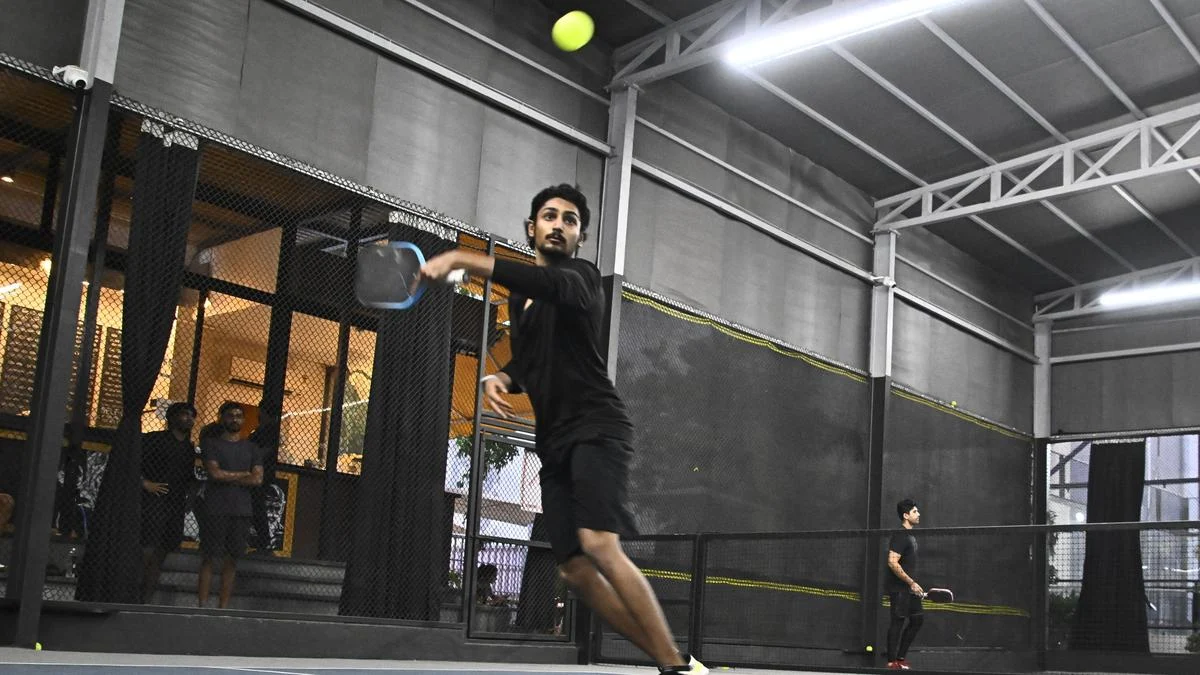
Hyderabad is experiencing a surge in pickleball participation, transforming the city’s sports landscape. Once a niche activity, the sport is now drawing crowds to dedicated courts across various localities, from the upscale Jubilee Hills to the bustling IT hub of Madhapur. This growing popularity, fueled by social media and a desire for engaging recreational pursuits, is creating a vibrant pickleball community, complete with its own set of challenges and rewards.
The Rapid Rise of a Novel Sport
The rhythmic thwack of plastic balls and the quick movements of players are becoming an increasingly common sight in Hyderabad. What began as a relatively casual social sport has rapidly escalated into a full-blown phenomenon, with dedicated pickleball courts now dotting the city. "Earlier, there were only 8 to 10 courts in the city. Now you can find courts in different localities," remarks Dorlodhu Pradeep, a part-time coach at Hyderabad Paddle Park. This expansion signifies a significant shift in recreational preferences, with pickleball carving out a substantial niche for itself.
Jubilee Hills has emerged as a prominent hub, with venues like Hyderabad Paddle Park and The Kitchen attracting steady evening crowds. The IT corridor of Madhapur is also a hotbed for the sport, with Pickle Yard being a particular favorite among IT professionals. For those seeking a more expansive sports campus environment, Gandipet’s Cross Court Sports offers a compelling option. Other frequently visited spots that contribute to the growing pickleball ecosystem include Dink N Dash and the renowned Pullela Gopichand Academy.
A notable trend in Hyderabad’s pickleball scene is the increasing shift towards indoor, air-conditioned facilities. This adaptation is driven by two primary factors: the city’s often sweltering climate and the growing demand for a premium playing experience. These indoor courts, while offering comfort, have also contributed to positioning pickleball as a more upscale recreational activity.
Understanding Pickleball: A Hybrid of Classic Sports
For the uninitiated, pickleball is a paddle sport that masterfully blends elements from tennis, badminton, and table tennis. Played on a court that mirrors the dimensions of a badminton doubles court – significantly smaller than a tennis court – the game utilizes solid paddles instead of stringed rackets. The distinctive perforated plastic ball, a key component of the game, exhibits an unpredictable bounce, adding a layer of strategic complexity. A fundamental rule across most formats dictates that the ball must bounce once before volleys are permitted. Scoring is typically reserved for the serving side, adding another strategic nuance to gameplay.
In Hyderabad, the doubles format is overwhelmingly popular, with four players sharing a court. This arrangement, coupled with the sport’s relatively straightforward rules, makes it exceptionally well-suited for social gatherings and community play.

The origin of the name "pickleball" itself is shrouded in a bit of delightful ambiguity, with competing narratives adding to its charm. One widely circulated explanation links the name to a dog named Pickles, who was purportedly fond of retrieving stray balls. Another popular theory traces its etymology to the "pickle boat" in rowing, a term used to describe a crew formed from the leftover members of other teams. Both these versions are frequently discussed in online forums and within the pickleball community, contributing to the sport’s unique lore.
Hyderabad’s Love Affair with Pickleball: A Social Media Spark
The initial spark for Hyderabad’s embrace of pickleball can largely be attributed to the pervasive influence of short-form video content on social media platforms. These engaging snippets showcased the sport’s accessible nature and fast-paced action, captivating viewers. Corporate groups, actively seeking novel and engaging team-building activities, were among the first to embrace the sport, quickly becoming enamored with its social and competitive aspects.
Darla Jyotirmayi, a finance professional hailing from Nanakramguda, exemplifies this transition. She makes a regular commute to Jubilee Hills to play, recalling her initial encounter: "We kept seeing it online and finally decided to try it. Though it seemed simple at first, we discovered it wasn’t." This sentiment is echoed by many new players who are initially drawn in by the perceived simplicity of pickleball, only to discover its underlying strategic depth and physical demands.
Garikapati Madhavi, an engineer from Kukatpally who was trying the sport for the first time, shared a similar experience of the disconnect between online perception and on-court reality. "Online videos never show how hard it is to judge the bounce," she admitted. "You think you know where it will go, and then you miss it completely." This gap between expectation and the actual playing experience has proven to be a significant driver of the sport’s growth, as players are motivated to return and refine their skills. The challenge of mastering the unpredictable bounce and the nuances of the game encourages repeated engagement, fostering a dedicated player base.
A Diverse Demographic on the Court
A casual observation of pickleball courts across Hyderabad reveals a remarkably diverse mix of players. The scene is populated by corporate teams embarking on their first foray into the sport, IT professionals who often transition directly from their workplaces, and even teenagers with strong tennis backgrounds approaching the game with a competitive zeal.
Gaurav Jha, a digital marketer from Ayyappa Society, Madhapur, discovered pickleball during a corporate outing. "My boss explained the rules and I just joined," he recounted. He quickly realized the sport’s complexities, struggling initially to connect with the ball. "I struggled to connect with it," he recalls. It took him approximately five to six matches to develop a comfortable grasp of the game.

Chandravela Yash, a competitive tennis player who now frequents The Kitchen in Jubilee Hills, undertakes a considerable commute from KPHB, a journey of 30 to 50 minutes. While his tennis background facilitated a quicker adaptation, he remains acutely aware of the sport’s unique challenges. "Tennis helped me adjust," he stated, "But the dink is the hardest shot and consistency matters." The "dink," a soft shot played into the opponent’s non-volley zone, requires precision and a delicate touch, proving to be a formidable skill to master even for experienced racket sport athletes.
Kannur Gopi, from Begumpet, represents the more dedicated segment of the pickleball community. A regular player at The Kitchen, he has transitioned from casual play to participating in competitive tournaments in less than a year. Gopi estimates his annual expenditure on pickleball to be around ₹40,000, encompassing court bookings, equipment, and shared costs. His carbon fiber paddles, priced at approximately ₹6,000, require replacement every three to four months due to the intensity of his play. "Most other sports are cheaper," he acknowledged, "But once you start, it is hard to stop." This sentiment highlights the addictive nature of the sport and the commitment it inspires among its enthusiasts.
The Financial Investment in Pickleball
The cost of participating in pickleball in Hyderabad varies significantly depending on the venue and the time of play. Smaller, less equipped facilities might charge around ₹700 per hour for court rental, while premium indoor venues command higher rates. At Hyderabad Paddle Park, court time can cost approximately ₹1,500 per hour, while at The Kitchen, it is around ₹1,600 per hour.
Beyond court fees, equipment represents another significant financial consideration. Entry-level paddles typically range from ₹1,500 to ₹2,000, whereas advanced carbon fiber paddles can cost considerably more. A standard session is usually shared among four players, which helps to mitigate individual costs. However, this necessitates coordination among players or a willingness to join rotating groups, fostering a sense of community but also requiring a degree of flexibility.
Navigating the Learning Curve: Tips for Aspiring Players
Experienced players often highlight key distinctions between indoor and outdoor pickleball balls. Indoor balls are generally perceived as slower and lighter, while outdoor balls are faster and heavier, presenting different challenges for new players. Wrist control emerges as another initial hurdle, with small technical errors having a more pronounced impact on consistency than sheer power.
The constant lateral movement inherent in the game necessitates appropriate footwear. Court shoes are strongly recommended to prevent ankle strain, as standard running shoes can increase the risk of injury due to their design not being optimized for side-to-side movements.

Dorlodhu Pradeep, at Hyderabad Paddle Park, emphasizes a crucial principle applicable to any sport or fitness regimen: "Most injuries happen when players skip warm-ups. People only take it seriously after they get hurt." He further notes that mastering correct wrist movement alone can dramatically transform a beginner’s game, leading to improved control and shot-making.
Newcomers with prior experience in racket sports typically require two to three sessions to feel comfortable with the game. Those without such a background may need a longer acclimatization period. A deeper understanding of the sport’s intricacies and strategic nuances typically develops over weeks of consistent play.
For many in Hyderabad, pickleball sessions have evolved beyond mere physical activity. They have transformed into vibrant community gatherings, centered around the shared passion for the game and the camaraderie forged on the court. The sport’s ability to foster social connections, combined with its engaging gameplay, has cemented its place as a burgeoning recreational phenomenon in the city.