

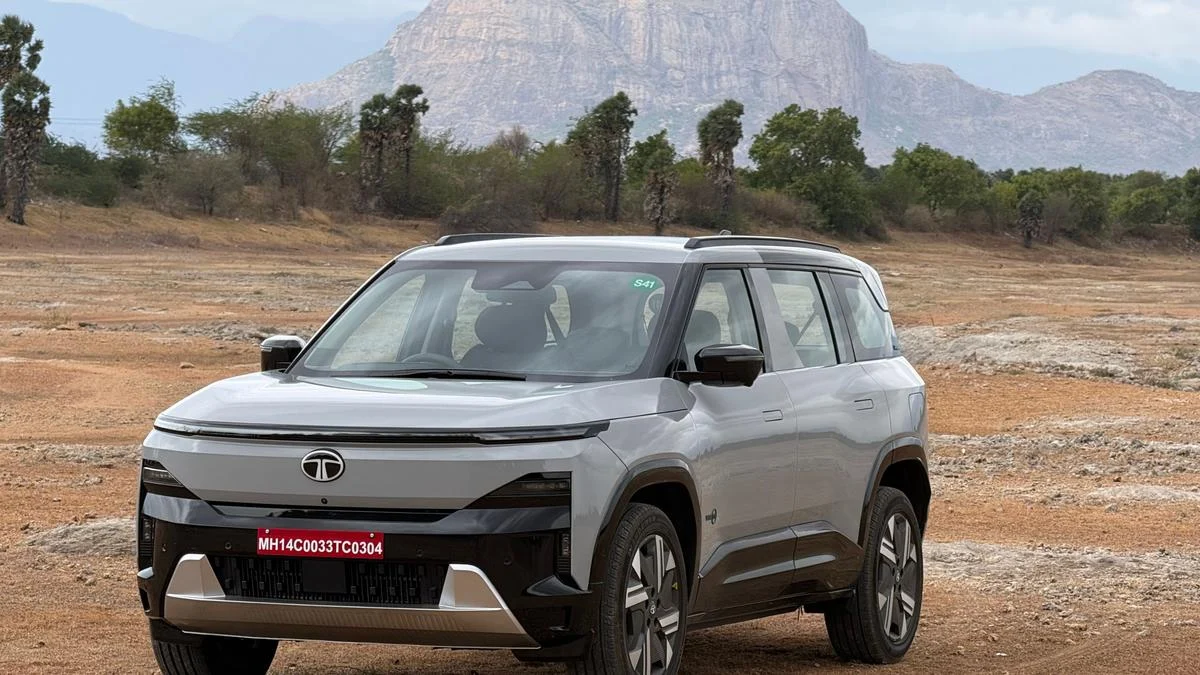
The Indian automotive landscape is currently undergoing a seismic shift, transitioning from the internal combustion engine (ICE) era to a future defined by electrification. At the heart of this transition is Tata Motors, a company that has moved from being a late entrant to a dominant market leader in the Electric Vehicle (EV) space. Their latest offering, the Tata Sierra.ev, is perhaps their most ambitious project to date. More than just a battery-powered SUV, it represents the culmination of years of engineering refinement, a deep understanding of Indian road conditions, and a respectful nod to a legendary nameplate from the 1990s.
After an extensive evaluation across the diverse terrains of Coimbatore—ranging from congested city arteries and high-speed highways to a controlled test track and a grueling off-road course—the Sierra.ev emerges not merely as a "good electric car," but as one of the most complete and sophisticated vehicles ever produced by an Indian manufacturer.
1. Main Facts: The Technical Blueprint of Excellence
The Tata Sierra.ev is built on the advanced Acti.ev architecture, a dedicated global EV platform designed to maximize cabin space, safety, and battery efficiency. Unlike earlier EV conversions, this platform allows for a "born electric" philosophy that dictates everything from weight distribution to structural rigidity.
Powertrain and Performance
The flagship variant of the Sierra.ev is the 75 kWh version, featuring a sophisticated dual-motor Quad Wheel Drive (QWD) system. This setup places a 234 bhp motor on the rear axle and a 138 bhp motor on the front, delivering a staggering combined torque output of 504 Nm.

- Acceleration: 0 to 100 km/h in a blistering 5.8 seconds.
- Drive Modes: Multiple modes tailored for efficiency, balanced city driving, and high-performance "Sport" settings.
- Entry Variant: For those prioritizing value over outright performance, Tata offers a 63 kWh variant with a single rear-mounted motor, maintaining the platform’s rear-wheel-drive bias for better handling dynamics.
Range and Charging
Range remains the primary metric for EV adoption in India. The Sierra.ev addresses this with an MIDC-certified range of 665 km for the 75 kWh battery. In real-world conditions, including high-speed highway runs and urban stop-and-go traffic, drivers can realistically expect between 450 to 500 km on a single charge.
- Fast Charging: The vehicle supports high-capacity DC fast charging, capable of replenishing 263 km of range in just 15 minutes, significantly reducing the downtime during long-distance interstate travel.
2. Chronology: From 1991 Legend to 2024 Revolution
To understand the significance of the Sierra.ev, one must look back at its lineage. The original Tata Sierra, launched in 1991, was a pioneer—the first SUV designed and produced in India. With its distinctive three-door layout and large alpine windows, it was ahead of its time.
- 2020: Tata Motors shocked the industry at the Delhi Auto Expo by showcasing the Sierra.ev Concept. It was a design study that blended the nostalgic silhouette of the original with futuristic EV aesthetics.
- 2023: A more production-ready version was displayed, moving from a three-door to a more practical five-door configuration while retaining the iconic "wrap-around" rear glass look.
- 2024: The official launch of the Sierra.ev marks the third phase of Tata’s EV strategy—moving from "Conversion" (Nexon EV) to "Born Electric" (Punch.ev/Curvv.ev) and finally to "Premium Lifestyle EV" (Sierra.ev).
The development cycle involved thousands of kilometers of testing across India’s extreme climatic zones, from the sub-zero temperatures of the Himalayas to the scorching heat of the Rajasthan deserts, ensuring the battery thermal management systems were robust enough for the subcontinent.
3. Supporting Data: Engineering the "Magic Carpet" Ride
One of the most impressive aspects of the Sierra.ev is its mechanical composure. Tata has utilized Frequency Dependent Damping (FDD) suspension, a technology usually reserved for luxury European marques.

Suspension and Chassis Dynamics
FDD allows the dampers to adjust their resistance based on the frequency of the bumps. High-frequency vibrations (small ripples, rough tarmac) are met with softer damping for comfort, while low-frequency movements (large undulations, cornering) trigger stiffer damping for better body control.
- Ride Quality: During our tests in Coimbatore, the Sierra.ev rounded off potholes and expansion joints with a "thud" rather than a "crash."
- Center of Gravity: By placing the heavy battery pack low within the floorpan, Tata has achieved a center of gravity far lower than a traditional ICE SUV. This minimizes body roll, allowing the Sierra.ev to feel planted and car-like through corners.
Interior and Digital Integration
The cabin is a departure from previous Tata vehicles, moving toward a "minimalist premium" aesthetic.
- Triple-Screen Layout: The dashboard features three distinct displays: a digital instrument cluster, a massive central infotainment touchscreen, and a dedicated passenger-side display.
- Entertainment: The inclusion of AirConsole allows for in-car gaming using smartphones as controllers—a feature designed to make charging stops at highway stations a social and entertaining experience.
- Audio Engineering: The JBL Black audio system is a highlight. Featuring Dolby Atmos integration, it provides an immersive 360-degree soundstage that rivals systems found in vehicles twice its price point.
4. Official Responses and Market Positioning
Tata Motors’ leadership has positioned the Sierra.ev as a "no-compromise" vehicle. According to company insiders, the goal was to create a flagship that didn’t just compete with other EVs but challenged the dominance of established mid-size ICE SUVs like the Hyundai Creta and Kia Seltos.
Pricing Strategy
With a price range of INR 18.79 – 24.79 Lakh (ex-showroom), Tata is targeting the heart of the premium SUV segment.

- The Value Proposition: While the upfront cost is higher than some ICE rivals, the total cost of ownership (TCO) over five years, combined with the performance levels of a 370+ bhp vehicle, makes a compelling financial case for the affluent Indian buyer.
Safety as a Standard
Tata has reaffirmed its commitment to safety, aiming for a 5-star Bharat NCAP rating. The Sierra.ev comes equipped with:
- 6 Airbags as standard.
- Level 2 ADAS (Advanced Driver Assistance Systems).
- 360-degree 3D surround-view camera.
- Electronic Stability Program (ESP) with i-VBAC (Innovative Vacuum-less Braking and Active Control).
5. Implications: The Future of the Indian EV Market
The arrival of the Sierra.ev has several far-reaching implications for the Indian automotive industry and the consumer mindset.
1. The End of "Range Anxiety"
With a realistic 450-500 km range and ultra-fast charging, the Sierra.ev effectively kills the argument that EVs are only for city use. It positions the EV as a primary vehicle capable of handling family road trips across the country.
2. A Challenge to Global Manufacturers
For years, Indian brands were seen as "budget" alternatives to global giants like Hyundai or Toyota. The Sierra.ev flips this script. Its interior quality, technological integration (like AirConsole and Dolby Atmos), and sophisticated FDD suspension prove that an Indian manufacturer can lead in innovation rather than just following global trends.

3. The Rise of "Lifestyle" EVs
The Sierra.ev isn’t just a transport tool; it’s a lifestyle statement. By reviving a nostalgic brand name and pairing it with futuristic tech, Tata is tapping into the emotional psyche of the Indian buyer. This could trigger a trend of "heritage-inspired" electric vehicles from other domestic manufacturers.
4. Competitive Pressure
The Sierra.ev enters a "war zone" of competition. It faces off against the Hyundai Creta Electric, the MG ZS EV, and the upcoming Mahindra BE 6. This competition will likely drive down prices and accelerate the rollout of charging infrastructure across India, benefiting the end consumer.
Critical Verdict: A New Benchmark
No vehicle is perfect. During our testing, the Sierra.ev exhibited noticeable wind noise around the A-pillars at speeds above 110 km/h—a phenomenon amplified by the otherwise silent electric drivetrain. Additionally, the one-touch window function on the driver’s side was occasionally temperamental.
However, these are minor blemishes on an otherwise stellar package. The Tata Sierra.ev is a triumph of engineering and a testament to how far Tata Motors has come. It manages to be exhilarating yet refined, high-tech yet intuitive, and nostalgic yet forward-looking.

In a market where many electric SUVs feel like appliances, the Sierra.ev feels like a soul-stirring machine. It doesn’t just ask you to accept the electric future; it makes you want to embrace it. For the buyer looking for a vehicle that can navigate the office commute, a weekend off-road trail, and a cross-country highway run with equal aplomb, the Sierra.ev is currently the undisputed benchmark in its segment.
