

MALKANGIRI, ODISHA — In the quiet, sun-dappled village of Gokharipada, nestled deep within the rugged Bonda Hills of Odisha’s Malkangiri district, a woman named Muduli sits before a weathered indigenous loom. Her movements are rhythmic and deliberate, a physical manifestation of a lineage that spans millennia. As she runs her hand over a freshly completed length of cloth, she speaks with a quiet pride that transcends the simple act of production.
“Every Ringa we weave carries our family’s story,” Muduli says. “It is not just a garment; it is who we are.”
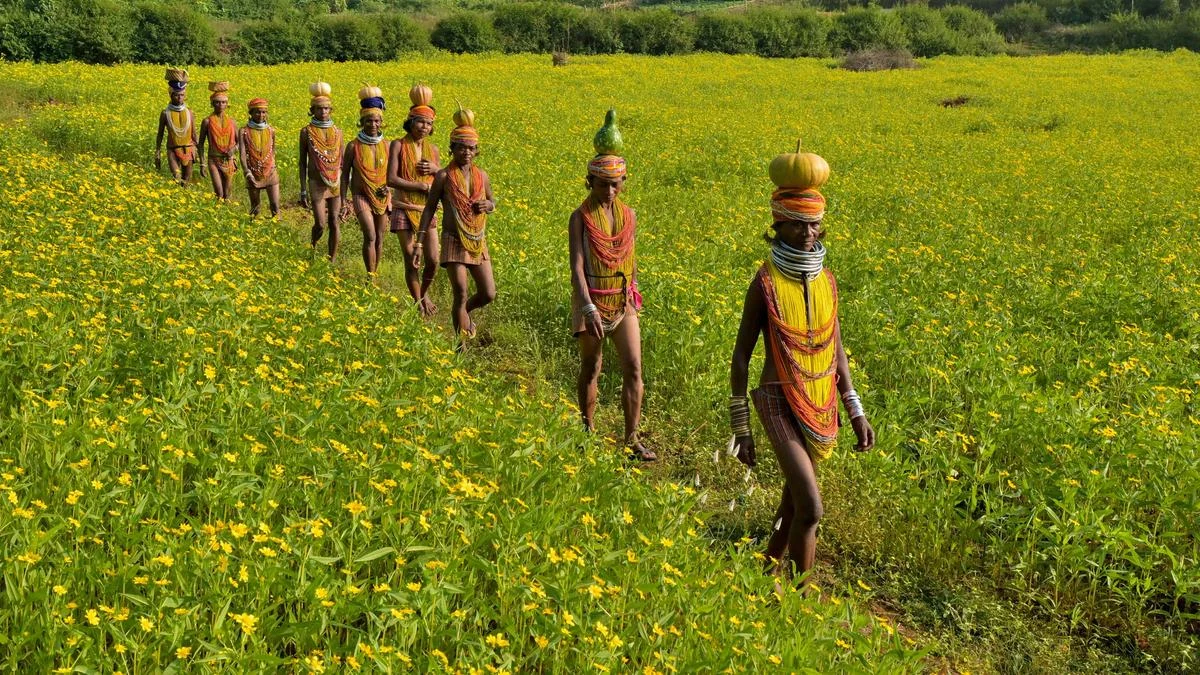
The cloth she refers to, the Ringa, is the traditional handwoven wraparound skirt worn by the women of the Bonda tribe. For centuries, this textile—characterized by its striking horizontal stripes of red, maroon, black, white, and blue—has served as the primary visual identity of one of India’s most reclusive and ancient communities. Classified as a Particularly Vulnerable Tribal Group (PVTG), the Bondas are the custodians of a culture that is currently navigating the delicate balance between ancestral preservation and the encroaching influence of the modern world.
Main Facts: The Ringa as a Cultural Emblem
The Bonda tribe, also known as the ‘Remo’ (meaning ‘people’ in their native language), resides primarily in the high-altitude plateaus of the Malkangiri district, a region bordering Andhra Pradesh and Chhattisgarh. Their isolation, facilitated by the treacherous terrain of the Eastern Ghats, has allowed them to maintain a way of life that remains largely distinct from mainstream Indian society.

At the heart of this identity is the Ringa. Unlike the commercial handlooms found in other parts of Odisha—such as the famous Sambalpuri or Maniabandha weaves—the Ringa was never originally intended for the marketplace. It was created by women, for women, within the domestic sphere.
The garment is a short, thick wrap, designed for the rigors of forest life. Traditionally, Bonda women would pair the Ringa with layers of vibrant bead necklaces that covered their torsos, heavy aluminum neck rings (known as khagla), and tonsured heads wrapped in beaded bands. While modern influences have introduced shawls and even synthetic fabrics into their daily attire, the Ringa remains the foundational element of their wardrobe, particularly during religious festivals and community gatherings.
Chronology: From Ancient Migrations to the Cotton Era
The history of the Bonda people is a subject of intense anthropological fascination. Many researchers believe the Bondas are descendants of one of the earliest waves of modern humans to migrate out of Africa approximately 60,000 years ago. While this remains a point of ongoing genomic and archaeological research, their linguistic roots in the Austroasiatic family and their unique social structures suggest a history that predates many of the surrounding civilizations.
The Evolution of the Fiber
For centuries, the Ringa was not made of cotton. Instead, it was woven using Kerang, a tough fiber extracted from the bark of a wild shrub native to the Eastern Ghats. The process of harvesting Kerang was arduous: the bark had to be soaked, beaten, and hand-spun into coarse yarn.
As the 20th century progressed and the Bonda Hills became more accessible through government-built roads and the establishment of weekly markets (shandies), cotton yarn began to flow into the hills. The community gradually transitioned from the labor-intensive Kerang to factory-spun cotton yarn. However, the visual grammar of the textile—the specific widths of the stripes and the traditional color palette—remained unchanged, preserving the aesthetic continuity of the tribe across generations.

Supporting Data: The Socio-Economics of the Loom
The Bonda society is notably matriarchal. Women are the primary decision-makers in the household, the main cultivators of crops, and the expert negotiators at the weekly markets. Weaving is an extension of this female-led economy.
The Production Process
- Timeframe: A single Ringa typically takes two to three days to complete. This timeline is dictated by the weaver’s other responsibilities, including farming, gathering forest produce, and domestic chores.
- The Loom: The indigenous Bonda loom is a simple, portable structure. It does not require a dedicated workshop; it is set up in the courtyards of homes, allowing the weaver to engage with her family while she works.
- Learning Curve: There is no formal apprenticeship. Girls learn by observation. "Like most Bonda girls, I watched my mother and the elder women weave from a young age," Muduli recalls. This "muscle memory" is passed down through grandmothers and mothers, making the loom a living archive of the family’s history.
The Weekly Shandy
Every Thursday, the Onukudelli market becomes a theater of Bonda culture. Women descend from the hills to trade vegetables and forest goods for salt, oil, and yarn. It is here that the Ringa is most visible, worn with the full regalia of beads and metal. In recent years, this market has also become the primary point of contact for textile collectors and tourists interested in the tribe’s unique craftsmanship.
Expert Perspectives: The Shift Toward Documentation
The transition of the Ringa from a personal garment to a sought-after textile art has been observed by experts like Navaldeep Thareja, a textile engineer from Punjab. Through his initiative, Behrupiaa Arts, Thareja has spent years documenting the "silent" weaving traditions of India—those that do not have the backing of large cooperatives or government export schemes.
“What makes the Bonda weaving tradition unique is that it has always been closely tied to the community’s identity rather than to commerce,” Thareja explains. “The fabric is tightly woven and incredibly durable because it was meant for everyday survival, not ceremonial display. It is one of the few textile traditions where a single garment has remained the central pillar of a community’s identity for millennia.”

Thareja’s work involves organizing small-scale, curated tours that allow outsiders to witness the weaving process without disrupting the social fabric of the villages. This "slow tourism" model aims to provide the Bondas with a supplementary income while ensuring their privacy and dignity remain intact.
Ethical Implications and Official Responses
The commercialization of PVTG cultures is a sensitive issue. Historically, the Bondas have been wary of outsiders, and for good reason. The "human zoo" style of tourism that plagued tribal regions in the past has led to strict regulations regarding photography and interaction.
The Tourism Protocol
In response to these concerns, modern advocates for the Bonda weavers have implemented strict ethical guidelines. "We never treat the village as a tourist attraction," Thareja emphasizes. Participants on his textile tours receive briefings on local customs and photography etiquette. Interactions are moved to locally managed homestays rather than private residences, ensuring that the weavers have the agency to decide when and how they engage with the public.
While there is no massive government subsidy specifically for Ringa production—partly because the Bondas prefer to remain self-reliant—local administrative bodies have focused on improving education and healthcare in the Bonda Hills. However, this progress brings its own set of challenges for the survival of traditional crafts.
Implications: The Loom at a Crossroads
The future of the Ringa is currently balanced on a knife-edge. As the younger generation of Bondas gains access to formal education and moves toward the plains for employment, the continuity of the weaving tradition is under threat.

The Challenge of Modernity
"The biggest challenge is that weaving alone does not provide a steady income," Muduli admits. "Many young people are choosing education and other jobs. Everyday clothing has also changed over time; ready-made garments are easier to wear and cheaper to buy."
As synthetic saris and t-shirts become common sights in the Bonda Hills, the Ringa is increasingly reserved for special occasions. If the younger generation stops learning the complex hand-spinning and loom-setting techniques, a 60,000-year-old cultural thread could be severed within a single generation.
A Path Forward
There is, however, a glimmer of hope. The growing global interest in "slow fashion" and indigenous art has created a niche market for the Ringa. Textile scholars and collectors are beginning to view the Ringa as "framed textile art," using it as wall hangings or table runners.
For Muduli and her fellow weavers, this outside appreciation provides more than just money—it provides validation. "It makes us happy that people appreciate our weaving and our traditions," she says. "When someone values the Ringa, it encourages us to continue this craft and pass it on."
The survival of the Ringa will ultimately depend on whether the Bonda youth see the loom not just as a tool of the past, but as a viable and respected profession for the future. For now, in the hills of Malkangiri, the rhythmic clack of the loom continues, weaving the story of a people who have survived the ages, one stripe at a time.
