

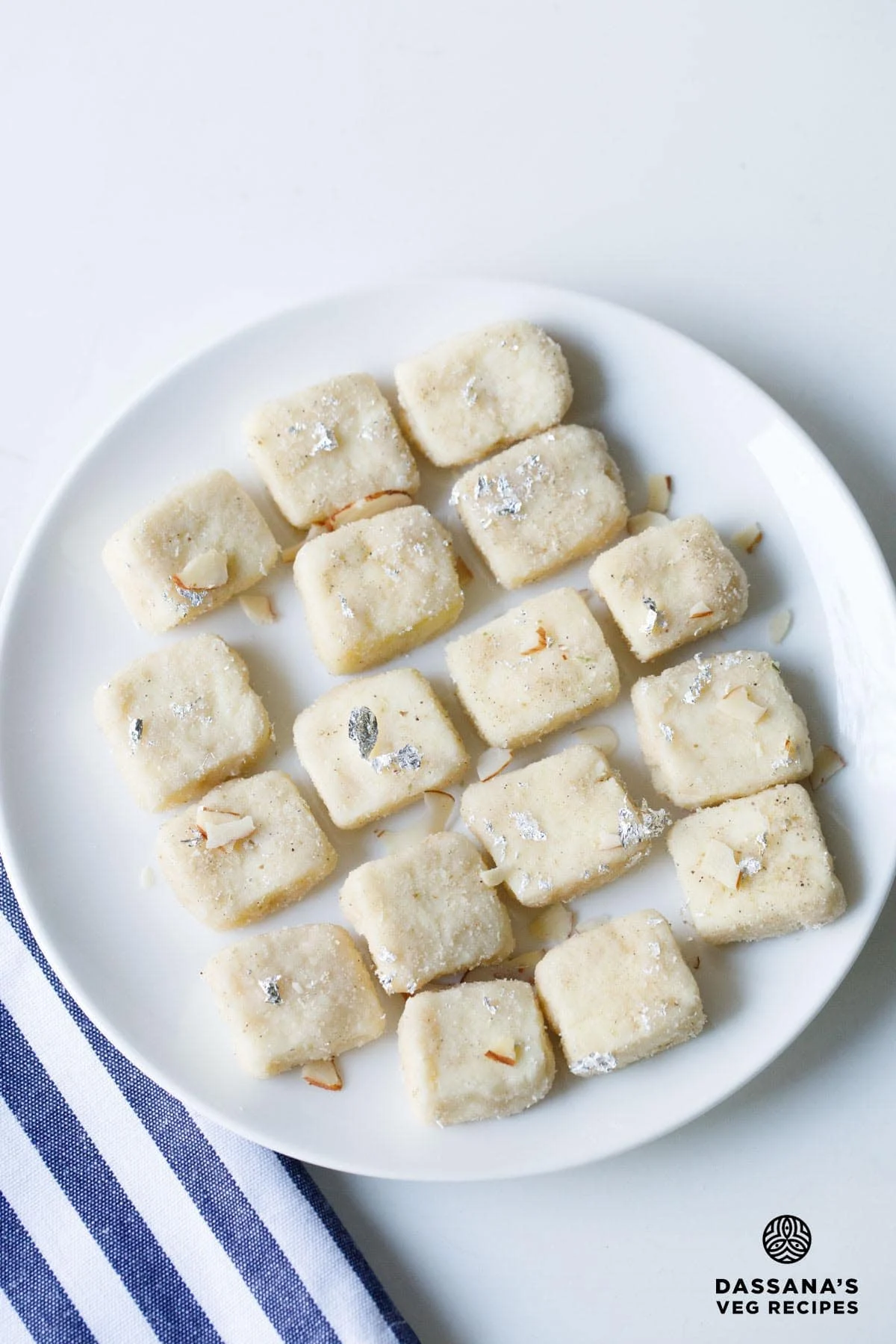
In the vast and intricate landscape of Indian confectionery, few regions command as much respect as West Bengal. Known as the "land of sweets," Bengal has gifted the world with legendary creations like the Rasgulla and Sandesh. However, nestled among these giants is a minimalist masterpiece that relies on textural contrast rather than complex flavoring: Chena Murki. A traditional sweet consisting of hand-cut cubes of fresh chhena (Indian cottage cheese) encased in a brittle, snow-white shell of crystallized sugar, Chena Murki represents a unique intersection of dairy science and artisanal patience.
As global culinary trends shift toward "clean labels" and gluten-free alternatives, this centuries-old sweet is seeing a resurgence. With only two primary ingredients—milk and sugar—Chena Murki stands as a testament to the sophistication that can be achieved through precise temperature control and manual agitation.

Main Facts: The Identity of a Bengali Classic
Chena Murki (also spelled Chhena Murki) is a dry sweet that occupies a specific niche in the Bengali mithai (sweetmeat) repertoire. Unlike the syrup-soaked Rasgulla or the soft, fudge-like Sandesh, Chena Murki is defined by its "crunch-to-soft" ratio. The exterior is a delicate, crystalline crust that shatters upon the first bite, revealing a tender, slightly chewy heart of cooked paneer.
The term "Murki" in the Bengali language traditionally refers to any food item—often puffed rice or legumes—that has been coated in a layer of dried, crystallized sugar or jaggery. In this context, Chena Murki is the premium iteration of that technique, replacing grains with high-quality dairy solids.

A Distinctive Profile
From a culinary standpoint, Chena Murki is distinguished by several factors:
- Minimalist Composition: It typically requires only paneer/chhena, sugar, and water, with optional aromatics like cardamom or rose water.
- Gluten-Free Nature: Because it relies entirely on dairy protein and sucrose, it is naturally suitable for those with gluten sensitivities, a factor contributing to its modern appeal.
- Textural Integrity: Unlike many Indian sweets that lose their structure over time, the crystallized coating of Chena Murki acts as a preservative and structural casing, though it remains sensitive to humidity.
While often confused with Odisha’s Chhena Gaja or Chena Khurma, Chena Murki is distinct. The former varieties are typically deep-fried before being soaked in syrup, resulting in a darker, caramelized exterior. Chena Murki, conversely, is never fried; the paneer is simmered directly in sugar syrup, maintaining its pristine white or cream color.

Chronology: The Lifecycle of a Chena Murki Cube
The production of Chena Murki is a process of transformation that requires a deep understanding of thermal dynamics. It is not merely a recipe but a chronological progression of chemical states.
Phase 1: The Foundation of Chhena
The process begins with the creation of chhena. Whole milk is heated to a boil and then curdled using an acidic agent, typically lemon juice or vinegar. The resulting solids are strained through a muslin cloth. For Chena Murki, the moisture content of the chhena is critical. If too wet, the cubes will disintegrate in the syrup; if too dry, they will become rubbery. Professional confectioners often press the chhena for exactly 15 to 20 minutes to achieve a semi-firm consistency that allows for clean, geometric dicing.

Phase 2: Precision Dicing and Air-Drying
Once the block of chhena (or fresh paneer) is set, it is sliced into uniform cubes, usually measuring between 2.5 to 3 centimeters. Uniformity is not merely aesthetic; it ensures that every piece cooks at the same rate and absorbs the same amount of heat. These cubes are then spread out to air-dry for 10 to 15 minutes. This brief resting period allows the surface proteins to firm up, creating a "skin" that prevents the cube from absorbing excess water during the boiling phase.
Phase 3: The Science of the Syrup
The most technically demanding stage involves the creation of the sugar syrup (chashni). Sugar and water are combined in a wide, thick-bottomed vessel. The goal is to reach a "one-string consistency" (ek-taar). In laboratory terms, this is the point where the sugar concentration reaches approximately 80%, and the temperature hovers around 104°C to 106°C (219°F to 223°F). At this concentration, the syrup is viscous enough to coat the paneer but fluid enough to allow for evaporation.

Phase 4: Simmering and Agitation
The paneer cubes are submerged in the boiling syrup and cooked for approximately five to six minutes. During this window, the osmotic pressure of the sugar syrup draws out the remaining moisture from the paneer, replacing it with sugar. This "cures" the cheese, giving it a longer shelf life and a firmer texture.
Phase 5: The Crystallization Finale
The final stage is where Chena Murki gains its signature appearance. The pan is removed from the heat, and the mixture is subjected to continuous, gentle stirring. As the temperature drops, the syrup becomes supersaturated. The mechanical action of stirring introduces air and provides nucleation points, causing the sugar to crystallize rapidly. Over a period of 10 to 20 minutes, the liquid syrup transforms into a dry, powdery, or crystalline coating that clings to each individual cube.

Supporting Data: Nutritional and Chemical Analysis
To understand the impact of Chena Murki on the modern diet, one must look at its nutritional composition. Based on standard artisanal preparations, a single serving (approximately one cube) contains:
- Calories: 49 kcal
- Carbohydrates: 6g (primarily sucrose)
- Protein: 1g (casein and whey proteins)
- Fat: 2g (saturated dairy fat)
- Calcium: 41mg (roughly 4% of the daily recommended intake)
The Role of Sugar Quality
Data suggests that the type of sugar used significantly alters the final product’s "snap." Refined white sugar, which is 99.9% sucrose, produces a bright white, hard crystal. In contrast, organic cane sugar, which contains trace minerals and molasses, results in a softer, "fudge-like" crystallization and a pale cream color.

Shelf Life and Stability
Unlike milk-based sweets like Mishti Doi, which have high water activity and require constant refrigeration, Chena Murki is relatively stable. The low moisture content of the crystallized shell inhibits microbial growth. However, it is highly hygroscopic—it absorbs moisture from the air. In environments with humidity above 60%, the sugar coating will begin to "weep" or turn sticky within 24 hours, highlighting the need for airtight storage.
Official Responses: Culinary Experts on the "Murki Standard"
Culinary historians and professional pastry chefs emphasize that Chena Murki is a test of a chef’s "hand-feel." According to veteran confectioners in Kolkata, the most common failure in making Chena Murki is the "rubbery center."

"The secret is not in the sugar, but in the paneer’s freshness," says Chef Anirban Mukherjee, a specialist in regional Indian desserts. "If you use store-bought paneer that has been frozen, the cellular structure of the cheese is damaged. When it hits the hot syrup, it becomes tough. To reach the professional standard, the paneer must be made fresh and used within hours."
Furthermore, culinary boards focusing on the preservation of Bengali heritage sweets have noted that Chena Murki is often used as a "benchmark" sweet. Because it has no colors or heavy spices to hide behind, any impurity in the sugar or any scorched notes in the dairy are immediately apparent to the palate. The addition of cardamom or rose water is officially viewed as an enhancement, but the "gold standard" remains the pure, unadulterated taste of milk and sugar.

Implications: The Future of Traditional Confectionery
The persistence of Chena Murki in the modern market carries several broader implications for the food industry and cultural preservation.
1. The Rise of "Clean Label" Sweets
As consumers become increasingly wary of preservatives, artificial stabilizers, and complex ingredient lists, Chena Murki stands out. Its ingredient list is essentially what a consumer would find in their own pantry. This "clean label" status makes it an attractive option for the health-conscious demographic that still wishes to indulge in traditional sweets during festivals like Diwali or Durga Puja.

2. The Global Diaspora and Export Potential
The dry nature of Chena Murki makes it more "travel-friendly" than its syrup-laden counterparts. As the Indian diaspora expands globally, there is a growing market for authentic sweets that can be shipped without the risk of leakage or rapid spoilage. Confectionery exporters are increasingly looking at Chena Murki as a candidate for vacuum-sealed packaging, which could introduce this Bengali delicacy to a wider international audience.
3. Cultural Diplomacy through Gastronomy
Sweets play a central role in Indian social fabric, particularly in the ritual of "Bhai Dooj" or "Holi." Chena Murki, with its snowy appearance and bite-sized form, is increasingly featured in high-end "fusion" dessert platters. Its ability to pair well with bitter beverages like black coffee or strong Darjeeling tea has allowed it to transcend its traditional roots and find a place in modern urban cafes.

4. Challenges in Mass Production
Despite its popularity, Chena Murki remains difficult to mass-produce. The crystallization stage requires human intervention to ensure the cubes do not clump together into a single mass. While industrial agitators exist, they often lack the "gentle touch" required to keep the delicate paneer cubes intact. Consequently, the sweet remains a stronghold of artisanal halwais (traditional sweet makers), ensuring that the craft is passed down through generations of skilled laborers.
In conclusion, Chena Murki is more than just a simple dessert; it is a sophisticated culinary artifact. It represents the Bengali ability to take the most basic of ingredients—milk and sugar—and, through a series of precise physical and chemical changes, create something that is structurally complex and sensorially satisfying. As the world looks toward more sustainable and traditional ways of eating, the humble crystallized cube of Chena Murki remains a shining example of timeless gastronomic excellence.
