

KOLKATA — On the second floor of the Altitude Building on Lee Road, the traditional boundary of a single restaurant entrance has been replaced by a conceptual crossroads. Two doors stand side-by-side, offering a choice that feels less like a selection of menus and more like a choice between timelines. To the left lies Tua, a sanctuary of roses, soft lighting, and the romanticism of the present. To the right lies Synthe, a neon-soaked portal into a speculative future where mixology is dictated by the philosophical milestones of the next century.
Together, these sister concerns represent a bold experiment by a trio of founders—Aman Bansal, Umaid Ahmed, and Tabrez Nadeem—who have partitioned a single address into two parallel universes. Each space operates under a distinct philosophy, refusing to borrow from the other’s identity, yet both are anchored by a meticulous attention to detail and a desire to disrupt the conventional F&B (Food and Beverage) landscape of the city.

Main Facts: A Dual-Concept Identity
The Altitude Building project is a study in architectural and emotional contrast. Tua, the larger of the two venues, spans 3,000 square feet and accommodates 75 guests. Its name, derived from the Latin word for "yours," sets the tone for a space designed with "emotional architecture" at its core. It focuses on Modern Asian, West Asian, and European cuisine, paired with a "Dance and Dine" ethos intended to revive the city’s social energy.
Conversely, Synthe is an intimate, 32-seater "omakase-style" bar. It draws its inspiration from electronic music history and futurist philosophy. Its menu is intentionally lean, featuring 22 small plates and 11 signature cocktails that follow a chronological timeline stretching from the year 2030 to 2130. While Tua is expansive and warm, Synthe is metallic, neon, and intellectual, focusing on the deconstruction of flavors.

Chronology: From Karaoke Sessions to Grand Openings
The genesis of Tua and Synthe is as serendipitous as the spaces are calculated. The three founders—Bansal, Ahmed, and Nadeem—met during karaoke sessions held in the very space they now own. What began as a lighthearted joke about professional collaboration eventually evolved into a concrete business plan.
"We joked that in another universe we should work together," Aman Bansal recalls. "One conversation led to another, and here we are."

The development phase was rigorous, involving a three-month period of experimentation where every cocktail and dish was tested, refined, and reconstructed. The rollout was staggered to allow each brand to establish its own foothold:
- May 27, 2024: Synthe commenced operations, introducing Kolkata to its futuristic mixology program.
- June 24, 2024: Tua was launched, completing the dual-concept vision and opening its doors to those seeking a more classical, high-energy dining experience.
Supporting Data: Tua’s Emotional Architecture and Culinary Precision
Tua is marketed as a space "built around women," though the founders are quick to clarify that this does not mean an adherence to clichés. There is no "Barbie-core" pink here; instead, the design utilizes warm reds, hushed yellow lighting, and recurring rose motifs to create a blanket of intimacy.

The Detail in the Decor
A unique feature of Tua is the personalized touch found at every table. Every guest receives a napkin embroidered with a different message. During our visit, the message read "Drinks Before Decisions," a subtle nod to the restaurant’s belief that good hospitality should lower the guest’s cognitive load.
Culinary Offerings
Under the guidance of consultant chef Vaibhav Bhargav and sous chef Shobuj Sheikh, Tua eschews "American-Chinese" staples like chili chicken in favor of a more nuanced "Modern Asian" and West Asian menu.

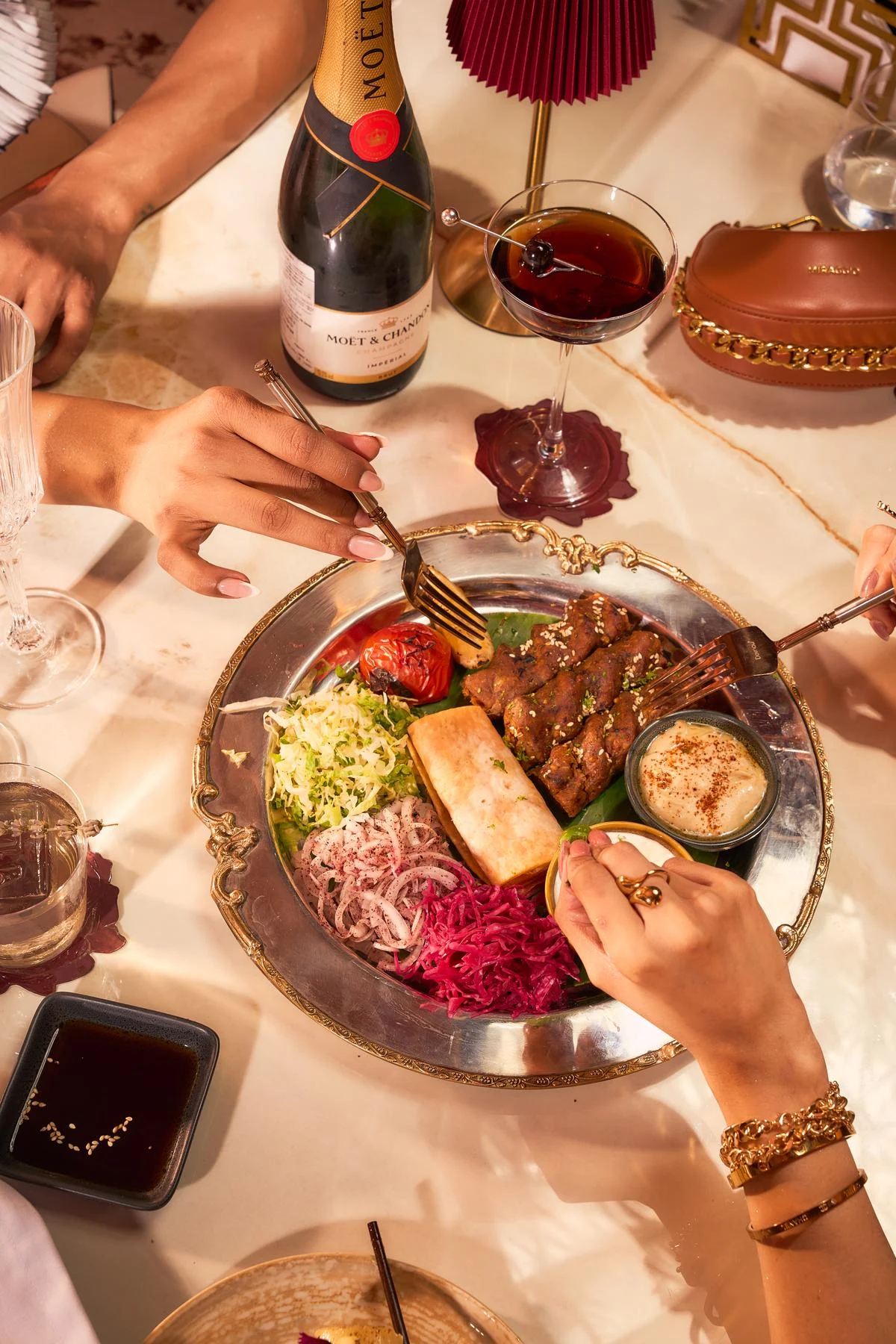
- The Turkish Kebab Platter: A standout dish featuring smoky, grilled meats served with warm flatbread, house-made tzatziki, and Turkish chilies that provide a buttery depth rather than sharp heat.
- The Prawn Har Gow: Served in a rich Dan Dan sauce, this dish balances the natural sweetness of shellfish with a spicy, nutty undertone.
- The Sando-Style Prawn Toast: A crowd favorite, though notably rich, featuring chunky prawns between deep-fried bread layers.
Mixology at Tua
Bar manager Akash James Mondal oversees a "zero waste" bar program. Ingredients like banana oleo and plum liqueurs are produced in-house. The cocktail menu follows the "arc of a night," starting with easy-drinking concoctions and moving toward more complex profiles.
- Cherry on the Top: A sophisticated take on a cola-based drink, using Jack Daniels force-carbonated with brandy and wine, finished with "clear cola" for a transparent aesthetic.
- Belonging: A comforting blend of coffee, whisky, and Kahlúa, topped with a thick vanilla cream foam and dark chocolate.
Official Responses: Synthe and the Philosophy of the Future
If Tua is about the comfort of the "now," Synthe is about the mystery of "what if." Mixologist Abhishek Das, the face of Synthe’s bar, traces the brand’s name to the track "Giorgio by Moroder" by Daft Punk, specifically the line: "The synthesizer is a musical instrument that belongs to the future."

The Timeline Menu
The beverage program at Synthe, curated by consultant Ankur Chawla, is a narrative journey.
- 2030 (Reclamation): A vodka-based drink using cucumber, mint, and shiso, symbolizing a return to nature and health.
- Synthesis: A layered drink where tequila, pineapple, and coconut sit beneath a float of oxidized red wine, representing the merging of disparate elements.
- 2060 (Restrain): A minimalist Old Fashioned made with Johnnie Walker Black Label and chamomile, reflecting a future defined by scarcity.
- Unlearn: Perhaps the most avant-garde offering, it uses tomato juice, strawberry, and vinegar, featuring a cherry tomato frozen inside a clear ice cube—visible but unreachable, forcing the guest to reconsider their perception of flavor.
The Omakase Food Program
Synthe’s food menu is designed to complement, not compete with, the complex spirits.

- Tokyo Crunch Royale: Crisp rice paired with avocado tartare.
- Blackout Futomaki: Charcoal asparagus tempura wrapped in dark nori.
- Charred Grilled Prawns: Finished with a delicate yuzu chili butter.
Abhishek Das, recognizable by his mismatched black-and-white spectacles, explains that the experience is rooted in the Japanese concept of Omakase ("I leave it to you"). "The mixologist is the narrator here," says Das. "We are deconstructing and reconstructing the idea behind each drink for the patron."
Implications: A Shift in Kolkata’s Gastronomic Identity
The emergence of Tua and Synthe signifies a broader maturation of the Kolkata F&B market. For decades, the city’s nightlife was concentrated in heritage districts like Park Street, often relying on nostalgia or high-volume "multi-cuisine" models. The Altitude Building project suggests a shift toward:

- Niche Segmentation: By splitting a single floor into two distinct identities, the founders are able to capture two different demographics—the high-energy "Dance and Dine" crowd and the intellectual "Craft Cocktail" enthusiast—without compromising the brand integrity of either.
- The Rise of the Consultant Chef/Mixologist: The involvement of high-profile consultants like Vaibhav Bhargav and Ankur Chawla indicates a move toward "chef-led" and "narrative-led" experiences that prioritize quality over quantity.
- Sustainability as a Standard: Tua’s zero-waste policy and the use of premium "Yukina ice" (designed to melt slowly and protect the throat) highlight a growing consumer demand for technical excellence and ethical sourcing in luxury dining.
- Reviving Social Rituals: Aman Bansal’s observation that "the city has forgotten how to dance" points to a post-pandemic desire to reintegrate dining with movement and celebration, moving away from static, formal dinner services.
Conclusion
Though separated by a mere wall, Tua and Synthe offer a profound commentary on the duality of modern hospitality. One provides a warm embrace through shared plates and retro music, while the other offers a cold, neon-lit challenge to the palate. Together, they suggest that the future of dining in Kolkata lies not in choosing one path, but in the ability to cross the threshold between two beautifully different worlds.
Operational Details:
- Average Cost: Approximately ₹4,000 for two.
- Location: Altitude Building, Lee Road, Kolkata.
- Contact: 9230197489
