

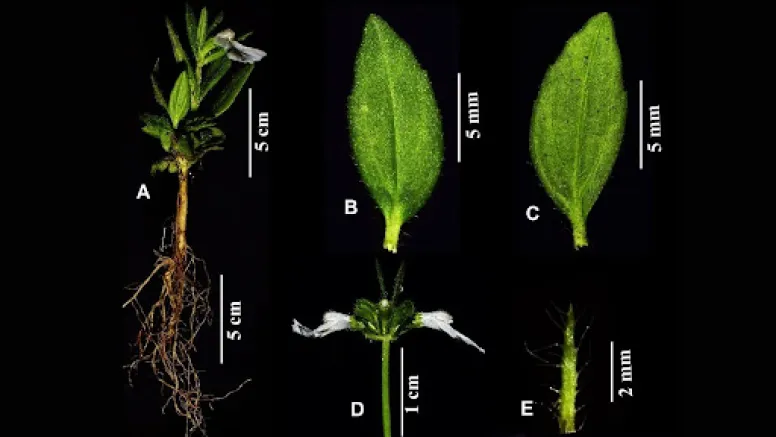
CUDDALORE, TAMIL NADU – In a significant development for Indian botany and coastal ecology, researchers have identified a previously unknown plant species thriving amidst the shifting sands of the Coromandel Coast. The discovery, made by a collaborative team from Annamalai University and the Government Siddha Medical College, marks a vital addition to India’s rich floral record. The new species, a resilient herb named Leucas droupadiae, has been christened in honor of the 15th President of India, Smt. Droupadi Murmu, symbolizing a bridge between scientific discovery and national representation.
While the discovery highlights the hidden biodiversity of India’s coastal dunes, it also serves as a clarion call for conservation. Found in a fragile ecosystem currently under pressure from industrial expansion and invasive plantations, Leucas droupadiae represents the delicate balance of nature in one of the country’s most vulnerable geographic zones.
Main Facts: The Discovery of Leucas droupadiae
The discovery of Leucas droupadiae occurred during a systematic botanical survey of the Cuddalore district in Tamil Nadu. The researchers were exploring the nutrient-poor, high-salinity environments of the coastal sand dunes—a habitat often overlooked in favor of lush tropical forests but one that harbors specialized life forms capable of surviving extreme conditions.
Botanical Classification and Characteristics
Leucas droupadiae belongs to the genus Leucas, a member of the Lamiaceae (mint) family. The genus is well-known in the Indian subcontinent, particularly in traditional medicine systems like Siddha and Ayurveda, where various species—commonly known as ‘Thumbai’ in Tamil—are used to treat ailments ranging from snakebites to respiratory issues.

However, Leucas droupadiae possesses morphological traits that distinguish it sharply from its 155 known relatives:
- Growth Habit: Unlike many Leucas species that exhibit creeping, decumbent, or heavily branched shrub-like growth, this new species is strictly erect. It grows as a solitary, unbranched stem reaching a modest height of approximately 15 centimeters.
- Root System: While most dune-dwelling plants develop deep taproots to seek moisture, Leucas droupadiae utilizes a shallow, intricate web of fibrous roots, allowing it to stabilize itself in the loose top-layer of the coastal sands.
- The Seeds (Nutlets): The most striking feature is the plant’s fruit. It produces oblong nutlets of a brilliant golden-yellow hue, adorned with irregular dark brown spots. This "leopard-print" patterning is unique within the genus and served as a primary diagnostic tool for the researchers.
The Geographic Context
The Coromandel Coast, stretching along the southeastern edge of the Indian peninsula, is characterized by its dynamic sandy shores and scrub jungles. The discovery site in Cuddalore is a testament to the evolutionary ingenuity of plants that have adapted to the harsh glare of the sun, salt spray, and the low moisture-retention capacity of sandy soil.
Chronology: From Field Observation to Scientific Recognition
The journey of Leucas droupadiae from an anonymous coastal weed to a recognized scientific species spanned over a year of rigorous investigation.
- Initial Discovery (2025): During a routine field expedition, botanists from Annamalai University noticed a small, upright herb that did not match the common Leucas aspera or Leucas diffusa typically found in the region.
- Life Cycle Study: To ensure the plant was not merely a stunted or juvenile form of an existing species, the team monitored its growth for a full year. They documented its flowering patterns, pollination mechanisms, and seed dispersal.
- Comparative Taxonomy: Samples were collected and processed into herbarium sheets. The researchers then began the painstaking process of comparing their specimen with global databases. This included digital and physical consultations with the Natural History Museum in London and the Royal Botanic Gardens, Kew.
- Verification: After confirming that the plant’s unique unbranched habit and spotted golden nutlets were not recorded in any existing literature or type specimens of the 155 known Leucas species, the team prepared their findings for peer-reviewed publication.
- Formal Naming (August 2026): The species was officially described and named Leucas droupadiae, honoring President Droupadi Murmu, coinciding with celebrations of national identity and biodiversity.
Supporting Data: Understanding the Genus Leucas
To appreciate the significance of this find, one must look at the broader context of the Leucas genus in India. India is considered a primary center of diversity for this genus, with dozens of species endemic to the Western and Eastern Ghats.

Comparative Table: Leucas droupadiae vs. Closest Relatives
| Feature | Leucas droupadiae | Common Leucas (e.g., L. aspera) |
|---|---|---|
| Stem Type | Unbranched, solitary | Highly branched, bushy |
| Rooting | Fibrous, shallow web | Deep, woody taproot |
| Height | Up to 15 cm | 30 cm to 60 cm |
| Nutlet Color | Golden yellow with dark spots | Dull brown or black |
| Habitat | Active sand dunes | Wastelands, roadsides, fields |
The data suggests that Leucas droupadiae has undergone "niche specialization." By remaining small and unbranched, it reduces its surface area, thereby minimizing water loss through transpiration—a crucial adaptation for a plant living in the desiccating winds of the Tamil Nadu coast.
Broader Botanical Trends
This discovery follows a trend of significant botanical and agricultural breakthroughs in India. Recently, researchers in Bihar uncovered charred remains of ancient seeds that trace a 3,000-year history of Indian agriculture, showing how ancient civilizations transitioned to intensive rice cultivation. The discovery of Leucas droupadiae adds another layer to this narrative, proving that while we are learning more about our agricultural past, our natural "wild" biodiversity still holds many secrets.
Official Responses and the Naming Tribute
The decision to name the plant after President Droupadi Murmu was a deliberate act of tribute by the research team. In a statement, the lead researchers from Annamalai University emphasized that the naming reflects more than just professional respect.
A Tribute to Representation
"President Droupadi Murmu’s journey from a humble tribal village to the highest office in the land is an inspiration to millions," the team stated. "By naming this species after her, we celebrate the resilience and the ‘roots’ of our nation. Just as this plant thrives in a challenging environment, the President has navigated a path of great significance for the marginalized communities of India."

Academic and Government Commentary
Officials from the Government Siddha Medical College noted the potential medicinal value of the new species. "The genus Leucas is a cornerstone of Siddha medicine. While we have just identified Leucas droupadiae, its unique morphology suggests it may contain distinct phytochemical properties. We are eager to investigate its potential therapeutic applications, particularly in treating skin conditions or inflammatory disorders common in coastal populations."
Implications: Conservation and the Future of Coastal Biodiversity
Despite the excitement surrounding its discovery, the future of Leucas droupadiae is precarious. The researchers have provisionally categorized the species as "Data Deficient" (DD) under the IUCN (International Union for Conservation of Nature) criteria, though they warn it likely nears the "Critically Endangered" threshold due to its limited range.
Environmental Threats
The study identified three primary threats to the survival of the species:
- Invasive Plantation Forestry: The expansion of eucalyptus plantations in Cuddalore is a major concern. Eucalyptus trees are known to be "water guzzlers," significantly lowering the local water table and altering the soil pH, which can be fatal for small herbs like Leucas droupadiae.
- Grazing Pressure: Local livestock often graze on the sparse vegetation of the dunes. Due to the plant’s small size and solitary growth, even minor grazing activity can wipe out an entire local population before it has the chance to set seed.
- Climate Change and Coastal Erosion: Rising sea levels and the increasing frequency of cyclonic storms in the Bay of Bengal threaten to wash away the very dunes the plant calls home.
The Path Forward
The discovery of Leucas droupadiae serves as a reminder that biodiversity loss is often "silent." Species may disappear before they are even discovered. The research team is now advocating for the Cuddalore coastal dunes to be designated as a "Biodiversity Heritage Site."

"We cannot protect what we do not know exists," said one of the botanists. "This plant has survived for thousands of years in the shadows of the Coromandel Coast. It would be a tragedy of the highest order if it were to go extinct within years of its discovery due to human negligence."
The team plans to conduct further surveys along the coast to see if other populations exist in neighboring districts like Nagapattinam or Villupuram. Furthermore, efforts are underway to cultivate the species in botanical gardens to ensure an ex-situ conservation backup.
As India continues to modernize, the story of Leucas droupadiae—a small, resilient herb named after a historic leader—underscores the necessity of looking closely at the ground beneath our feet. In the grains of sand on a Tamil Nadu beach, science has found a new treasure, and a nation has found another reason to take pride in its natural heritage.
