

High above the clouds in the Western Ghats of South India lies an ancient and ethereal landscape known as the "Shola Sky Islands." This unique ecosystem, characterized by a mosaic of stunted montane evergreen forests (Sholas) nestled in the folds of rolling high-altitude grasslands, is one of the world’s most significant biodiversity hotspots. However, a silent crisis is unfolding across these peaks. As the native grasslands vanish, replaced by invasive exotic plantations and human infrastructure, the biological "bridges" that allow endemic bird species to survive are crumbling.
New research from the Indian Institute of Science Education and Research (IISER) Tirupati reveals that this habitat loss is fundamentally altering how birds navigate the landscape. While forest-dwelling species are finding ways to adapt to the changing terrain, the region’s specialist grassland birds—most notably the endemic Nilgiri pipit—are becoming increasingly isolated, facing a future of genetic stagnation and potential extinction.
Main Facts: A Landscape Under Siege
The Shola Sky Islands are biologically significant because they function like oceanic islands; they are isolated high-altitude habitats separated by "seas" of lower-elevation valleys. This isolation has led to the evolution of numerous species found nowhere else on Earth.
The core of the current crisis lies in the dramatic shift in land-use dynamics over the last century. Historically, the Nilgiris were a balanced mix of dense Shola patches and expansive grasslands. However, colonial-era policies viewed these grasslands as "wastelands" or "unproductive" spaces. To remedy this, the British and subsequent Indian administrations introduced exotic tree species, including Acacia (Wattle), Eucalyptus, and Pinus (Pine), intended for timber, fuel, and the tanning industry.
These exotic species did not remain confined to their plantations. Being highly invasive, they have marched across the hillsides, choking out the native grasses. The scale of this transformation is staggering: between 1973 and 2017, the Sky Islands lost approximately 516 square kilometers of grasslands and 63 square kilometers of native forests. This represents a massive reduction in the primary habitat for species that have spent millennia evolving to fit this specific ecological niche.
The recent study by IISER Tirupati, led by researchers including Postdoctoral Fellow Chiti Arvind and Associate Professor V.V. Robin, examined how this fragmentation affects the movement of seven endemic bird species. The findings highlight a stark divide: "landscape connectivity"—the ease with which an animal can move through its environment—is being severed for those who need open skies and grass, while being artificially maintained or even expanded for those who can tolerate woody cover.

Chronology: From Colonial "Greening" to Modern Crisis
The transformation of the Nilgiris is not a recent phenomenon but the result of nearly two centuries of ecological mismanagement.
The 19th Century: The Colonial Aesthetic
When British officials first arrived in the Nilgiris, they found the rolling grasslands reminiscent of the Scottish Highlands but felt they lacked "useful" timber. Beginning in the mid-1800s, they began large-scale trials of Australian exotics. Eucalyptus was planted for fuel, while Acacia was introduced for the tannins in its bark. These species were chosen for their rapid growth, which far outpaced the slow-growing native Shola trees.
The Mid-20th Century: Industrial Expansion
Following India’s independence, the drive for self-sufficiency led to further expansion of these plantations. The state forest departments continued to convert "barren" grasslands into productive timber stands. During this period, the ecological value of grasslands as water catchments and carbon sinks was largely ignored in favor of industrial output.
1973–2017: The Great Decline
Satellite imagery from this 44-year period provides a grim record of the acceleration of habitat loss. As the exotic plantations matured, they began to seed themselves into the surrounding grasslands. This "woody invasion" was compounded by the expansion of tea estates, commercial agriculture, and urban settlements in towns like Ooty and Kodaikanal.
The Present Day: The Research Awakening
In the last decade, ecologists have begun to sound the alarm. The IISER Tirupati study represents the latest effort to quantify the damage, moving beyond mere acreage lost to understanding the "functional connectivity" of the landscape—essentially, how difficult it has become for a bird to fly from one patch of habitat to another.
Supporting Data: Specialists vs. Generalists
The IISER Tirupati study covered 2,900 square kilometers across the Nilgiris and the Palani-Anamalai hills, focusing on elevations above 1,400 meters. Researchers built 126 sophisticated models to predict movement patterns based on the behavior of seven endemic species.

The Forest Specialists
Six of the species studied were forest specialists:
- White-bellied Sholakili
- Nilgiri Sholakili
- Palani Laughingthrush
- Nilgiri Laughingthrush
- Black-and-orange Flycatcher
- Nilgiri Flycatcher
The models showed that while these birds avoid human settlements and tea plantations, they are surprisingly mobile within the "woody" landscape. The invasive Acacia and Eucalyptus stands, while not their preferred habitat, provide enough cover for these birds to move between native Shola patches. In some cases, the increase in tree cover has actually created new pathways for these species, though the quality of the habitat remains inferior to native forests.
The Grassland Specialist: The Nilgiri Pipit
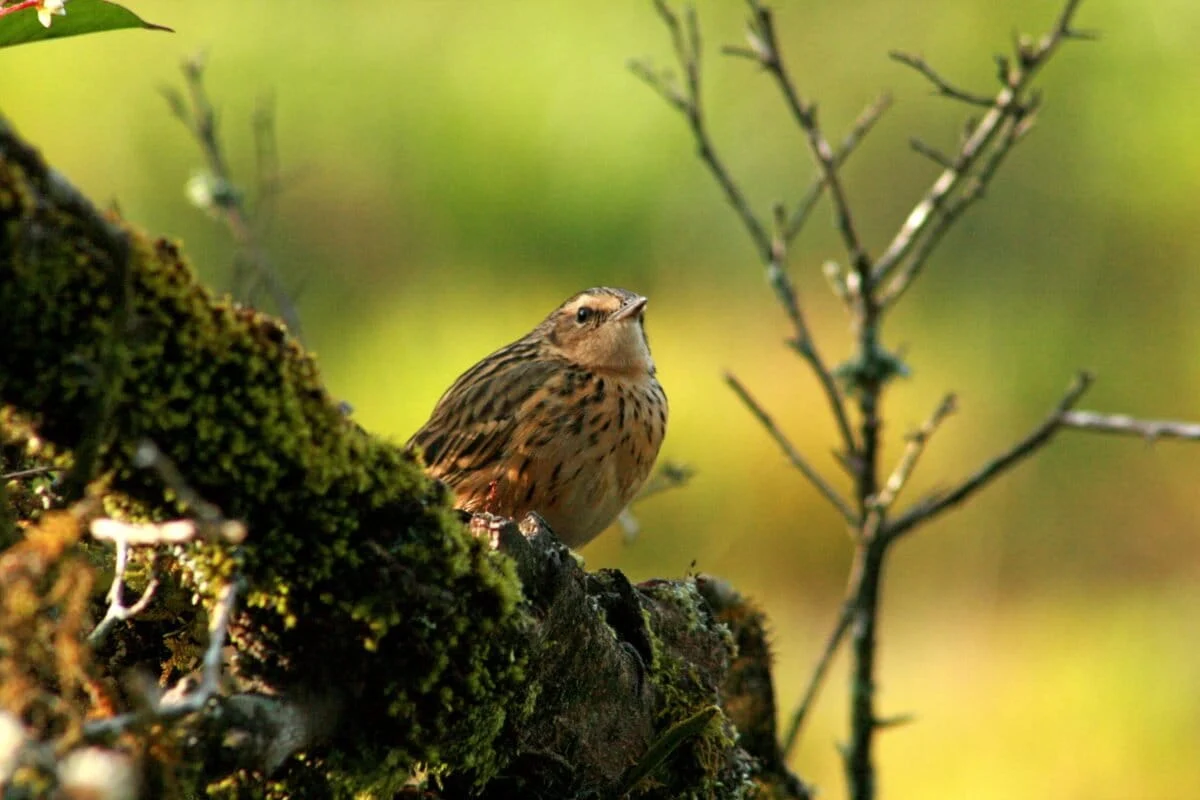
The seventh species, the Nilgiri pipit (Anthus nilghiriensis), tells a much darker story. As the only high-altitude endemic grassland specialist with sufficient data for the study, the pipit serves as a bioindicator for the health of the entire grassland ecosystem.
The data reveals that the Nilgiri pipit’s movement is severely hindered. Unlike the forest birds, the pipit requires open, treeless spaces for foraging, nesting, and roosting. To a pipit, a dense stand of invasive Wattle is as much of a barrier as a concrete wall. Consequently, populations are being squeezed into smaller and smaller "islands" of grass. Separate studies have confirmed that the Nilgiri pipit has suffered the steepest population decline of any bird in the region over recent decades.
The Genetic Threat
The fragmentation of habitat leads to the fragmentation of the gene pool. When birds cannot move between populations to mate, inbreeding becomes inevitable. "Future studies examining genetic connectivity… are needed to determine whether these habitat changes have actually reduced gene flow and whether there is a risk of isolation," noted Chiti Arvind. If the pipit populations become genetically isolated, their ability to adapt to climate change or disease will be severely compromised.
Official Responses and Ecological Perspectives
The research has sparked a call for a paradigm shift in how the Western Ghats are managed. For too long, "reforestation" has been the buzzword for conservation, but in the Sky Islands, planting trees can be part of the problem.

Arunima Jain, a project student at IISER Tirupati and contributor to the research, emphasizes that "an increase in woodland cover implies a corresponding decrease in grassland." This zero-sum game means that every hectare of "greenery" added via plantations is a hectare of habitat lost for the Nilgiri pipit.
V.V. Robin, Associate Professor at IISER Tirupati, argues that the study provides a roadmap for conservation. "The results of our study… can be used to identify priority areas for restoration," he says. The goal is no longer just to "save the forest," but to restore the mosaic—the specific balance of forest and grass that defines the region.
The Tamil Nadu Forest Department has, in recent years, begun to acknowledge this. There have been pilot projects aimed at removing invasive Wattle and restoring native grasses, but the work is labor-intensive and expensive. The invasive seeds can remain dormant in the soil for decades, meaning that once an area is cleared, it requires constant monitoring to prevent the exotics from returning.
Implications: More Than Just Birds
The disappearance of the Shola grasslands and the isolation of its birds have implications that extend far beyond ornithology. These high-altitude ecosystems are the "water towers" of Southern India.
Water Security
The Shola-grassland mosaic acts as a giant sponge. The grasslands intercept rainfall and allow it to seep slowly into the soil, replenishing the headwaters of major rivers like the Bhavani and the Cauvery. The native grasses have deep, complex root systems that maintain soil porosity. In contrast, exotic plantations like Eucalyptus are notorious "water guzzlers," transpiring vast amounts of groundwater and drying up local streams. Furthermore, the loss of grasslands has been linked to diminished soil quality and reduced water retention capacity, threatening the water security of millions of people downstream.
A Warning for Other Ecosystems
The Nilgiris are not an isolated case. Similar patterns have been observed in the grasslands of Maharashtra, where afforestation programs—often well-intentioned attempts to increase carbon sequestration—have replaced native grasslands with woody plantations. In these regions, too, grassland specialists are being pushed out by forest generalists, leading to a homogenization of biodiversity where unique, specialized species are lost in favor of more common ones.

The Restoration Imperative
The study’s most urgent implication is the need for a "grassland-first" restoration strategy in specific zones. To save the Nilgiri pipit and the hydrological integrity of the Sky Islands, conservationists argue that we must stop viewing grasslands as "empty" spaces waiting to be filled with trees.
Restoration will require:
- Aggressive Removal of Exotics: Systematic clearing of Acacia and Eucalyptus in key corridors to reconnect isolated grassland patches.
- Scientific Replanting: Using native grass species to stabilize soil and prevent the re-emergence of invasives.
- Community Involvement: Engaging local communities in the Nilgiris to move away from tea expansion in sensitive high-altitude zones.
The Nilgiri pipit, fluttering over a dwindling patch of golden grass, is a reminder that nature’s beauty lies in its diversity. If the connectivity of the Shola Sky Islands is not restored, the "islands" will only grow further apart, until the unique life they hold vanishes into the mist of the Western Ghats.
