

MALKANGIRI, ODISHA – In the emerald-draped folds of the Bonda Hills, where the air is thick with the scent of wild shrubs and the echoes of the Remo language, an ancient rhythm persists. It is the sound of the indigenous loom—a rhythmic clacking that has served as the heartbeat of the Bonda tribe for millennia.
“Every Ringa we weave carries our family’s story,” says Muduli, a weaver from Gokharipada village. Her fingers, weathered by years of agricultural toil and intricate threadwork, move with a practiced grace over a striped cloth she has just completed. This garment, the Ringa, is more than just a wraparound skirt; it is a woven document of one of the world’s most reclusive and fascinating cultures.
The Main Facts: An Emblem of Identity
The Bonda tribe, residing primarily in the Malkangiri district of Odisha, is classified by the Government of India as one of the 75 Particularly Vulnerable Tribal Groups (PVTGs). They are a community that has, with fierce determination, safeguarded its customs, language, and attire against the encroaching tides of globalization.
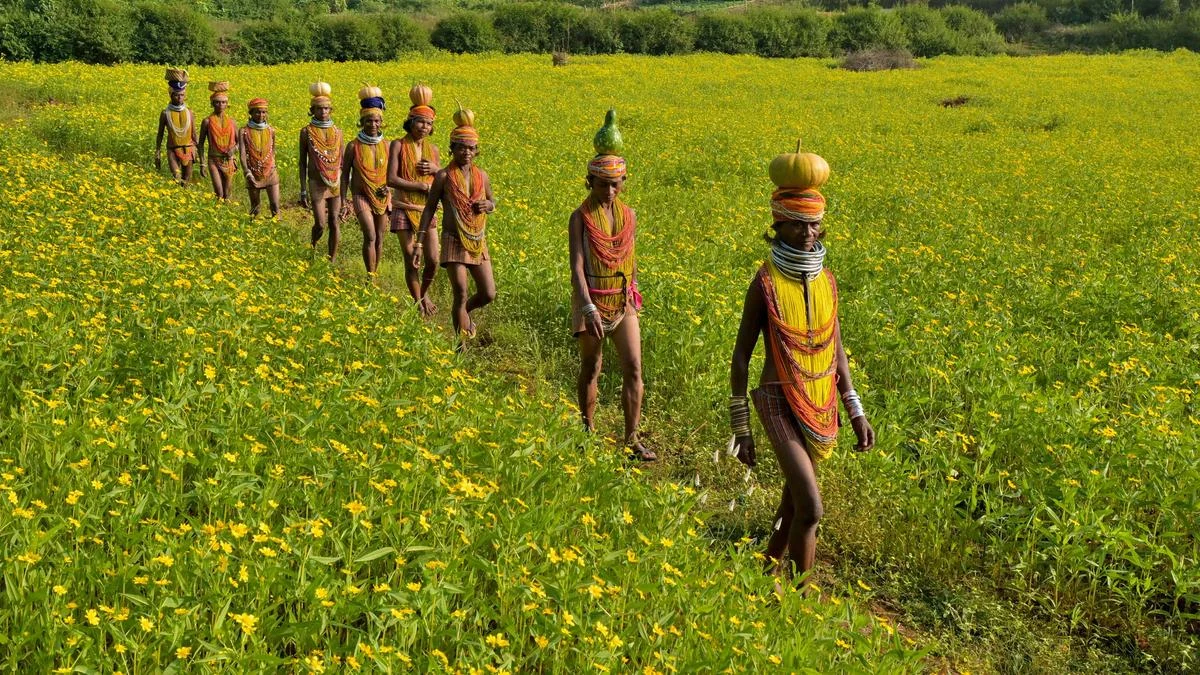
Central to this identity is the Ringa. A traditional handwoven garment, the Ringa is characterized by its striking horizontal stripes, featuring a palette of deep red, maroon, black, white, and blue. For the Bonda woman, the Ringa is the foundational element of an elaborate traditional ensemble that includes layers of vibrant bead necklaces covering the torso, gleaming aluminum neck rings, and blue shawls draped over the shoulders.

Unlike many of India’s famous handloom traditions—such as the Sambalpuri or Ikat of the Odisha plains—the Bonda weaving tradition did not emerge from a desire for commerce. Instead, it is an autarkic craft, born of necessity and maintained for personal and communal use. In the matriarchal structure of Bonda society, the Ringa is the visual signature of womanhood, passed down from mother to daughter as both a skill and a rite of passage.
Chronology: From the Migration out of Africa to the Modern Loom
To understand the Ringa, one must understand the deep history of the people who wear it. Anthropologists and geneticists often point to the Bondas as part of the "first wave" of modern humans who migrated out of Africa approximately 60,000 years ago. While research continues to refine this timeline, the Bondas remain a vital link to the Austroasiatic-speaking populations that have inhabited the Indian subcontinent since prehistory.
The Era of Kerang (Pre-20th Century):
Historically, the Ringa was a product of the forest itself. The primary raw material was not cotton, but Kerang—a fiber extracted from a wild shrub native to the Eastern Ghats. The process was grueling: women would harvest the bark, soak it in mountain streams, beat it to separate the fibers, and then spin it into a coarse, incredibly durable yarn. This "bark cloth" was the original medium of the Bonda identity, a literal manifestation of their connection to the land.
The Transition to Cotton (Mid-20th Century to Present):
As the Bonda Hills became slightly more accessible and the weekly markets (shandies) grew in importance, cotton yarn began to filter into the highlands. While the material changed, the visual lexicon remained static. The horizontal stripes and the specific color configurations were preserved, ensuring that even as the "skin" of the garment changed from bark to cotton, its "soul" remained Bonda.
The Modern Era of Exposure:
In recent decades, the outside world has taken a keener interest in the Bonda Hills. What was once a closed ecosystem is now a site of careful cultural exchange. Today, while many Bonda women still weave for their families, a growing number of Ringas are finding their way into the hands of textile collectors and scholars, marking the beginning of a subtle shift from personal use to a niche artisanal economy.

Supporting Data: The Mechanics of a Matriarchal Craft
The Bonda society is one of the few remaining matriarchal bastions in India. Here, women are the primary decision-makers, the negotiators at the Thursday markets, and the sole custodians of the weaving tradition.
The Production Cycle:
- Time Intensity: A single Ringa typically takes two to three days of focused labor to complete. However, because weaving is integrated into the "rhythm of life," a piece may take longer as women balance the loom with farming, foraging for forest produce, and household management.
- The Loom: The Bonda use a simple, indigenous tension loom (or backstrap loom). It is portable and suited to the hilly terrain, allowing a woman to set up her work wherever she finds a moment of respite.
- Economic Structure: Traditionally, the "cost" of a Ringa was only the labor involved. Today, with the use of market-bought cotton yarn, a small investment is required, which is often recouped by selling surplus crops at the Onukudelli market.
The Thursday Shandy:
The weekly market at Onukudelli serves as the primary point of contact between the Bondas and the outside world. It is here that the visual impact of the Ringa is most potent. Hundreds of Bonda women descend from the hills, their Ringas serving as a uniform of cultural pride. For the community, it is a place of trade; for the observer, it is a living gallery of ancient textile art.
Expert Perspectives: Documentation and Ethical Tourism
Navaldeep Thareja, a textile engineer and founder of Behrupiaa Arts, has spent years documenting the Bonda weaving tradition. His perspective highlights the uniqueness of the Ringa in the broader context of Indian textiles.
“What makes the Bonda weaving tradition unique is that it has always been closely tied to the community’s identity rather than to commerce,” Thareja explains. “Unlike many handloom traditions in Odisha that evolved around royal patronage or market demand, the Bonda wove the Ringa primarily for themselves. It is one of the few textile traditions where a single garment has remained central to the community’s identity for generations.”

Thareja’s work involves organizing curated, small-group tours that prioritize ethics over "poverty tourism." He emphasizes that the Bonda are not a spectacle, but a living civilization.
“We never treat the village as a tourist attraction,” says Thareja. “The purpose is to create understanding while respecting the community’s privacy.” To maintain this boundary, Thareja facilitates interactions in neutral spaces, such as locally managed homestays, where weavers can choose to share their craft on their own terms. This model ensures that the "gaze" of the outsider does not disrupt the internal social fabric of the village.
Implications: The Fragile Future of the Ringa
Despite the resilience of the Bonda culture, the Ringa faces an uncertain future. The challenges are multi-faceted, ranging from economic pressures to the inevitable shift in generational aspirations.
1. The Economic Gap:
“The biggest challenge is that weaving alone does not provide a steady income,” Muduli admits. For a young Bonda woman, the choice is often between spending three days weaving a garment for herself or seeking education and employment that could provide a more stable financial future. As the Bonda youth become more integrated into the mainstream educational system, the "muscle memory" required for weaving is at risk of being lost.
2. The Infiltration of Ready-made Garments:
Modernity brings convenience. Synthetic saris and factory-made tops are increasingly common in the Bonda Hills, particularly among the younger generation. These garments are cheaper, easier to maintain, and represent a "modern" identity that some youth find appealing. While the Ringa remains essential for festivals and ceremonies, its status as everyday wear is slowly eroding.

3. The "Artisan" Pivot:
One potential path for the survival of the Ringa is its recontextualization as art. As textile scholars and collectors begin to value the Ringa as a piece of "framed textile art" or a wall hanging, it creates a new market. This "supplementary income" could provide the necessary incentive for young women to continue learning the craft. However, this also raises questions about "cultural commodification"—can the Ringa remain a sacred tribal emblem if it becomes a decorative item in a city-dweller’s living room?
Conclusion: A Loom of Hope
The story of the Ringa is a microcosm of the struggle faced by indigenous cultures worldwide. It is a tension between the desire to preserve a unique, ancient heritage and the natural human drive toward modernization and ease.
For Muduli and the women of Gokharipada, the loom remains a "family archive." Every stripe is a memory of a grandmother’s instruction; every color is a link to the forest they have inhabited for sixty millennia.
“It makes us happy that people appreciate our weaving and our traditions,” Muduli concludes. “When someone values the Ringa, it encourages us to continue this craft and pass it on to the next generation.”
As the sun sets over the Malkangiri district, the clacking of the looms begins to fade, replaced by the evening sounds of the hills. For now, the story of the Bonda continues to be written, one thread at a time, in the vibrant, resilient stripes of the Ringa. The survival of this craft will depend not just on the weavers themselves, but on how the modern world chooses to value, protect, and respect the hands that create it.
