

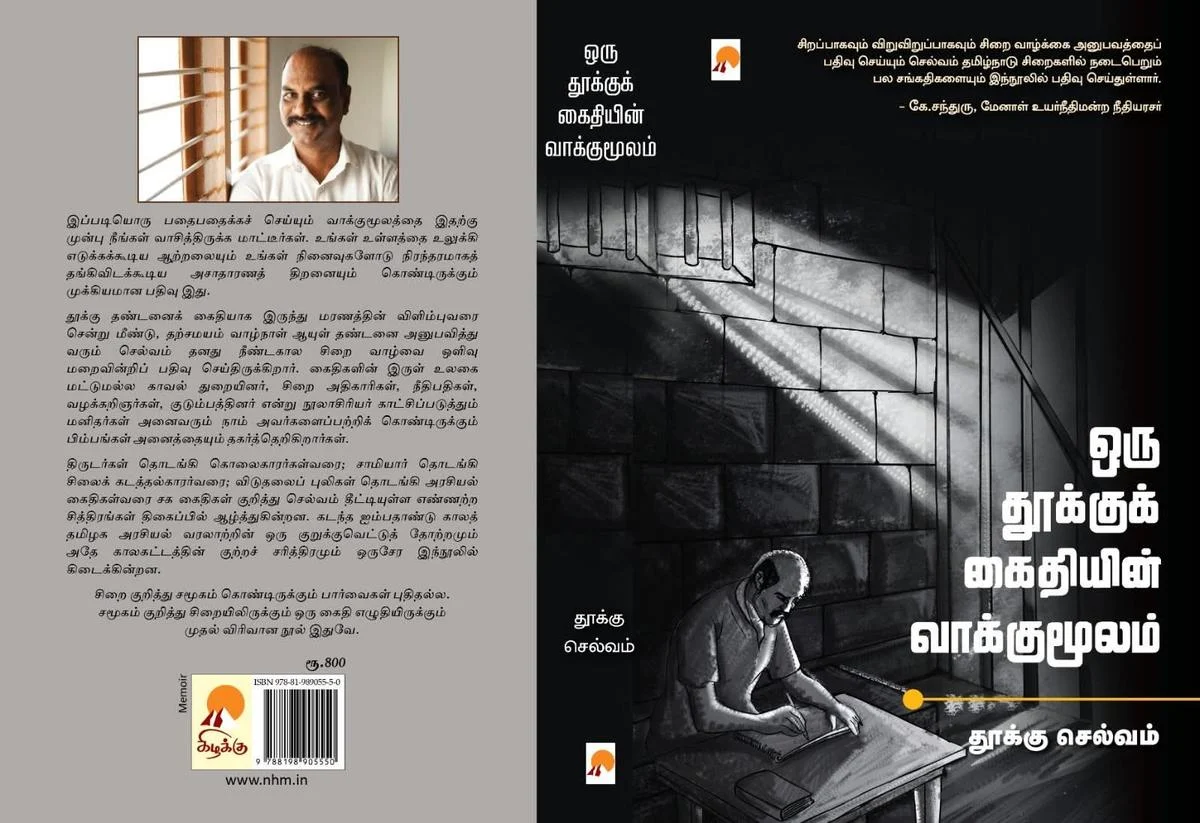
VELLORE – In an unprecedented intersection of criminal justice and high literature, C. Selvam, a life convict who has spent over three decades behind bars, has been named the recipient of the prestigious Iyal Award for non-fiction. The accolade, conferred by the Canada-based Tamil Literary Garden, recognizes his seminal memoir, Oru Thooku Kaithiyin Vaakumoolam (Testimony of a Death Warrant Prisoner).
This recognition marks a historic moment in the Tamil literary landscape, as it is believed to be the first time a major international literary prize has been awarded to an individual serving a life sentence within the Indian prison system. Selvam’s work, which emerged from the depths of a death row cell, has been lauded not only for its raw emotional honesty but for its profound insights into the necessity of prison reform and the resilience of the human spirit.
Main Facts: A Voice from the Shadows
The announcement by the Tamil Literary Garden has sent ripples through both the literary and legal communities. The Iyal Award is one of the most coveted honors in Tamil letters, typically reserved for scholars and writers of immense pedigree. By selecting Selvam, the committee has acknowledged the power of "literature from the margins"—narratives written by those whom society has largely forgotten.
Selvam, currently lodged in the Vellore Central Prison and briefly out on parole, received the news with a mixture of humility and reflection. The award carries a cash prize of 1,000 Canadian Dollars and a citation, which will be presented at a ceremony in Canada. Given Selvam’s legal status, the organizers have requested that he depute a representative to accept the honor on his behalf.
The book, Oru Thooku Kaithiyin Vaakumoolam, is more than a mere autobiography; it is an ethnographic study of the Indian penal system from the perspective of the condemned. It chronicles the psychological toll of living under a death warrant, the harrowing atmosphere of the "gallows cell," and the eventual transition to life imprisonment.
Chronology: Thirty-Two Years of Incarceration
The path to this literary milestone began in 1994, a year that altered the course of Selvam’s life forever. A native of Thenthamaraikulam in the Kanniyakumari district, Selvam was embroiled in a murder case that shocked the local community.
- 1994: Selvam and his associates, Radhakrishnan and Shiekmeeran, surrendered before a court in Nagercoil. The legal proceedings that followed were swift and severe.
- The Trial and Sentencing: The trial court awarded the death penalty to Selvam and his co-accused. For years, Selvam lived as a "death warrant prisoner," a status that carries a unique form of psychological purgatory, where every dawn could potentially be one’s last.
- The Commutation: After years of legal battles and mercy petitions, the President of India commuted the death sentences to life imprisonment. However, the commutation came with a stringent caveat: the convicts were to remain in prison for the remainder of their natural lives, without the possibility of the standard remissions usually granted for good behavior.
- The Intellectual Awakening: Having dropped out of school after Class 9, Selvam entered prison with limited formal education. However, the isolation of the cell became a catalyst for intellectual growth. Over three decades, he transformed into a voracious reader, consuming the works of Tamil literary giants.
- December 2025: His memoir, Oru Thooku Kaithiyin Vaakumoolam, was published by Kizhakku Pathippagam, marking his official entry into the world of letters.
- August 2026: The Canada-based Tamil Literary Garden announces Selvam as the winner of the Iyal Award for non-fiction.
Supporting Data: The Literary Influence and the Publication Process
Selvam’s transformation from a school dropout to an award-winning author was not an accidental occurrence. It was the result of thousands of hours spent in prison libraries. He cites a "Mount Rushmore" of Tamil literary figures as his primary influences: Sundara Ramasamy, S. Ramakrishnan, Nanjil Nadan, and Jayamohan.

"I consider it an award for my reading," Selvam stated while on parole. "I could not study beyond Class 9, and reading sustained me in prison all these years. It was the books that kept the walls from closing in."
The journey to publication was equally serendipitous. The manuscript came to the attention of Badri Seshadri, the publisher of Kizhakku Pathippagam, during a period when Seshadri himself was briefly lodged in Tiruchi jail due to legal issues involving remarks against the judiciary. This "chance encounter" between a seasoned publisher and a veteran convict allowed Selvam’s voice to transcend the prison walls.
The Foreword by Justice K. Chandru
Further legitimizing the work is the foreword penned by Justice K. Chandru, a retired judge of the Madras High Court renowned for his landmark judgments on social justice (and the inspiration for the film Jai Bhim). Justice Chandru noted that he chose to support the book because of its uncompromising commitment to the truth. Unlike sensationalized "true crime" novels or cinematic depictions of prison life, Selvam’s narrative avoids melodrama in favor of a stark, realistic portrayal of the legal and carceral machinery.
Official Responses: Acclaim from the Literary Fraternity
The news of the award has been met with widespread acclaim from authors and activists alike. A. Muthulingam, a legendary Sri Lankan Tamil writer based in Canada and a key figure in the Tamil Literary Garden, sent a personal message of congratulations to Selvam, emphasizing the book’s contribution to the non-fiction genre.
Badri Seshadri, Selvam’s publisher, highlighted the book’s multi-dimensional impact. "The book was likely to win many awards as it seemed to have touched people across multiple domains," Seshadri said. "It is not just about its literary aspects; it deals with complex legal issues with a clarity that has made a significant impact on the legal fraternity, including sitting judges."
The Tamil Literary Garden’s press release also listed other luminaries being honored alongside Selvam, providing a sense of the high company he now keeps:
- Lifetime Achievement Award: Trotsky Marudhu (Artist and Intellectual)
- Fiction Award: Writer Thirusenthalai
- Non-Fiction Award: Shared by C. Selvam and Sankar Saravanan
- Poetry Award: Karunakaran
- Translation Award: Geetha Sukumaran
Implications: Prison Reform and the Ethics of Punishment
The recognition of Oru Thooku Kaithiyin Vaakumoolam raises critical questions about the nature of rehabilitation and the Indian penal code. Selvam’s case is a prime example of the "life until death" sentencing structure, which leaves little room for the traditional concept of reform-based release.

1. The Power of Rehabilitation through Art
Selvam’s achievement serves as a powerful argument for the rehabilitative potential of literature and education within prisons. His ability to produce a work of such high caliber suggests that even those convicted of the gravest offenses are capable of profound personal evolution if given access to intellectual resources.
2. A Critique of the Legal System
The book is being hailed as a "testimony" that exposes the flaws in the judicial process. By detailing the experience of being on death row, Selvam provides a rare look at the "death warrant" phase—a period of intense psychological trauma that many activists argue constitutes "double punishment" (the trauma of waiting to die, followed by the execution or life imprisonment).
3. Impact on Legal Discourse
According to legal experts, Selvam’s writing provides a "view from below" that is often missing in high-court deliberations. His descriptions of prison conditions, the behavior of authorities, and the internal hierarchy of inmates offer a roadmap for potential prison reforms. Justice Chandru’s involvement suggests that the book may be used as a reference point for future discussions on the rights of life convicts.
4. Redefining the "Convict" Identity
Selvam’s award challenges the societal stigma associated with long-term prisoners. By being recognized as a peer by international literary scholars, Selvam has successfully reclaimed an identity beyond that of "Convict No. X." This shift from "prisoner" to "author" is a significant cultural milestone in the effort to humanize incarcerated individuals.
Conclusion: The Unconquerable Mind
As C. Selvam prepares to return to the confines of Vellore prison following his parole, he does so not just as a man serving a life sentence, but as a celebrated author whose words have traveled across oceans to Canada and back.
His story is a testament to the fact that while the body can be confined within stone walls and iron bars, the intellect remains a territory that cannot be easily occupied. Oru Thooku Kaithiyin Vaakumoolam stands as a monumental contribution to Tamil non-fiction, ensuring that even if Selvam remains physically incarcerated, his voice will continue to advocate for justice, reform, and the enduring power of the written word.
The Iyal Award is more than a trophy for Selvam; it is a validation of thirty-two years of silent study, a tribute to the authors who kept him company in the dark, and a clarion call for a more empathetic understanding of the human condition behind bars.
