

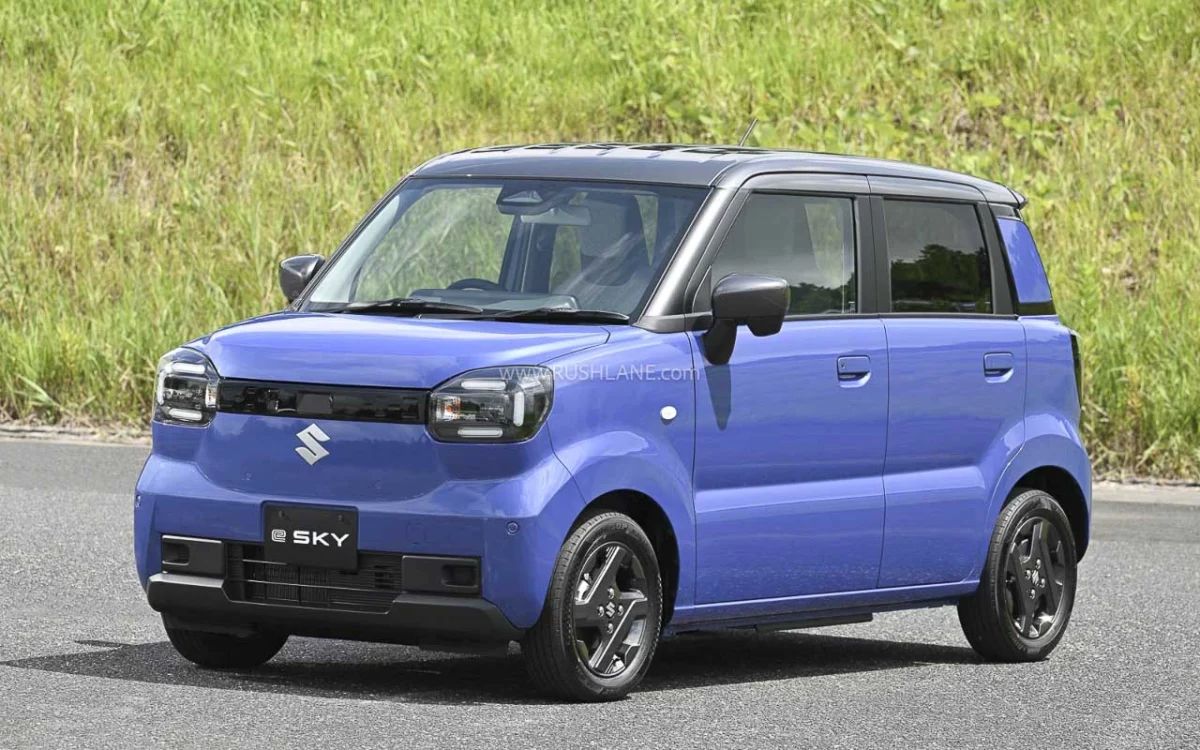
In a move that signals a significant shift in the Japanese automotive landscape, Suzuki has officially unveiled the near-production version of its first-ever electric kei car, the Suzuki e Sky. Making its debut in Japan, this compact powerhouse represents the culmination of years of research, concept development, and rigorous international testing. Following its initial reveal as the "Vision e Sky" concept and subsequent sightings during testing on European roads, the production-ready model arrives with a surprising headline figure: a claimed driving range of 310 kilometers.
As the automotive world pivots toward electrification, the "kei car" segment—Japan’s unique category of small, tax-efficient vehicles—has become a crucial battleground. With the e Sky, Suzuki aims to prove that electric mobility does not require a compromise on space, utility, or affordability.

I. Main Facts: The Suzuki e Sky at a Glance
The Suzuki e Sky is a two-wheel-drive, fully electric hatchback designed specifically to navigate the dense, often narrow urban environments of Japan. While it adheres to the strict physical dimensions required for "kei" classification, it leverages modern EV packaging to maximize interior volume.
Key Specifications and Design Language
The e Sky measures precisely 3,395 mm in length, 1,475 mm in width, and 1,625 mm in height. These dimensions are the maximum allowed for the kei segment, ensuring it qualifies for various Japanese tax and insurance incentives. It sits on a 2,460 mm wheelbase, which is remarkably long relative to its overall length, pushing the wheels to the corners to create a stable footprint and a spacious cabin.

Architecturally, the vehicle adopts a "boxy" silhouette. This "tall-boy" design is a hallmark of Suzuki’s expertise in compact cars (reminiscent of the legendary WagonR), allowing for ample headroom and a flat floor. The exterior aesthetic is modernized with:
- Rectangular LED Headlamps: Featuring distinct C-shaped signatures that give the car a high-tech "face."
- Contrasting Aesthetics: A slim black panel connects the lights, while a contrasting black roof provides a two-tone finish that lowers the visual center of gravity.
- Functional Utility: Vertical tail lamps and a flat tailgate maximize rear access, while squared-off wheel arches hint at a robust, durable build.
Performance and Efficiency
Perhaps the most striking detail of the debut is the 310 km range. This is a significant leap over the 270 km range initially estimated during the concept phase. Suzuki attributes this efficiency to a "gram-by-gram" approach to weight reduction, resulting in a kerb weight of just 1,030 kg—exceptionally light for a battery-electric vehicle.

To combat the range-sapping effects of climate control, Suzuki has equipped the e Sky with a direct heat-pump system and an air-heated electric heater. These components are far more efficient than traditional resistive heaters, ensuring that the driving range remains viable even during Japan’s cold winters.
II. Chronology: From Concept to Near-Production
The journey of the Suzuki e Sky has been a transparent one, reflecting Suzuki’s cautious yet deliberate entry into the EV market.

- The Vision e Sky Concept: The world first saw the design language of this vehicle under the "Vision e Sky" moniker. At the time, it was presented as a futuristic study of how an electric WagonR might look, focusing on "connected" features and sustainable materials.
- European Proving Grounds: In a move that surprised many industry analysts, Suzuki was spotted testing the small EV in Europe. This suggested that while the car is a kei car by Japanese standards, Suzuki is considering its viability as an "A-segment" electric vehicle for global markets like the UK, France, and Italy, where narrow city streets demand similar dimensions.
- The Near-Production Debut (August 2026/2027): The current reveal showcases the car in its final form. Most concept-only flourishes have been replaced by production-ready parts, such as standard-sized side mirrors, legal lighting arrays, and a finalized interior.
- Market Launch: Suzuki has confirmed that the e Sky will officially go on sale in Japan within the current financial year, with a deadline of March 2027.
III. Supporting Data: Interior Technology and Utility
The Suzuki e Sky is not merely a battery and a motor; it is designed to be a "mobile living space" and a power source.
The Digital Cockpit
Inside, the e Sky moves away from the utilitarian interiors of past small cars. It features a 10.1-inch floating touchscreen infotainment system as the centerpiece. This is complemented by a fully digital instrument cluster that provides real-time data on energy flow, regenerative braking status, and battery health.

The infotainment system is integrated with app-based connected navigation. This software is specifically tuned for EVs, calculating routes based on the current state of charge, topography, and real-time traffic, while automatically suggesting charging stops if the destination is beyond the vehicle’s current range.
Vehicle-to-Load (V2L) Capability
One of the most touted features is the V2L functionality. This allows the car’s high-voltage battery to act as a massive power bank for external devices. Suzuki’s official promotional materials highlight several use cases:

- Remote Work: Powering laptops and mobile hotspots for professionals on the move.
- Outdoor Leisure: Running induction cooktops or coffee makers for camping and "tailgating."
- Emergency Power: Serving as a critical backup power source for small household appliances during power outages, which are a concern in earthquake-prone regions of Japan.
Urban Maneuverability
The e Sky boasts a turning radius of just 4.4 meters. For context, this allows the vehicle to perform a U-turn in spaces where most mid-sized sedans would require a three-point turn. This agility is a key selling point for urban dwellers who frequent tight multi-story parking garages and narrow residential alleys.
IV. Official Responses: Suzuki’s Strategic Positioning
While specific pricing has yet to be finalized, Suzuki’s leadership has been vocal about the vehicle’s mission. The primary goal is to lower the barrier to entry for EV ownership.

Focus on Affordability
A spokesperson for Suzuki indicated that the company intends to price the e Sky competitively against high-end petrol-powered kei cars. By leveraging their expertise in mass production and minimizing unnecessary weight, Suzuki aims to "encourage the transition from internal combustion engines (ICE) to electric mobility without the ‘price shock’ typically associated with EVs."
The "Easy Drive Pedal" Philosophy
Engineers have also highlighted the Easy Drive Pedal function. Suzuki describes this as an evolution of one-pedal driving. When the driver lifts off the accelerator, the regenerative braking system provides a stronger-than-usual deceleration. This reduces the need to switch between pedals in stop-and-go city traffic, thereby reducing driver fatigue and maximizing energy recuperation into the battery.

V. Implications: The Competitive Landscape and Global Potential
The debut of the Suzuki e Sky comes at a pivotal moment. The Japanese market, once dominated by domestic players, is seeing new entries from abroad.
The Rise of Competition
The mention of the BYD Racco (the Japanese market version of the BYD Dolphin or similar small EV) underscores the pressure Suzuki faces. Chinese manufacturers are aggressively entering the small EV space with high-tech features and low price points. The e Sky is Suzuki’s defensive—and offensive—play to retain its crown as the "King of Small Cars."

Impact on the Indian Market
While an India launch has not been confirmed, the implications for Maruti Suzuki (Suzuki’s Indian subsidiary) are immense. India is currently seeing a surge in demand for affordable EVs, currently led by the Tata Tiago EV and MG Comet. The technology used in the e Sky—specifically the weight-saving measures and the efficient heat pump—could easily be adapted for an Indian "e-WagonR" or a similar city car. Given Maruti Suzuki’s massive market share, an affordable EV based on the e Sky platform could potentially democratize electric mobility in the subcontinent.
Environmental and Societal Shift
The e Sky represents more than just a new product; it represents a shift in how urban transportation is viewed. By integrating V2L technology and connected navigation into a vehicle that weighs almost half as much as a standard electric SUV, Suzuki is advocating for "right-sized" electrification. This approach uses fewer raw materials for batteries and consumes less electricity per kilometer, making it a more sustainable path for mass-market decarbonization.

Conclusion
As the Suzuki e Sky prepares for its March 2027 sales debut, it stands as a testament to the idea that the future of the automobile may not be found in larger batteries and faster top speeds, but in smarter packaging and higher efficiency. For the millions of drivers in Japan and beyond who navigate congested cities every day, the e Sky offers a glimpse of a cleaner, quieter, and more versatile urban future. Suzuki has successfully transitioned its "small car, big future" mantra into the electric age, and the 310 km range of the e Sky suggests they are ready to lead the charge.
