

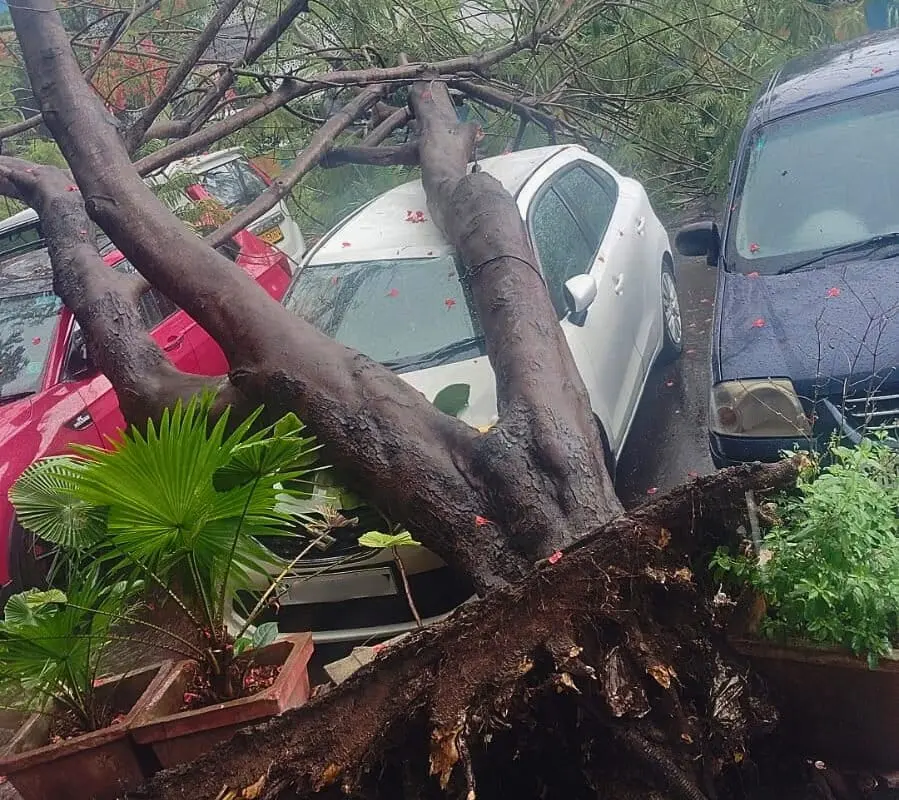
For decades, the arrival of the monsoon in Mumbai was celebrated as a respite from the sweltering tropical heat. Today, however, that sentiment has shifted from relief to apprehension. As heavy rains and gusty winds lash the metropolis, the city’s iconic tree-lined avenues have transformed into high-risk zones. The monsoon no longer merely signifies flooded tracks and traffic snarls; it now carries the terrifying possibility that the next tree one walks under could be the one that falls.
In mid-2024, a series of tragic fatalities and a staggering number of uprooted trees sparked a heated debate between civic authorities and environmental experts. While the Brihanmumbai Municipal Corporation (BMC) attributes the carnage to "natural causes" and unprecedented wind speeds, arborists and urban planners point to a man-made catastrophe rooted in poor urban design, unscientific maintenance, and administrative apathy.
Main Facts: A City Under Siege by its Own Canopy
The scale of the crisis during the current monsoon cycle is unprecedented. Between June 22 and July 17, Mumbai witnessed the uprooting of 902 trees and the falling of 1,251 large branches across public spaces. The intensity of these incidents peaked during a 48-hour window on July 5 and July 6, which recorded 203 and 523 tree-fall incidents, respectively.
The human cost of this ecological failure has been devastating. In a single week spanning late June and early July, three lives were claimed in separate incidents:
- June 30: 11-year-old Vihaan Srivastava was killed in Chembur when a 60-year-old tree crushed the school bus he was traveling in.
- July 5: 18-year-old Kumar Hasan Raza Jahangir Alam Syed lost his life in Aarey Colony after being struck by a falling branch while riding his motorcycle.
- July 5: 63-year-old Yunus Kundawala died after a tree collapsed on him in Kurla.
Data released by the BMC illustrates a worrying upward trend in tree instability. The city recorded 655 tree falls in 2022, 687 in 2023, and 653 in 2024. Projections for 2025 already suggest a spike to 855 incidents, indicating that the measures currently in place are failing to mitigate the risk.

Chronology of a Crisis: From Warnings to Fatalities
The current crisis did not emerge in a vacuum. It is the result of years of systemic neglect and a failure to adhere to environmental safeguards.
The Legal Preamble (2015–2023)
The battle to protect Mumbai’s trees began in earnest in 2015 when the non-profit Vanashakti approached the National Green Tribunal (NGT). The petition highlighted the "choking" of trees due to the concretization of their bases. In July 2015, the NGT ordered a phased de-concretization program across all municipal wards. However, progress remained sluggish.
In 2023, the legal pressure intensified when Thane resident Rohit Manohar Joshi filed a Public Interest Litigation (PIL) in the Bombay High Court. The court eventually directed the Thane Municipal Corporation (TMC) to de-concretize over 7,400 trees and made the BMC a party respondent to ensure similar standards were met in Mumbai.
The 2024 Monsoon Surge
As the 2024 monsoon intensified, the consequences of delayed action became lethal. Following the death of Vihaan Srivastava on June 30, public outrage forced the BMC to conduct a risk assessment. Yet, while the assessment was underway, the city experienced its worst two days of tree falls on July 5 and 6. According to the India Meteorological Department (IMD), wind speeds during this period reached 70–80 kilometers per hour—speeds that healthy, well-rooted trees should theoretically be able to withstand.
The Aftermath and Inquiry
On July 7, 2024, BMC Commissioner Ashwini Bhide held a press conference to address the fatalities. The official stance was defensive, attributing the incidents primarily to natural forces rather than infrastructure flaws. By mid-July, the BMC released a summary of an internal inquiry into the Chembur tragedy, which largely exonerated civic officials while penalizing private contractors.
Supporting Data: The Mechanics of Failure
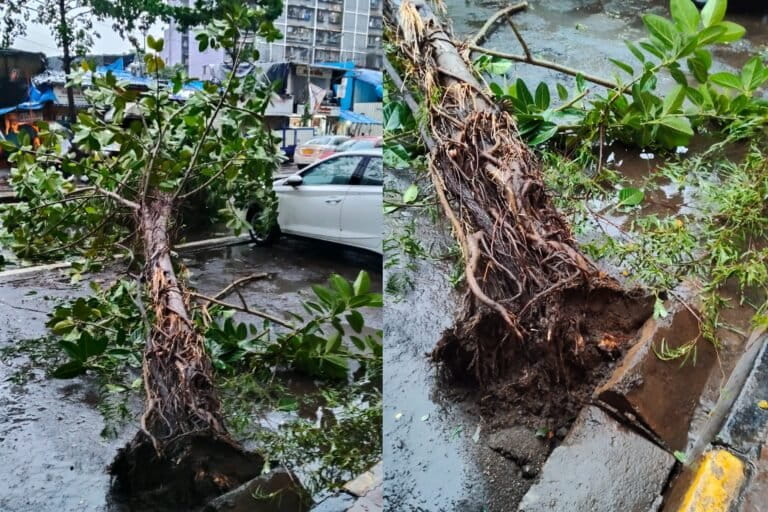
To understand why Mumbai’s trees are falling, one must look beneath the surface. Environmental experts and arborists argue that the "natural" explanation of wind and rain is merely the final trigger for trees already weakened by urban design.
1. The Concretization Trap
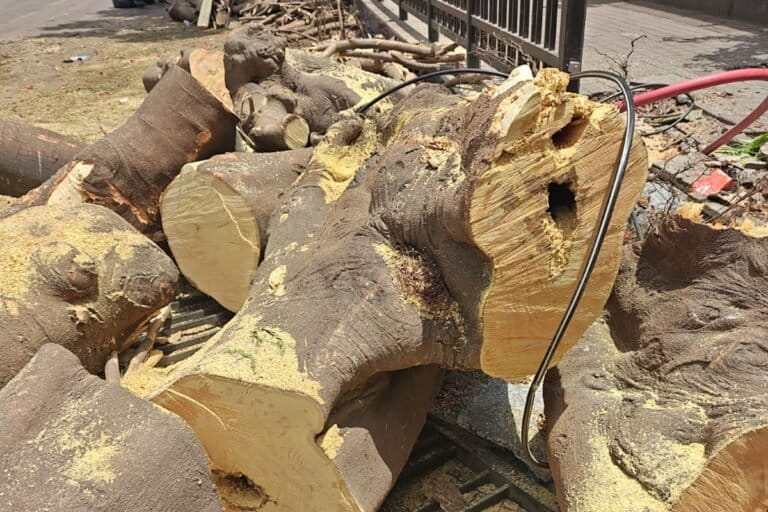
When the base of a tree is paved over with concrete or bitumen, it creates a physical barrier that prevents oxygen and water from reaching the root zone. This "choking" prevents roots from spreading laterally to provide the necessary anchorage. While the canopy may appear lush and healthy, the structural base is often hollowed out or decayed.
A joint inspection conducted by municipal representatives and citizen volunteers across 12 wards in Mumbai revealed startling statistics: of the 1,115 trees inspected, 61% were still heavily concretized, and 50 were identified as "dead and dangerous."
2. Infrastructure Conflict: Drains and Utilities
Mumbai’s narrow sidewalks are a battleground for space. Stormwater drains often run directly alongside or beneath roadside trees. Abhijit Ekbote, an urban practitioner, notes that whenever a road is concretized, the adjoining footpath and reinforced cement concrete (RCC) drain boxes are revamped together. This excavation often involves cutting through primary root systems to make way for the heavy concrete structures, leaving the tree balanced precariously on a compromised foundation.
3. The Lack of Professional Oversight
Despite the scale of its green cover—estimated at 29.8 lakh trees, including 2 lakh roadside trees—the BMC’s Tree Authority department lacks a permanent, professional arborist. Pruning is typically carried out by contractors who lack training in arboricultural principles.

Vaibhav Raje, a professional arborist, explains that unscientific pruning often makes trees "top-heavy." Instead of thinning the canopy to allow wind to pass through, contractors often prune haphazardly, shifting the tree’s center of gravity and making it more susceptible to toppling during high-speed winds.
Official Responses and Accountability
The BMC’s response to the recent fatalities has been met with skepticism by the families of victims and civic activists.
Internal vs. Independent Inquiries
The internal inquiry into the death of 11-year-old Vihaan Srivastava concluded in just 15 days. The report gave a "clean chit" to the road and garden department officials, instead placing the blame on a private contractor and consultant involved in nearby excavation work. A penalty of ₹700,000 was imposed—a sum critics describe as a "token gesture" that fails to address the systemic negligence of the department.
In response to the dissatisfaction expressed by Vihaan’s father, Gaurav Srivastava, and local political leaders, a single-member independent committee was proposed. Headed by botanist Sanjay V. Deshmukh, the committee is tasked with providing a more transparent analysis of the failure.
Administrative Gaps
The Maharashtra (Urban Areas) Protection and Preservation of Trees Act, 1975, mandates the appointment of Tree Officers and the conduct of a tree census every five years. However, activists like Nilesh Baxi point out significant vacancies in these roles. Furthermore, the last comprehensive tree census in Mumbai was conducted in 2018. It was only after the July 2024 disasters that the BMC announced a new census would finally commence.
Implications: The Ecological and Human Cost
Beyond the immediate danger to life, the tree-fall crisis reflects a deeper fracture in the relationship between the city and its natural environment.
The "Extinction of Experience"
Psychologist Reshma Ashar points to a phenomenon known as the "extinction of experience"—a growing alienation of urban dwellers from nature. In a city where trees are often viewed as "hindrances" to development or "obstacles" on a sidewalk, the public and civic officials alike lose the ability to notice the signs of a tree in distress. This lack of attention leads to a cycle of neglect where trees are only noticed when they cause a tragedy.
The Loneliness of the Urban Tree
Ecologists are now highlighting the social nature of trees. In a forest, trees are connected via underground networks of mycorrhizal fungi, allowing them to exchange nutrients and "warn" each other of pests or environmental stress.
Sayee Girdhari of SeasonWatch explains that urban trees are often "isolated." Cut off from these social networks by concrete and pipes, they become more vulnerable to fungal decay and structural failure. "Isolated trees cannot form the symbiotic networks they need to survive," Girdhari notes. This isolation, combined with soil compaction and pollution, means that even "mature" trees in Mumbai are often living in a state of chronic stress.
The Path Forward: Coexisting Infrastructure
Environmental scientist Umesh Mundlye argues that the only way to prevent future fatalities is to shift from an anthropocentric mindset to one of "coexisting infrastructure." This would involve:

- Scientific Root Management: Designing sidewalks and drains that allow for root expansion.
- Arboricultural Standards: Mandating that all pruning be supervised by certified arborists rather than general contractors.
- Aggressive De-concretization: Moving beyond "sample surveys" to a city-wide removal of concrete from tree bases, as mandated by the NGT nearly a decade ago.
As Mumbai continues to expand and its weather patterns become more volatile due to climate change, the city’s green canopy cannot remain an afterthought. Without a fundamental shift in how the BMC manages its urban forest, the monsoon will remain a season of fear, where the very trees meant to provide life and shade become silent, lethal threats to the citizens below.
