

By [Your Name/Editorial Staff]
Published: October 9, 2026
In a move set to redefine the landscape of Indian infrastructure and real estate, the Union Cabinet, chaired by the Prime Minister, officially approved the creation of the Integrated Transport and Logistics Authority (ITLA) on October 6, 2026. Established as a high-powered Special Purpose Vehicle (SPV), the ITLA is designed to serve as the nation’s apex body for transport and logistics planning, aiming to end decades of "siloed" development and fragmented connectivity.
As India moves toward its goal of becoming a developed economy by 2047, the ITLA represents the institutional muscle required to synchronize billions of dollars in public and private investment. For stakeholders ranging from multinational logistics firms to individual homebuyers, the birth of this authority signals a fundamental shift in how value is created and captured in the Indian market.
I. The Mandate: A Ten-Year Blueprint for Connectivity
The ITLA is not merely another regulatory layer; it is envisioned as the "brain" of India’s physical movement. Its primary responsibility is the formulation of the National Transport Master Plan (NTMP), a comprehensive document with a minimum ten-year horizon.
1. Multimodal Synchronization
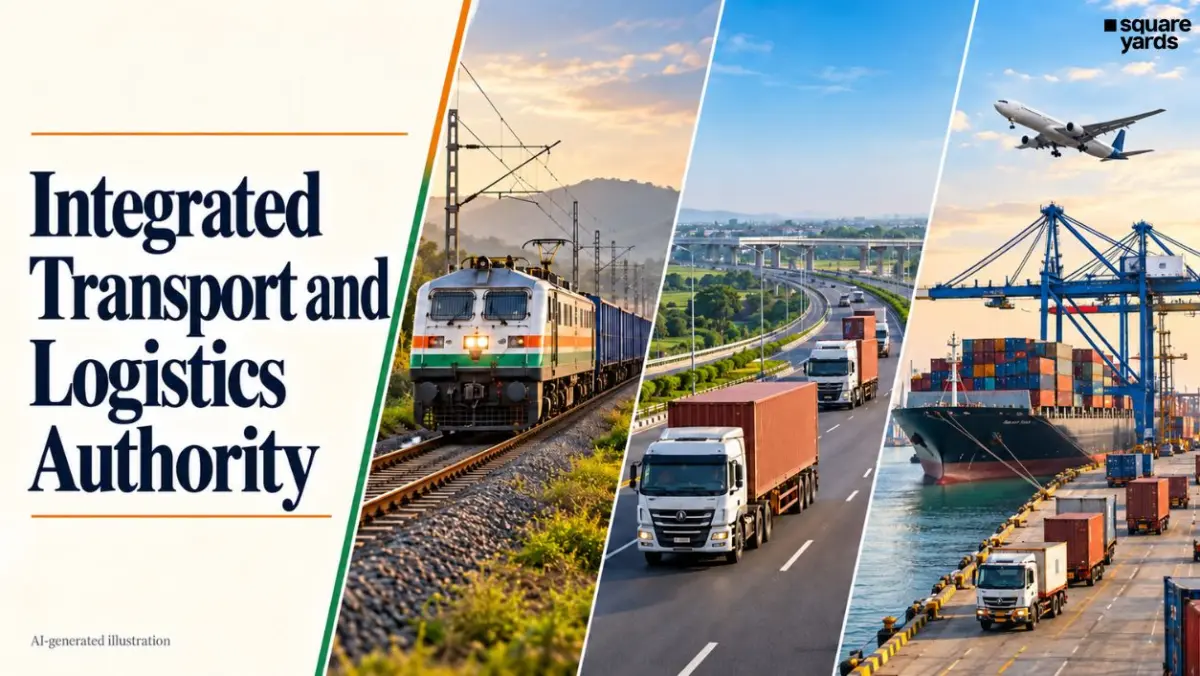
Unlike previous planning efforts that saw the Ministry of Railways and the Ministry of Road Transport and Highways operating independently, the NTMP will provide a unified roadmap covering:
- Roads and Highways: National corridors and expressways.
- Railways: Dedicated Freight Corridors (DFCs) and high-speed passenger rail.
- Ports and Maritime: Coastal shipping and the "Sagarmala" initiatives.
- Aviation: Regional connectivity and cargo hubs.
- Inland Waterways: Utilizing India’s vast river network for bulk transport.
- Urban Mobility: Metro rails, Bus Rapid Transit Systems (BRTS), and last-mile connectivity.
2. The ₹500 Crore Watchdog
One of the most significant powers granted to the ITLA is the technical appraisal and monitoring of all central infrastructure projects with an estimated cost of ₹500 crore or more. While financial appraisal remains with the Ministry of Finance, the ITLA will ensure that every major project aligns with the National Master Plan. This is intended to prevent "white elephant" projects—infrastructure that is built but remains underutilized due to a lack of connecting links.
3. The National Transport Data Repository
In an era where data is the new oil, the ITLA will build and manage a massive Data Repository. By integrating real-time data from GST e-way bills, FASTag, Vahan (vehicle registration), GPS tracking systems, and urban traffic sensors, the authority will gain an unprecedented view of how people and goods move across the subcontinent. This data will be instrumental for developers and investors in identifying high-demand zones before they become obvious to the general market.
II. Chronology: From Fragmentation to Integration
The journey toward the ITLA has been a decade-long evolution of policy and massive capital expenditure.
- 2014–2021: The Expansion Phase. This period saw the launch of Bharatmala (roads) and Sagarmala (ports). While successful in increasing capacity, these projects often lacked inter-departmental coordination.
- October 2021: Launch of PM Gati Shakti. The National Master Plan for Multimodal Connectivity was introduced to break departmental silos using a GIS-based platform.
- September 2022: National Logistics Policy (NLP). The government set a target to reduce logistics costs from 13-14% of GDP to a single-digit figure, rivaling global standards.
- FY 2025–2026: The Investment Peak. India crossed the threshold of $360 billion in cumulative infrastructure investment over the decade. Logistics costs were recorded at 10–10.7% of GDP.
- October 6, 2026: The ITLA Approval. Recognizing that Gati Shakti needed a permanent institutional home with statutory teeth, the Union Cabinet approved the ITLA to move beyond digital mapping into active planning and monitoring.
III. Supporting Data: The Economic Engine
The rationale behind the ITLA is grounded in hard economic data. The efficiency of a country’s transport network is directly proportional to its GDP growth.
| Metric | 2016 (Approx.) | 2026 (Reported) |
|---|---|---|
| Logistics Cost (% of GDP) | 13.5% | 10.2% |
| Total Infrastructure Investment | ~$100 Billion | ~$360 Billion (Decade Total) |
| Highway Construction Rate | 12 km/day | 35+ km/day |
| Logistics Leasing Growth (Tier 1) | 12% YoY | 22% YoY |
| Ahmedabad/Kolkata Leasing Growth | ~10% | 30%+ |
The reduction in logistics costs to the 10% range has already saved the Indian economy billions. However, to reach the global benchmark of 8% (seen in the US and Germany), the ITLA’s role in eliminating the "weakest link" in the supply chain is critical.
IV. Official Responses and Industry Perspectives
The announcement has triggered a wave of responses from government officials and industry captains.
Government Perspective:
A senior official from the Ministry of Commerce and Industry stated, "The ITLA is the final piece of the puzzle. We have the assets—the roads, the ports, the tracks. Now we need the harmony. The ITLA ensures that a container landing at Mundra Port doesn’t get stuck on a highway because the rail link wasn’t synchronized."
The Real Estate View:
Anand Gupta, a veteran real estate analyst, noted, "Real estate value is essentially a proxy for accessibility. In the past, developers gambled on ‘proposed’ projects. With the ITLA’s ten-year master plan, the speculative risk decreases. We will see capital flow toward ‘confirmed’ multimodal nodes rather than random peripheral land."
Logistics Sector:
The CEO of a leading national 3PL (Third-Party Logistics) provider remarked, "The Data Repository is the real game-changer. Accessing anonymized data on freight movement allows us to optimize our warehouse locations. This will drive down ’empty miles’ and significantly boost our margins."
V. Implications for Property Markets
Connectivity is the primary driver of real estate appreciation. The ITLA’s intervention is expected to create distinct "winners" in the property sector.
1. Strengthening Established Logistics Clusters
Traditional hubs like Delhi-NCR, Chennai, Mumbai, Pune, and Bengaluru currently dominate the leasing market. The ITLA’s focus on port-to-hinterland connectivity will likely lead to the expansion of "Warehouse Belts" around these cities. For instance, the strengthening of the Western Dedicated Freight Corridor (WDFC) links will solidify the logistics dominance of the Bhiwandi and Panvel clusters in the Mumbai Metropolitan Region (MMR).
2. The Rise of Emerging Freight Corridors
Cities like Ahmedabad and Kolkata are witnessing growth rates exceeding 30% in logistics leasing. These regions have historically suffered from "thin" infrastructure. Coordinated planning by the ITLA will likely fast-track intermodal terminals in these cities, turning them into regional distribution powerhouses and driving up land values for industrial use.
3. Transit-Oriented Development (TOD) and Residential Premiums
In urban centers, the ITLA will work alongside Unified Metropolitan Transport Authorities (UMTAs). As Delhi and other metros renew efforts to integrate bus, rail, and last-mile cycles, residential projects located near "Multimodal Transit Hubs" will command a significant premium. The "commute-time-to-price" tradeoff remains the most critical factor for Indian homebuyers; ITLA’s success in reducing this time will directly inflate property values in well-connected suburbs.
VI. The Fine Print: Why Caution is Warranted
While the ITLA is a visionary step, historical precedent in India suggests several hurdles that investors and citizens must monitor.
1. The "Advisory" Trap
India has a history of creating coordination bodies that lack the power to enforce their will on individual ministries. If the ITLA remains a consultative body without the power to veto projects that deviate from the Master Plan, it risks becoming another layer of red tape.
2. Overlap with PM Gati Shakti
The Gati Shakti platform already provides a digital framework for planning. There is a risk of institutional friction between the ITLA’s administrative mandate and Gati Shakti’s existing digital infrastructure. Synergy between the two is essential to avoid "too many cooks" in the infrastructure kitchen.
3. The Implementation Lag
The National Common Mobility Card (NCMC) serves as a cautionary tale. Launched in 2019 to provide "One Nation, One Card" for all transport, it was functional in only 13 metro projects and 11 bus corporations by July 2026. Data integration and inter-agency cooperation are notoriously slow.
4. The ₹500 Crore Threshold
By focusing only on large-scale central projects, the ITLA might miss the "micro-bottlenecks." A ₹1,000 crore highway is useless if the local municipality fails to build a ₹50 crore access road. Real estate investors must realize that ITLA improves the "macro" picture, but local "micro" infrastructure still depends on state and municipal efficiency.
VII. Conclusion: The Connectivity Dividend
The Integrated Transport and Logistics Authority is not a magic wand, but it is a sophisticated compass. For the property buyer and the industrial investor, the ITLA provides a much-needed "signal" in a market often clouded by "noise."
The connectivity dividend will ultimately go to those who study the National Transport Master Plan with precision. As the ITLA begins its work, the focus of the Indian real estate market will shift from "location, location, location" to "integration, integration, integration." The next era of property growth will not be found in isolated luxury, but in the places where planning and execution finally meet.
Strategic Advice for Investors:
- Patience is Key: A master plan takes years to manifest. Avoid buying into speculative hype before the ITLA’s first reviews are published.
- Follow the Data: Watch for the ITLA’s data releases on freight movement to identify the next big logistics hub.
- Prioritize Interchanges: Value will congregate where several modes of transport (e.g., Metro + Bus + Rail) converge.
As India moves into 2027, the ITLA stands as the gatekeeper of the nation’s physical progress. Its success or failure will determine whether India’s infrastructure remains a collection of impressive parts or becomes a world-class, integrated machine.
