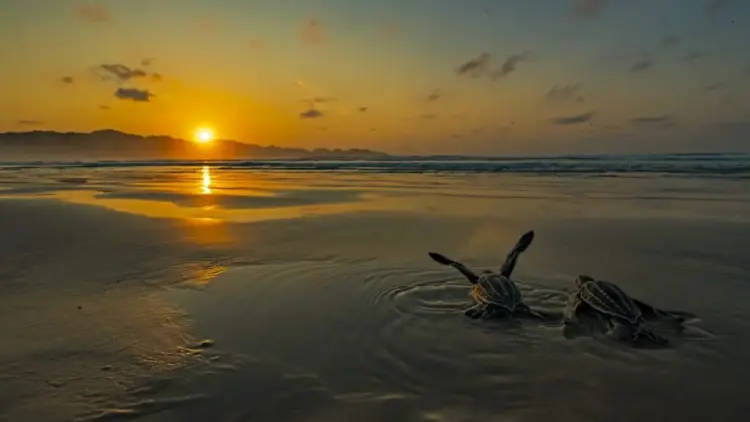
In the silvered moonlight of the remote Andaman and Nicobar Islands, a prehistoric ritual has reached a modern crescendo. Last winter, the shores of Galathea Bay on Great Nicobar Island witnessed a surge of activity that has captivated marine biologists and conservationists alike. According to recent data from the Andaman and Nicobar Forest Department, obtained through a Right to Information (RTI) Act request, female leatherback turtles (Dermochelys coriacea) heaved their massive, barrel-like frames onto the sand to deposit eggs in 869 nests.
This figure represents the highest number of leatherback nests recorded on any single beach in the Indian Ocean during the most recent nesting season, which concluded in March. While the data suggests a thriving population, it also highlights a profound ecological tension. As these "living dinosaurs" reclaim their ancestral nesting grounds in record numbers, their primary stronghold is simultaneously being slated for a massive industrial transformation that could alter the landscape of the Indian Ocean forever.
I. Main Facts: A Stronghold in the Northeastern Indian Ocean
The recent nesting data is not an isolated spike but part of a broader, encouraging trend. Along with Galathea Bay, the South Bay and West Bay beaches of Little Andaman Island have shown consistent increases in nesting activity over the past several years. Experts now characterize the Andaman and Nicobar archipelago as the "stronghold" of the Northeastern Indian Ocean leatherback population.
"The population, being left alone, is thriving and likely overflowing onto other beaches in the neighborhood," noted one researcher who requested anonymity due to the sensitive nature of conservation work in the region.
Galathea Bay is the undisputed epicenter of this recovery. While leatherbacks also nest on the coasts of Sumatra and other smaller islands in the archipelago, Galathea consistently hosts the highest density of nests. Current estimates suggest that the bay alone supports at least 175 nesting mothers per year—a figure that surpasses the estimated nesting populations of all of Sumatra or the other Andaman islands combined.

This resurgence is particularly significant given the global status of leatherbacks. Unlike other sea turtles, leatherbacks lack a hard shell, instead possessing a thick, leathery skin embedded with tiny osteoderms. They are the largest of all living turtles and can traverse entire ocean basins, yet their survival is inextricably linked to the specific beaches where they were born.
II. Chronology: Mariners from Deep Time
To understand the weight of the current nesting data, one must look back millions of years. Leatherback turtles belong to the family Dermochelyidae, a lineage that has navigated the world’s oceans for over 100 million years. They shared the planet with the Tyrannosaurus rex and survived the Cretaceous-Paleogene extinction event 66 million years ago that wiped out the non-avian dinosaurs.
The Evolutionary Timeline
- 5 Million Years Ago: Genetic mapping suggests the primordial mother of all modern leatherbacks lived in the Pacific Ocean.
- 3 Million Years Ago: Her descendants spread into the Indian Ocean.
- 2.8 Million to 700,000 Years Ago: During the Pleistocene ice ages, a massive population "bottleneck" occurred. Only one species, Dermochelys coriacea, survived.
- 1 Million Years Ago: As tectonic plates shifted and the Indian subcontinent collided with Eurasia, the Andaman and Nicobar Islands emerged, providing stable nesting havens within the Sundaland biodiversity hotspot.
- 2001-2002: The first major genetic baseline for Galathea’s leatherbacks was established by marine biologists Kartik Shanker and B.C. Choudhury.
- 2004: The Indian Ocean Tsunami devastated the coastline, temporarily destroying nesting beaches.
- 2023-2024: Nesting numbers reach record highs, signaling a full recovery from the tsunami’s impact.
The ability of these creatures to endure is legendary. They can dive to depths of over 1,200 meters—where the pressure would crush most organisms—and possess a unique thermoregulatory system that allows them to forage in sub-freezing polar waters. However, their Achilles’ heel remains their terrestrial requirement: the need to return to dry land to lay their eggs.
III. Supporting Data: Genetic Diversity and Resilience
The importance of Galathea Bay is not merely numerical; it is genetic. In the winter of 2001-2002, researchers from the Wildlife Institute of India and the Centre for Cellular and Molecular Biology (CCMB) conducted a landmark study on the mitochondrial DNA (mtDNA) of Galathea’s nesting females.
The Haplotype Measure
Scientists use "haplotypes"—segments of genes passed intact through the maternal line—to measure genetic diversity. The 2001 study identified four distinct haplotypes (labelled A, D, E, and I) in the Galathea population. At the time, this was among the highest genetic diversities recorded anywhere in the world, matched only by the now-extinct population in Terengganu, Malaysia.

"Diversity is the raw material upon which adaptation works," says Kartik Shanker, now a professor at the Indian Institute of Science and founder of the Dakshin Foundation. "If you have two populations to conserve, and you could only pick one, you want to pick the one with greater diversity because that provides the raw material for evolution and adaptation to challenges like climate change."
Modern Comparisons
Recent studies using more advanced sequencing techniques have found even higher diversity in other regions:
- West Papua (Jeen Yessa): 11 haplotypes identified.
- Sumatra: 8 haplotypes, including a unique variant not found elsewhere.
While some researchers argue that Sumatra and Great Nicobar host distinct populations, Shanker suggests the difference in diversity scores is likely due to the length of DNA segments being sequenced. Modern studies analyze roughly 800 base pairs, whereas the 2001 Galathea study looked at fewer than 400. Satellite tracking supports the theory of a highly connected regional population; turtles tagged in the Andamans have been spotted nesting in Sumatra just days later.
IV. Official Responses and Bureaucratic Hurdles
Despite the ecological importance of the region, obtaining fresh scientific data is becoming increasingly difficult. The 2004 tsunami not only altered the physical landscape but also shifted the focus of research. For the past 15 years, much of the monitoring has moved to Little Andaman due to the logistical and safety challenges of Great Nicobar.
The RTI and the "Information Black Hole"
The fact that the most recent nesting data had to be obtained via a Right to Information (RTI) request underscores a growing lack of transparency. Previously, such data was routinely published in scientific journals. Now, as the government moves forward with development plans, information regarding the island’s wildlife is being held closely by government-affiliated departments.

Legislative Protection vs. Research
Leatherback turtles are a Schedule I species under the Indian Wild Life (Protection) Act, 1972, granting them the highest level of legal protection. Paradoxically, this protection often hinders the very research needed to save them. B.C. Choudhury notes that the bureaucratic process for obtaining tissue samples is so arduous that grant periods often expire before permissions are granted.
"Sometimes the permitted sample size is so low—limiting you to just five individuals—that it’s not even worth trying to do the work," Choudhury explained. This "information black hole" makes it difficult for independent scientists to challenge or verify government environmental impact assessments.
V. Implications: The "Million-Dollar Question"
The record-breaking nesting numbers at Galathea Bay arrive at a precarious moment. The Indian government has greenlit a massive development project on Great Nicobar’s southern and eastern coasts. This includes the construction of an international container transshipment terminal directly at Galathea Bay.
The Threats of Industrialization
The project is expected to bring:
- Habitat Loss: The construction of the port will physically occupy the primary nesting beach.
- Light Pollution: Artificial lighting from ports and ships can disorient hatchlings, leading them away from the ocean and toward predators or exhaustion.
- Human Influx: A projected 325,000 newcomers are expected to settle on the island, increasing the pressure of egg poaching and accidental bycatch in local fisheries.
- Maritime Traffic: Massive container ships increase the risk of turtle-vessel collisions and oil spills.
The Malaysian Cautionary Tale
Conservationists point to Terengganu, Malaysia, as a grim reminder of how quickly a stronghold can collapse. Once a site where thousands of leatherbacks nested, the population was virtually extirpated by a combination of excessive egg collection, drowning in fishing nets, and poorly managed hatcheries. After a nine-year absence, a single female returned to nest in Malaysia this past September—a poignant but likely futile sign of life for a lost colony.

Conclusion: A Test of Resilience
Leatherbacks have survived five million years of climatic shifts, but the speed of industrial development poses a different kind of threat. Carl Safina, in his book Voyage of the Turtle, notes that their need to return to the specific beach of their birth is a "hallmark of vulnerability, not resilience."
The current surge in nesting at Galathea Bay proves that when left undisturbed, these ancient mariners can thrive. However, the impending transformation of Great Nicobar into a shipping hub poses a question that many scientists fear to answer.
"What happens when that stronghold breaks?" asked the anonymous researcher. "That’s the million-dollar question that all of us would not like to test."
As the first ships prepare to dock where turtles once laid their eggs, the world is watching to see if the leatherback’s 100-million-year winning streak is finally coming to an end.