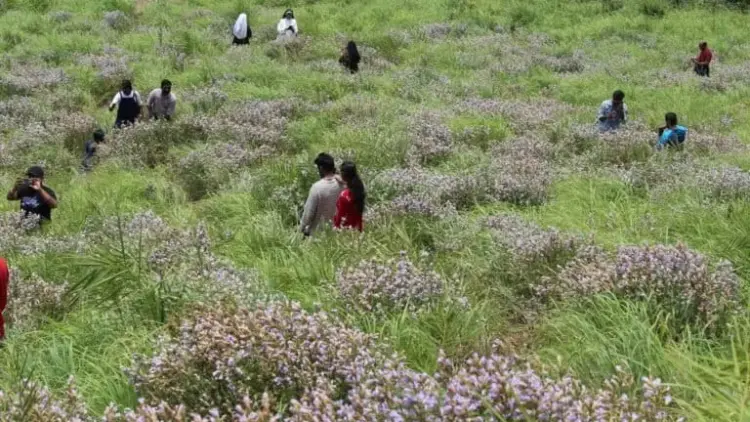
The mist-laden hills of Idukki, Kerala, witnessed a rare biological spectacle in the late summer of 2026. For a brief, shimmering window, the emerald slopes of the Western Ghats were transformed into a sea of bluish-purple as the Neelakurinji (Strobilanthes kunthiana) entered its legendary mass flowering phase. However, as thousands of tourists descended upon the region, a familiar conflict emerged: the struggle to protect a vulnerable, once-in-a-decade botanical treasure from the very people who admire it most.
Main Facts: A Biological Phenomenon Under Pressure
The Neelakurinji is not merely a flower; it is a symbol of the Western Ghats’ ecological complexity. Characterized by its unique 12-year blooming cycle, the plant is semelparous—meaning it flowers only once in its lifetime, produces seeds, and then dies. This makes the survival of the species entirely dependent on the successful maturation and dispersal of its seeds following a bloom.
In August 2026, the Chokramudi hills in the Idukki district became the epicenter of this phenomenon. Within just five days of the garden opening to the public, more than 4,000 visitors had navigated the winding roads of Munnar to witness the "purple gold." By the end of the first week, that number had doubled to nearly 8,000.
While the Forest Department implemented strict controls at primary sites like Chokramudi—including fixed visiting hours, marked footpaths, and a cap on daily entries—the sheer scale of the interest created a spillover effect. In unrestricted areas like Korandakkad and Mattupetty, where the flowers also bloomed in dense clusters, the lack of oversight led to environmental degradation, legal violations, and a stark reminder of the "Instagram effect" on fragile ecosystems.
Chronology: The 2026 Bloom Timeline
The road to the 2026 bloom began years prior with ecological monitoring, but the public frenzy started in earnest during the monsoon transition.

- April 2026: The Jawaharlal Nehru Tropical Botanic Garden and Research Institute (JNTBGRI) submitted a critical report to the National Green Tribunal (NGT). The report warned of the limited and scattered distribution of Strobilanthes kunthiana and identified tourism-related activities and invasive species as primary threats.
- August 2026: The first major clusters of Neelakurinji began to open on the Chokramudi slopes. The Kerala Forest Department officially opened designated viewing areas. Within 120 hours, over 4,000 people had arrived, many driven by viral social media posts.
- Late August 2026: Reports surfaced of massive crowds in the first week, reaching 8,000 visitors. Digital "influencers" began sharing photographs from non-designated areas, encouraging followers to find "hidden" and "unrestricted" spots to avoid the crowds and official rules.
- September 2026: The peak of the bloom. Ragini Anil, a visitor from Aluva, noted that social media was the primary catalyst for her visit. During this month, the Forest Department registered a high-profile legal case against two influencers who were filmed plucking the protected flowers for social media content.
- October 2026: As the flowers began to fade and turn brown, the focus shifted from tourism to seed protection. Ecologists raised alarms about soil compaction in areas where tourists had strayed from paths, potentially hindering the next generation of seedlings.
Supporting Data: The Science of Vulnerability
The 2026 bloom was more than a tourist attraction; it was a data point in the survival of a species. According to the 2024 assessment by the International Union for Conservation of Nature (IUCN), Strobilanthes kunthiana is classified as "Vulnerable." In India, it is afforded high-level legal protection under the Wildlife (Protection) Act, 1972.
The Semelparity Risk
Because the Neelakurinji dies after flowering, the 2026 seeds are the only hope for the 2038 bloom. If a plant is uprooted or trampled before its seeds mature and drop, that specific lineage is effectively extinguished. Ecologists point out that the soil in the Munnar grasslands is thin and sensitive. Constant foot traffic from thousands of visitors "wears" paths into the slopes, leading to erosion that can wash away the seeds before they take root.
The Threat of "Green Deserts"
Data from the Western Ghats Hornbill Foundation highlights a secondary, more silent threat: the invasive Black Wattle (Acacia mearnsii). These trees, originally introduced for plantations, spread aggressively into the grasslands where Neelakurinji grows. They shade out the sun-loving Kurinji and alter the soil chemistry. In the 2026 season, experts noted that the Kurinji habitat is shrinking, squeezed between human infrastructure and invasive timber.
Tourist Demographics and Behavior
Surveys of visitors during the first week of September 2026 indicated that nearly 70% of travelers came specifically because of images seen on platforms like Instagram and TikTok. While this boosted the local economy, it also led to "unregulated exploration." In areas like Korandakkad, where no official staff were posted, footpaths were widened by over 40% due to people walking side-by-side to take selfies, destroying the very plants they came to admire.
Official Responses: Management and Legal Action
The Kerala Forest Department faced a dual challenge: facilitating public interest while enforcing environmental law.

The Chokramudi Model
Saju Varghese, the Divisional Forest Officer (DFO) of Munnar, explained that the department treated Chokramudi as a controlled ecotourism zone. "We restricted access to only half of the flowering area to keep a significant portion of the habitat free from any human disturbance," Varghese stated. By capping visitors at 1,000 per day and mandating stay-on-path rules, the department hoped to ensure natural regeneration.
Legal Recourse
The department did not hesitate to use the "teeth" of the Wildlife (Protection) Act. When two young men posted images of themselves plucking Neelakurinji flowers on Instagram in September, the Forest Department tracked them down and registered a criminal case. Under the 1972 Act, damaging or collecting protected flora can result in heavy fines and imprisonment. This served as a deterrent, though officials admit that monitoring every remote slope in the Idukki district is a logistical impossibility.
NGT and Long-term Monitoring
The National Green Tribunal has been instrumental in pushing for a "carrying capacity" assessment. The JNTBGRI report recommended that the government move away from "mass tourism" toward "educational tourism." This includes establishing permanent designated paths and soil conservation measures that remain in place even during the 11 years when the flowers are not in bloom.
Implications: The Future of the "Blue Hills"
The 2026 Neelakurinji season has left behind a set of critical implications for the future of Kerala’s ecotourism and the survival of the Western Ghats’ biodiversity.
The Instagram Trap
The "influencer" culture presents a new type of ecological threat. When a location is geotagged, it can attract thousands of people to a site that has no infrastructure to handle them. The 2026 bloom showed that while official sites can be managed, the "unrestricted" slopes suffer the most. Moving forward, there are calls for social media platforms to work with environmental agencies to attach "protection warnings" to posts featuring endangered species.

The 2030 and 2038 Outlook
While the next major bloom around Munnar is expected in 2030 (a different variety or sub-cycle), the 12-year kunthiana cycle will return in 2038. The success of that future bloom depends entirely on what happens in the next 12 months. If the seeds from the 2026 plants fail to germinate due to soil compaction or invasive species, the "blankets of blue" will become increasingly threadbare.
Conservation Recommendations
Ecologist Amitha Bachan K.H. emphasizes that protecting the plants during the bloom is only half the battle. "The most critical phase is the post-flowering period," Bachan notes. "The seeds need undisturbed soil and protection from invasive species to establish the next generation."
His recommendations for future cycles include:
- Mandatory Soil Conservation: Implementing physical barriers to prevent erosion on popular slopes.
- Invasive Species Eradication: A multi-year program to remove Black Wattle and other non-native plants from Kurinji habitats.
- Carrying Capacity Limits: Extending the 1,000-person-per-day limit to all known Kurinji slopes, not just Chokramudi.
- Public Awareness: Creating visitor centers that explain the life cycle of the plant, shifting the focus from "the perfect photo" to "the survival of a species."
The 2026 bloom was a stunning reminder of nature’s beauty, but it was also a warning. As the last of the purple petals turn to brown and fall to the earth, the responsibility shifts from the Forest Department to the environment itself. Whether the hills of Munnar turn blue again in 2038 depends on whether we can learn to admire the Neelakurinji without trampling the very ground that sustains it.