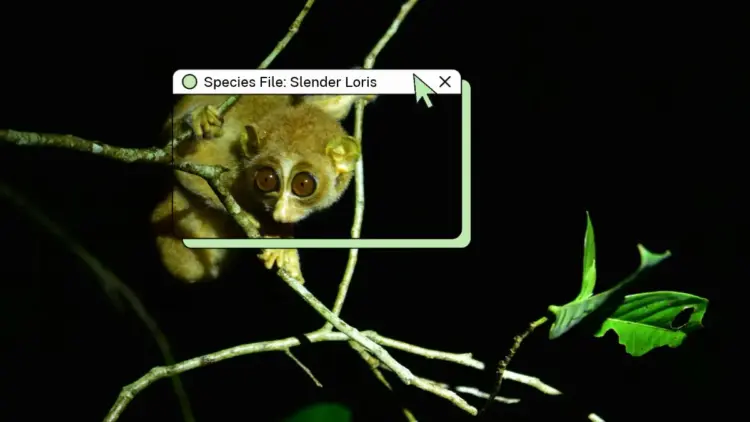
In the velvet darkness of the southern Indian scrub forests, two enormous, amber-colored orbs reflect the moonlight. These are the eyes of the slender loris, a primitive primate that has inhabited the Indian subcontinent for millions of years. Known locally in Karnataka as kaadu papa (forest baby) and in Tamil Nadu as thevangu, this elusive creature is a masterpiece of evolutionary specialization. However, as India’s landscape transforms under the pressure of infrastructure, mining, and agriculture, this "forest baby" is finding fewer places to call home.
The slender loris is more than just a biological curiosity; it is a sentinel of the health of India’s tropical dry and wet forests. Yet, its reliance on a continuous canopy and its inability to leap across gaps make it uniquely vulnerable to the fragmentation of the modern world.
Main Facts: The Biology of a Specialist
The slender loris (Loris) is a small, nocturnal prosimian primate. Unlike its more robust cousins, the slow lorises of Southeast Asia, the slender loris is characterized by its exceptionally long, spindly limbs and a total lack of a tail.
Taxonomy and Distribution
Globally, the genus is divided into two distinct species:
- The Grey Slender Loris (Loris lydekkerianus): Found across southern India and parts of Sri Lanka.
- The Red Slender Loris (Loris tardigradus): Endemic exclusively to the rainforests of Sri Lanka.
In India, the grey slender loris is further categorized into two subspecies that have adapted to vastly different environments. The Malabar grey slender loris inhabits the lush, wet evergreen forests of the Western Ghats, a global biodiversity hotspot. In contrast, the Mysore grey slender loris has adapted to the harsher, more arid conditions of the deciduous forests and thorny scrub jungles of Karnataka, Tamil Nadu, and Andhra Pradesh.
Evolutionary Adaptations
The loris is a nocturnal hunter. Its diet primarily consists of insects—specifically ants and termites—but it is also known to consume small reptiles, birds’ eggs, and occasionally fruit. Its large eyes are packed with a reflective layer called the tapetum lucidum, which enhances night vision by reflecting light back through the retina.
Perhaps its most defining physical trait is its movement. Unlike most primates, the slender loris cannot leap. It possesses a "slow-climbing" gait, moving hand-over-hand with a deliberate, trembling precision. While this makes them silent and difficult for predators to spot, it also means they are strictly arboreal. If a forest canopy is broken by a road or a cleared patch of land, the loris is effectively trapped in a "vegetation island," unable to cross the gap to find food or mates.
Chronology: From Folklore to Formal Protection
The history of the slender loris in India is a transition from being a staple of rural folklore to a high-priority conservation subject.
- Pre-20th Century: The loris was largely known through local myths. In some cultures, they were feared as omens of bad luck; in others, their body parts were sought for traditional medicine, believed to cure ailments ranging from leprosy to impotence.
- 1972: Recognizing the rapid decline of many indigenous species, the Indian government passed the Wildlife (Protection) Act. The slender loris was eventually granted Schedule I status—the highest level of legal protection in the country, on par with the Bengal tiger and the Asian elephant.
- 2000s – 2010s: Rapid urbanization in cities like Bengaluru began to isolate urban populations of lorises. Researchers started noting that the "garden city" was losing the canopy connectivity required for these primates to survive in urban pockets like the Indian Institute of Science (IISc) campus.
- 2022: A landmark moment occurred when the Tamil Nadu government notified the establishment of the Kadavur Slender Loris Sanctuary. Spanning 118 square kilometres across the Karur and Dindigul districts, it became India’s first dedicated sanctuary for the species.
- 2025: Recent reports highlight a burgeoning crisis. Despite the sanctuary’s protected status, illegal mining activities in the buffer zones and surrounding hills have begun to encroach upon the loris’s last strongholds, prompting fresh calls for federal intervention.
Supporting Data: Populations and Pressures
Quantitative data on the slender loris is notoriously difficult to collect due to their nocturnal nature and camouflage. However, recent studies have provided a clearer picture of their status.
Population Estimates
A comprehensive 2022 study conducted by the Salim Ali Centre for Ornithology and Natural History (SACON) provided the baseline for the Kadavur Sanctuary. The researchers estimated:
- Karur Forests: Approximately 8,844 individuals.
- Dindigul Forests: Approximately 8,412 individuals.
While these numbers seem robust, experts warn that "density" does not always equal "health." As Honnavalli N. Kumara, a principal scientist at SACON, noted in February 2025, high concentrations of lorises are often found in small "refugee" patches of forest. When their primary habitat is destroyed, the entire population is forced into a tiny remnant area, leading to overcompetition for food and increased susceptibility to disease.

Conservation Status
- IUCN Red List: Near Threatened.
- CITES: Appendix II (International trade is strictly controlled).
- WPA (India): Schedule I (Hunting or trade carries heavy prison sentences).
Threats by the Numbers
The primary driver of decline is habitat loss. In the scrub forests of Tamil Nadu, illegal red soil mining and sand mining have altered the topography. Mining doesn’t just remove trees; it lowers the water table and destroys the micro-habitats of the insects the lorises eat. Furthermore, roadkill remains a significant threat; in fragmented landscapes, lorises attempting to cross roads are frequently struck by vehicles, as their slow movement makes them easy targets.
Official Responses and Conservation Efforts
The response to the loris’s plight has been a mix of legislative action and community-based initiatives.
The Kadavur Sanctuary Initiative
The Tamil Nadu Forest Department’s decision to create the Kadavur Sanctuary was hailed as a visionary move. By protecting 11,806 hectares, the state aimed to create a contiguous corridor that allows for genetic exchange between different loris groups. The government has also invested in anti-poaching camps and solar-powered lights to help forest guards monitor the area at night.
Scientific Monitoring
Institutions like SACON and various NGOs are working to map "canopy gaps." In some areas, conservationists have proposed the installation of artificial canopy bridges—thick ropes or bamboo structures that span across roads—allowing lorises to cross safely without descending to the ground.
Addressing the Illegal Trade
Law enforcement agencies, including the Wildlife Crime Control Bureau (WCCB), have increased surveillance on the illegal pet trade. The slender loris is often trafficked to East Asia, where it is sold as an "exotic pet" due to its "cute" appearance, despite the fact that it rarely survives long in captivity due to its specialized dietary needs and stress-induced heart failure.
Implications: Why the Slender Loris Matters
The struggle of the slender loris is a microcosm of the broader conservation challenges facing India. The implications of its potential disappearance are both ecological and social.
Ecological Balance
As insectivores, slender lorises play a vital role in controlling agricultural pests. They consume vast quantities of heart-eating ants and termites that can otherwise devastate crops and timber. Their removal from the ecosystem could trigger an explosion in pest populations, leading to an increased reliance on chemical pesticides by local farmers.
The "Refugee" Crisis
The observation by Dr. Kumara regarding "refugee" populations highlights a terrifying trend in conservation: the creation of "living dead" populations. These are groups of animals that are still alive but have no long-term future because their habitat is too small to support a healthy, breeding community. If the slender loris is confined to agricultural hedges and small city parks, it loses its resilience to climate change and localized disasters.
Urban Biodiversity
The presence of the slender loris in a metropolis like Bengaluru is a testament to the city’s once-rich heritage. However, the loris’s struggle for canopy in urban spaces reflects the "greening" paradox. While cities may plant more trees, they often plant ornamental species that do not support the local insect life the loris needs, or they fail to ensure that the canopies of these trees actually touch.
A Call for Integrated Conservation
The survival of the slender loris requires more than just the designation of sanctuaries. It requires:
- Strict Enforcement against Mining: Red soil and sand mining must be halted in ecologically sensitive zones to prevent the total collapse of the scrub forest floor.
- Canopy Connectivity: Future infrastructure projects in southern India must include "arboreal bypasses" as a standard requirement.
- Community Engagement: Local communities must be incentivized to protect the loris. In Tamil Nadu, programs are being explored to link loris conservation with eco-tourism, providing a financial reason for villagers to guard the "forest babies."
The slender loris is a creature of the shadows, but its future must be brought into the light. As a Schedule I species, it carries the same legal weight as the most iconic animals of India. The coming decade will determine whether the thevangu remains a living part of the Indian landscape or becomes merely a ghost in our folklore.