

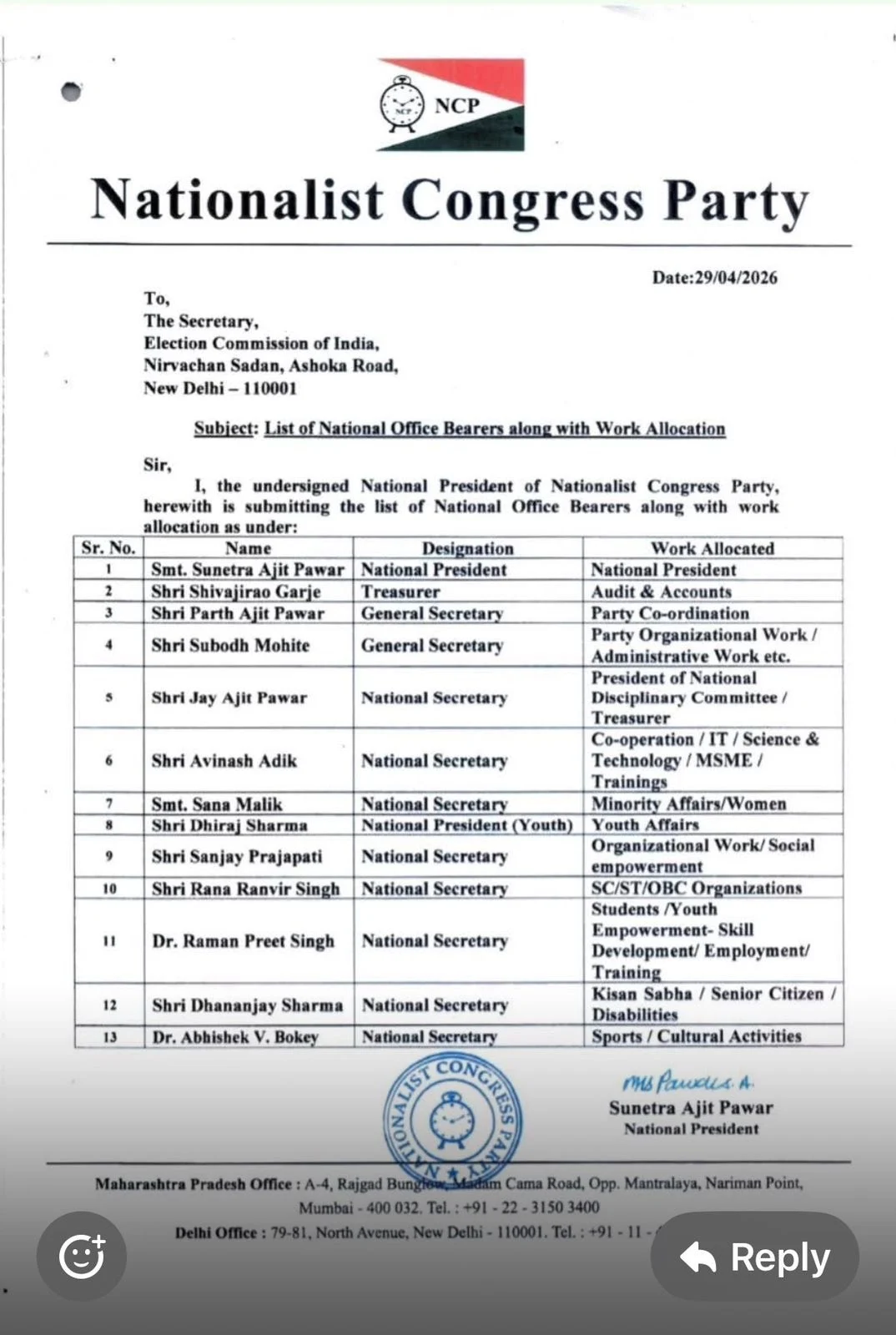
Mumbai, India – May 12, 2026 – In a significant restructuring that has sent ripples through Maharashtra’s political landscape, veteran Nationalist Congress Party (NCP) leader Praful Patel has been formally removed from his powerful position as the party’s national working president. The move, confirmed through official Election Commission documents, underscores a profound generational shift and a consolidation of power within the Ajit Pawar-led faction of the NCP, with Sunetra Pawar now firmly established as the national president and a new crop of younger Pawar leaders assuming critical organizational roles.
This dramatic reshuffle marks a pivotal moment for the NCP faction that aligned with the ruling Maha Yuti alliance in Maharashtra, signaling a clear intent to rejuvenate its leadership and perhaps streamline its decision-making apparatus ahead of future electoral battles. While Patel remains a member of the 22-member national committee, the stripping of his specific designation is widely interpreted as a curtailment of his authority, raising questions about the future roles of long-standing senior leaders within the party.
The Genesis of Change: Main Facts Unveiled
The formal demotion of Praful Patel from the national working president’s post is the culmination of several weeks of intense internal speculation and strategic maneuvers within the Ajit Pawar-led NCP. Patel, a seasoned politician with decades of experience and a close confidante of NCP patriarch Sharad Pawar before the party split, found his influence gradually diminishing as the new guard asserted its dominance.
The most prominent aspect of this reshuffle is the undisputed ascent of Sunetra Pawar, wife of Deputy Chief Minister Ajit Pawar, to the apex leadership position as the national president. Her appointment, initially made in February 2026, has now been unequivocally recognized in official party communications to the Election Commission. This elevation places her at the helm of the party’s organizational structure, a role that carries immense weight in guiding its policies, electoral strategies, and internal administration.
Further reinforcing the generational transition, the party has actively promoted several younger leaders, particularly from the Pawar family’s extended network. Parth Pawar, son of Ajit Pawar, and Subodh Mohite have been appointed national general secretaries, indicating their increased prominence in the party’s central command. Additionally, Jay Pawar and several others have been accommodated as national secretaries, signaling a clear intent to empower the next generation and infuse fresh energy into the party’s ranks.
The reshuffle, while ostensibly aimed at organizational strengthening, has inevitably fueled discussions about loyalty, power dynamics, and the future trajectory of a party grappling with its identity post-split. The official confirmation from Election Commission documents has brought clarity to what was previously a subject of intense political conjecture, yet it simultaneously opens new avenues for analysis regarding the implications for the NCP’s internal cohesion and its standing in the broader political landscape.
A Detailed Chronology of the Power Shift
The journey leading to Praful Patel’s demotion and Sunetra Pawar’s rise has unfolded over several critical months, punctuated by strategic communications and calculated omissions, all against the backdrop of the NCP’s complex post-split reality.
July 2023: The Original Split and Alliance Formation
To fully understand the context of the 2026 reshuffle, one must recall the dramatic events of July 2023. This was when Ajit Pawar, along with a significant number of MLAs and MLCs, broke away from the Nationalist Congress Party founded by his uncle Sharad Pawar. This faction subsequently allied with the Bharatiya Janata Party (BJP) and the Shiv Sena (Shinde faction) to form the Maha Yuti government in Maharashtra, with Ajit Pawar taking on the role of Deputy Chief Minister. Praful Patel was a key figure who sided with Ajit Pawar during this momentous split, lending his considerable political weight and experience to the new faction. His loyalty at that critical juncture was seen as a major boost for Ajit Pawar, making his current sidelining all the more striking.
Early 2026: Whispers of Change and Sunetra Pawar’s Initial Elevation
The internal dynamics of the Ajit Pawar-led NCP began to show signs of impending change in early 2026. While not widely publicized at the time, discussions within party circles hinted at a strategic move to solidify Ajit Pawar’s control and integrate his immediate family more deeply into the party structure. These discussions culminated in the appointment of Sunetra Pawar as the national president of the NCP faction in February 2026. This was a significant step, as it placed a direct family member of Ajit Pawar at the very top of the party’s organizational hierarchy, signaling an intent to centralize authority.
March 10, 2026: The Omission That Sparked Speculation
The first concrete public indicator of an impending shift emerged on March 10, 2026. On this date, the Ajit Pawar-led NCP submitted a letter to the Election Commission of India, outlining its national executive committee. Crucially, while the letter included the names of Praful Patel and Maharashtra unit chief Sunil Tatkare among the 22 members, it conspicuously omitted any specific posts or designations next to their names. This deviation from standard protocol immediately triggered intense political chatter and speculation within media and political circles. Observers keenly noted the absence of their previously held high-profile titles, interpreting it as a deliberate signal of reduced authority, though the party leadership refrained from offering any public clarification at that time, allowing rumors to proliferate.
Weeks of Undercurrents and Power Struggle Reports
Following the March 10 communication, the weeks that followed were rife with reports of an internal power struggle brewing within the Ajit Pawar faction. Political analysts and insiders pointed to a potential tug-of-war involving Praful Patel, Sunil Tatkare, and the ascendant Parth Pawar. The narrative suggested a gradual but definitive shift in influence, with the younger generation, spearheaded by Parth, seeking to carve out more significant roles, potentially at the expense of veteran leaders who had been instrumental in the party’s formation and survival. The lack of official statements from the party only intensified the speculation, painting a picture of calculated ambiguity.
April 29, 2026: Formal Confirmation and Definitive Shift
The period of suspense drew to a definitive close on April 29, 2026. On this date, a fresh and more explicit communication was dispatched to the Election Commission. This letter formally confirmed the restructuring and explicitly dropped Praful Patel from the post of national working president. More importantly, it officially recognized only Sunetra Pawar as the national president and Shivajirao Garje as the treasurer. This communication left no room for ambiguity, cementing the changes and providing official sanction to the new power structure. It marked the formal conclusion of the internal adjustments and the beginning of a new chapter for the Ajit Pawar-led NCP.
May 12, 2026: Public Confirmation and Analysis
The news became widely public and was reported on May 12, 2026, solidifying the understanding of the significant internal changes within the NCP. This date marks the point where the political community began to openly dissect the implications of these moves for the party’s future, its alignment within the Maha Yuti, and the broader political landscape of Maharashtra.
Supporting Data: Unpacking the Profiles and Dynamics
The reshuffle is not merely an administrative adjustment; it is a profound reflection of evolving power dynamics, personal ambitions, and the strategic imperatives of the Ajit Pawar-led NCP.
Praful Patel: The Veteran Statesman’s Diminished Role
Praful Patel, a scion of a prominent industrialist family, has been a central figure in Indian politics for over three decades. His political career began under the tutelage of Sharad Pawar, establishing himself as a key strategist, financial wizard, and an effective administrator. He served multiple terms as a Member of Parliament (both Lok Sabha and Rajya Sabha) and held significant portfolios as a Union Minister, including Civil Aviation, Heavy Industries, and Public Enterprises. Patel was known for his suave demeanor, extensive network, and ability to navigate complex political and economic landscapes.
When the NCP split in July 2023, Patel’s decision to align with Ajit Pawar was a massive coup for the latter. His presence lent credibility and a national face to the breakaway faction, signaling that it wasn’t merely a regional defection. His role as national working president was a testament to his stature and perceived importance. However, his current removal from this designated post, despite remaining in the national committee, suggests a deliberate move to consolidate power around the core Pawar family unit. This shift could be interpreted as Ajit Pawar prioritizing dynastic succession and direct family control over the influence of long-standing, powerful allies. Patel’s extensive experience and independent political base might now be seen as a potential counterweight to the central authority Ajit Pawar is attempting to establish.
Sunetra Pawar: The Ascendant Matriarch
Sunetra Pawar’s elevation to national president is arguably the most significant aspect of this reshuffle. While she has been active in social work and rural development initiatives through organizations like the Environmental Forum of India, her direct political involvement has been more recent and less prominent than other members of the Pawar family. Her political aspirations became more evident when she recently contested the Lok Sabha elections from Baramati, a traditional Pawar stronghold, against her sister-in-law Supriya Sule (Sharad Pawar’s daughter). Although she lost that contest, her candidacy itself was a strong indicator of her growing political ambition and her husband Ajit Pawar’s intent to bring her into the political mainstream.
Her appointment as national president signifies Ajit Pawar’s clear strategy to firmly place his immediate family at the helm of the party. It ensures that the top organizational post is held by a trusted family member, thereby solidifying his control over the party’s direction and future. This move mirrors a broader trend in Indian politics where spouses and children of prominent leaders are increasingly being brought into central party roles, ensuring dynastic continuity and a tight grip on party machinery.
The Younger Pawar Generation: Parth and Jay Pawar
The promotion of Parth Pawar and Jay Pawar (Ajit Pawar’s son and nephew, respectively) to national general secretary and national secretary roles underscores the generational shift. Parth Pawar has been actively trying to establish his political career. He unsuccessfully contested the 2019 Lok Sabha elections from Maval, but has since remained active in youth politics and party affairs. His new role as a national general secretary is a significant step up, indicating that he is being groomed for more prominent leadership positions in the future.
Jay Pawar, while less in the public eye than Parth, also represents the rising generation. Their appointments suggest a deliberate effort to inject youth into the party’s top brass and prepare them for future electoral challenges. This strategy aims to create a pipeline of leadership that is loyal to Ajit Pawar and his vision for the party, ensuring continuity and family control for decades to come.
Sunil Tatkare: The Lingering Uncertainty
While Praful Patel’s fate is now clear, uncertainty continues to shroud the future of Sunil Tatkare, the current Maharashtra unit chief of the NCP faction. Like Patel, his name appeared in the March 10 communication without an accompanying designation. Although he remains a part of the national executive, the absence of his specific post in the April 29 formal communication has fueled speculation about whether he will retain his crucial role as the state unit president. Tatkare is another seasoned politician who has been a loyal supporter of Ajit Pawar. His potential sidelining, if it comes to pass, would further reinforce the narrative of Ajit Pawar consolidating power within his immediate family and a smaller, trusted circle, potentially at the expense of other established leaders.
The Broader Context: NCP’s Legal Battle and Electoral Future
These internal changes are happening amidst the ongoing legal battle between the Ajit Pawar and Sharad Pawar factions over the official name and symbol of the Nationalist Congress Party. The Election Commission had previously recognized Ajit Pawar’s faction as the "real" NCP, granting them the party symbol. This internal reshuffle within the Ajit Pawar faction can be seen as a strategic move to present a unified and stable leadership structure as they navigate future legal challenges and prepare for upcoming elections, including potentially the Maharashtra Assembly elections. By placing his family members in key positions, Ajit Pawar aims to project a strong, centralized leadership, which could be beneficial in demonstrating control and organizational coherence.
Official Responses: A Calculated Silence
In the immediate aftermath of the official confirmation, there has been a noticeable lack of direct, explicit statements from the principal actors regarding the specifics of the reshuffle.
From Praful Patel: The veteran leader has maintained a stoic silence, offering no public comment on his removal from the national working president’s post. This silence is characteristic of experienced politicians navigating delicate internal party matters. Any public display of dissent or disappointment could be seen as undermining the party leadership. His continued presence in the national committee, albeit without a specific designation, might offer a face-saving mechanism, allowing him to remain a part of the party’s broader structure while his influence is significantly curtailed.
From Ajit Pawar and Sunetra Pawar: The top leadership of the Ajit Pawar-led NCP has largely opted for a measured, almost understated approach. While there haven’t been elaborate press conferences detailing the reasons behind the changes, official statements, when made, have focused on themes of "organizational rejuvenation," "strengthening the party at the grassroots," and "preparing for future electoral challenges." These are standard political narratives used to frame leadership changes as strategic and forward-looking, rather than as internal power struggles. The emphasis is on the collective growth of the party and the empowerment of new talent, without directly addressing the demotion of specific senior leaders.
From Other NCP Leaders: The general reaction from other leaders within the Ajit Pawar faction has been one of public support for the decisions made by the party high command. Statements often reiterate faith in Ajit Pawar’s leadership and the necessity of adapting the party structure to contemporary political realities. Any underlying disgruntlement, if present, is being carefully contained, reflecting the centralized control that Ajit Pawar is exercising over his faction.
From the Opposition (Sharad Pawar faction and Maha Vikas Aghadi): Predictably, the rival Sharad Pawar faction and other opposition parties within the Maha Vikas Aghadi (MVA) have seized upon the reshuffle as evidence of internal instability and a "power grab" within the Ajit Pawar camp. They have portrayed it as a sign of growing authoritarianism and a lack of respect for veteran leaders who were instrumental in the party’s past. Such criticisms aim to sow discord and question the democratic credentials of the Ajit Pawar-led NCP, especially given the ongoing battle for the party’s legacy.
Implications: Reshaping the Political Chessboard
The dramatic leadership changes within the Ajit Pawar-led NCP carry profound implications, not just for the party itself but for the broader political landscape of Maharashtra and potentially national politics.
Consolidation of Power and Dynastic Imperatives:
The most immediate implication is the undeniable consolidation of power around Ajit Pawar and his immediate family. Sunetra Pawar’s elevation to national president and Parth Pawar’s prominent role as national general secretary firmly embed the family’s control at the party’s core. This move ensures that strategic decisions and the party’s ideological direction will be largely dictated by the Ajit Pawar household, potentially streamlining decision-making but also risking alienation among other senior leaders who may feel overlooked despite their loyalty. This further solidifies the trend of dynastic politics, where family lineage plays a crucial role in political succession, a common feature across many Indian parties.
Potential for Disgruntlement and Internal Dissent:
While the official narrative emphasizes rejuvenation, the sidelining of a figure like Praful Patel, a national-level leader with significant experience and influence, carries the risk of internal disgruntlement. Loyalists of Patel or other senior leaders like Sunil Tatkare (whose future as Maharashtra unit chief remains uncertain) might feel a sense of betrayal or disrespect. While open rebellion is unlikely given Ajit Pawar’s firm grip, simmering resentment could potentially lead to reduced enthusiasm, passive resistance, or, in extreme scenarios, even future defections if electoral prospects become challenging. The party will need to carefully manage these potential tensions to maintain unity.
Impact on the Maha Yuti Alliance:
The reshuffle also has implications for the Maha Yuti alliance (BJP, Shiv Sena (Shinde), NCP (Ajit Pawar)). A stronger, more centralized NCP under Ajit Pawar’s direct control could potentially make the party a more assertive partner within the alliance. While the BJP and Shiv Sena will appreciate a stable and predictable NCP, any perceived overreach by Ajit Pawar in consolidating power could also lead to minor friction in seat-sharing negotiations or policy decisions. However, a unified NCP faction under Ajit Pawar’s control also presents a more cohesive and predictable ally for the BJP, particularly in the run-up to state elections.
Preparing for Future Elections:
This restructuring is undoubtedly a strategic move aimed at preparing the party for upcoming electoral battles, including the crucial Maharashtra Assembly elections. By presenting a ‘new look’ leadership with a blend of experience (Ajit Pawar) and youth (Parth Pawar), the party hopes to appeal to a broader demographic. Sunetra Pawar’s leadership could also be leveraged to attract women voters and project a progressive image. The focus on grassroots strengthening and organizational efficiency, often cited as reasons for such reshuffles, is vital for electoral success.
Praful Patel’s Future Role:
Despite his demotion, Praful Patel remains a Rajya Sabha MP and a member of the national committee. His vast experience and network cannot be entirely dismissed. He might be assigned a more advisory role or be tasked with specific diplomatic or strategic assignments where his expertise is invaluable, without holding a formal executive party position. However, his political clout and decision-making authority within the party are undoubtedly diminished, marking a significant personal setback for a leader who has historically operated at the highest echelons of power.
Sharad Pawar Faction’s Strategy:
The Sharad Pawar faction of the NCP will closely monitor these developments. They might use the reshuffle to highlight what they perceive as the "undemocratic" nature of the Ajit Pawar faction, further emphasizing their narrative of being the "original" and more inclusive NCP. Internal conflicts or signs of disgruntlement within the Ajit Pawar camp could be exploited by the Sharad Pawar faction to attract disgruntled leaders or consolidate their own base.
In conclusion, the formal removal of Praful Patel from the national working president’s post and the ascendance of Sunetra Pawar, alongside the promotion of younger Pawar leaders, signals a definitive new era for the Ajit Pawar-led NCP. It is a calculated move to centralize power, streamline leadership, and prepare the party for the intricate political battles ahead, solidifying the family’s grip on the party’s destiny even as it navigates the complex terrain of Maharashtra’s coalition politics. The coming months will reveal how successfully this revamped leadership can unite its ranks and project a cohesive front against its rivals.
