


The administration of property tax within Agartala, the capital of Tripura, represents a critical intersection of civic duty and urban development. Managed by the Agartala Municipal Corporation (AMC), the property tax system is designed to sustain and enhance the city’s burgeoning infrastructure. As Agartala continues its trajectory toward becoming a modern urban hub under various national schemes, the systematic collection of property tax remains the primary engine for providing essential services such as 24/7 water supply, waste management, and road maintenance.
Main Facts: The Framework of Property Taxation in Agartala
Property tax in Agartala is a mandatory annual levy imposed on all owners of real estate within the AMC jurisdiction. This includes not only residential and commercial buildings but also vacant land. The fiscal year for the AMC culminates in a critical deadline: June 30 of every year, by which time all property owners are expected to have cleared their dues to avoid financial penalties.
The Agartala Municipal Corporation utilizes a specific methodology for assessment, ensuring that the tax burden is distributed based on the property’s value-generating potential and its demand on municipal resources. The core components of this assessment include the residential locality, the total plinth area, the building’s usage (residential vs. commercial), the type of occupancy, and the age of the structure.
Key Highlights of the AMC Tax Regime:
- Governing Body: Agartala Municipal Corporation (AMC).
- Mandatory Status: Compulsory for all constructed and vacant properties.
- Primary Deadline: June 30 annually.
- Revenue Utilization: Infrastructure, street lighting, sanitation, and social amenities.
- Payment Channels: Both digital (online portal) and physical (AMC offices).
Chronology: The Evolution and Cycle of Tax Compliance
The process of property tax in Tripura has undergone a significant digital transformation over the last decade. Historically, tax collection was a manual, labor-intensive process involving door-to-door assessments and physical ledger entries. Today, the system follows a streamlined annual cycle:
- Assessment Phase: At the start of the fiscal year, the AMC updates its records based on new constructions or modifications in property usage.
- Notification and Self-Assessment: Property owners are encouraged to use the online portal to calculate their dues based on the established Unit Area Value (UAV) system.
- Payment Window: While payments can be made throughout the year, the bulk of collections occurs in the first quarter of the fiscal year, leading up to the June 30 deadline.
- Penalty Enforcement: Following the deadline, the system automatically begins accruing interest on unpaid balances.
- Reconciliation and Audit: The AMC conducts audits in the latter half of the year to identify defaulters and verify the accuracy of self-assessments.
This chronology reflects a shift toward "e-governance," aiming to reduce the friction between the citizen and the state while increasing transparency in revenue collection.
Supporting Data: Tax Rates and Calculation Formulae
To ensure fairness, the AMC has categorized buildings into different types, each with a specific "Indicative Rate." These rates are reflective of the construction quality and the economic utility of the property.
AMC Property Tax Rates (Indicative)
| Building Type | Usage Type | Indicative Rate (per sq. ft.) |
|---|---|---|
| M. Building (Masonry/Permanent) | Residential | Rs. 0.60 |
| M. Building (Masonry/Permanent) | Commercial | Rs. 1.80 |
| S.P. Building (Semi-Permanent) | Residential | Rs. 0.50 |
| S.P. Building (Semi-Permanent) | Commercial | Rs. 1.50 |
| Frame Building | Residential | Rs. 0.40 |
| Frame Building | Commercial | Rs. 1.20 |
| Katcha Building | Residential | Rs. 0.30 |
| Katcha Building | Commercial | Rs. 0.90 |
The Mathematical Formula for Assessment
The AMC employs a scientific formula to arrive at the Annual Property Value (APV). This ensures that a luxury villa in a prime locality is taxed differently than a modest ancestral home.
The Formula:
Yearly AMC Property Tax = 5% of Annual Property Value (APV)

Where APV is calculated as:
APV = Plinth Area (Sq. Ft.) × Unit Area Value (Rs) × Age Factor × Structural Factor × Occupancy Factor × Usage Factor.
- Age Factor: Newer buildings typically have a higher factor, which decreases as the building depreciates.
- Structural Factor: Determined by whether the building is Pucca, Semi-Pucca, or Katcha.
- Occupancy Factor: Distinguishes between self-occupied properties and those that are rented out.
Official Responses and Policy Exemptions
In recent years, the Tripura State Government and the AMC have introduced several policy shifts aimed at social welfare and administrative efficiency. Under the "Azadi ka Amrit Mahotsav" initiative, the government has taken a compassionate stance toward those who have served the nation.
Key Exemptions and Rebates:
- Freedom Fighters: Total exemption from property tax for recognized freedom fighters.
- Defense Personnel: A 10% rebate is offered to the families of freedom fighters, ex-servicemen, and currently serving defense personnel.
- Educational Institutions: Recognized educational institutions are exempt, provided they are not used for purely commercial profit-making ventures.
Official Stance on Delinquency:
The AMC has clarified that while it seeks to be citizen-friendly, the 10% monthly interest penalty on late payments is a necessary deterrent to ensure the liquidity of municipal funds. Officials emphasize that timely tax payment is directly linked to the corporation’s ability to maintain the city’s "Smart City" status.
Procedural Guide: Digital Integration and Name Updates
The transition to the Tripura e-Municipality Portal has simplified the taxpayer experience. Below is the detailed procedure for modern tax management.
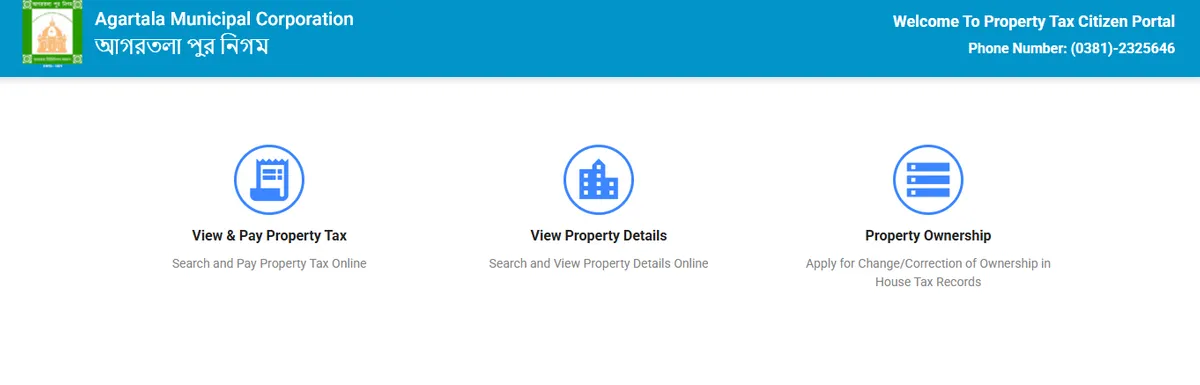
How to Pay AMC Agartala Property Tax Online
- Access the Portal: Visit the official e-municipality website (https://emunicipality.tripura.gov.in/).
- Authentication: Log in using your registered credentials or proceed as a guest user if the option is available.
- Property Search: Enter your unique Property ID or Ward Number to fetch current tax details.
- Verification: Review the calculated tax amount, ensuring the plinth area and usage type are correctly reflected.
- Payment: Use the secure gateway to pay via Credit/Debit card, Net Banking, or UPI.
- Receipt Generation: Download and save the digital receipt immediately for future reference.
Updating Ownership Records
The AMC has also digitized the "Mutation" process—updating the owner’s name in the event of a sale, gift, or inheritance. This is vital for legal clarity and future transactions.
Steps for Name Update:
- Step 1: Navigate to the ‘Online Modification in Property’ section on the AMC portal.
- Step 2: Select the specific request type (Transfer, Deletion, Splitting, or Merging).
- Step 3: Provide the Sale Deed, Death Certificate (in case of inheritance), and the latest tax clearance certificate.
- Step 4: Submit the application and track the status using the generated reference number.
Implications: Taxation as a Tool for Urban Transformation
The systematic collection of property tax in Agartala has profound implications for the city’s future. As one of the prominent cities in Northeast India, Agartala’s ability to self-fund its development is a marker of its economic maturity.
1. Infrastructure Quality
Property tax revenue is the primary source for the "Maintenance Fund." This fund ensures that internal colony roads, which are not covered by national highways, remain motorable. It also funds the complex drainage systems necessary for Agartala’s monsoon resilience.
2. Social Equity
By offering rebates to veterans and exemptions to schools, the AMC uses property tax as a tool for social engineering, rewarding service to the nation and promoting literacy.
3. Real Estate Transparency
A digitized tax system creates a "paper trail" for every property. For potential buyers, a "Tax Clearance Certificate" from the AMC is now a non-negotiable document, reducing the risk of fraudulent land deals and ensuring that all property in the city is accounted for.
4. Penalties and Civic Responsibility
The 10% monthly penalty serves as a reminder that municipal services are not free. The AMC’s firm stance on this interest rate highlights the shift from a "subsidy-based" model to a "service-based" model, where citizens are viewed as stakeholders in the city’s success.
Conclusion: The Path Forward for Agartala
The Agartala Municipal Corporation’s property tax system is more than just a fiscal requirement; it is the foundation of the city’s social contract. By leveraging technology to simplify payments and name updates, the AMC has significantly lowered the barriers to compliance. However, the responsibility ultimately lies with the property owners.
As the June 30 deadline approaches each year, citizens are encouraged to view their tax contributions as an investment in the streetlights that keep their neighborhoods safe, the pipes that bring clean water to their homes, and the roads that connect them to the rest of the state. In the journey toward a "Srestha Tripura" (Great Tripura), the Agartala property tax remains an indispensable vehicle for progress.
Contact Information for AMC Inquiries:
For further clarification or to resolve disputes regarding tax assessments, citizens may visit the Agartala Municipal Council Head Office at City Centre Complex, Paradise Chowmuhani, Agartala-799001.
- Phone: (0381)-2325507 / 2325646
- Email: [email protected]
