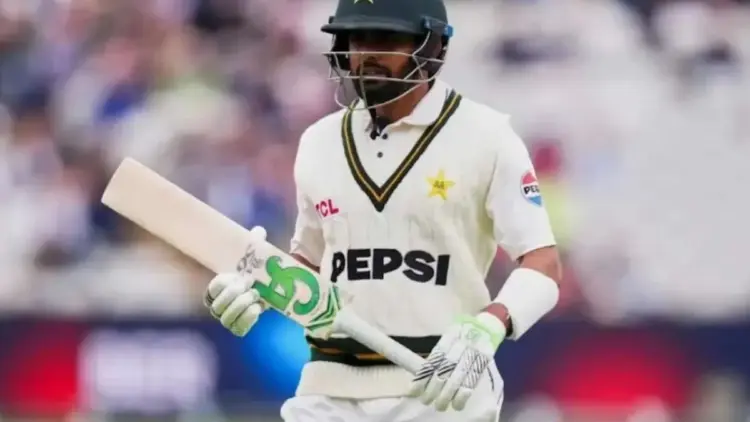
Karachi, Pakistan – November 1, 2026 – The cricketing world is abuzz following a forthright and impassioned plea from former Pakistan captain Mohammad Yousuf, who has urged a drastic shift in the approach to managing Babar Azam’s current dip in form. Yousuf, a batting maestro himself, believes that relying on domestic cricket alone to help Babar rediscover his best is a misstep, advocating instead for focused, specialised coaching abroad to address what he perceives as fundamental technical issues. This stark recommendation underscores a growing concern among cricketing pundits and fans alike regarding the trajectory of Pakistan’s premier batsman.
Yousuf’s advice is not merely a suggestion but an urgent call for intervention, delivered with the conviction of a veteran who has witnessed the ebb and flow of many illustrious careers. His core message is unequivocal: Babar Azam needs to step away from the relentless cycle of competitive cricket, particularly the first-class format, to undergo intensive, tailored training. This, Yousuf argues, is the only way to prevent further erosion of confidence and to facilitate a genuine return to the kind of form that has cemented Babar’s status as one of the world’s leading batsmen.

An Urgent Plea from a Legend
The gravity of Mohammad Yousuf’s concern was palpable in his recent social media post, which quickly gained traction across cricketing circles. "I don’t think #BabarAzam should be playing first class cricket until he fixes his technical issues through specialized coaching. Struggling in domestic cricket could further harm his confidence and career. Send him to an academy in #England or #Australia. He is still Pakistan’s top player, and with the right guidance and a little effort, he can return to his best. I said this four years ago, and nobody listened. Please listen now," Yousuf wrote, his words echoing a long-held conviction that has evidently intensified with Babar’s ongoing struggles.
This public declaration is significant for several reasons. Firstly, it comes from a figure whose own batting prowess is legendary, lending immense weight to his technical assessment. Secondly, the explicit mention of a four-year-old warning highlights a potential missed opportunity for early intervention, adding a layer of urgency and perhaps frustration to Yousuf’s current plea. The phrase "Please listen now" is not just a request but a desperate appeal to the Pakistan Cricket Board (PCB) and Babar Azam himself, underscoring the critical nature of the situation.

The Rationale Behind the Radical Suggestion
Yousuf’s recommendation to temporarily remove Babar from first-class cricket stems from a deep understanding of player psychology and technical development. For a player of Babar’s calibre, continuing to struggle in any competitive format, even domestic, can have a profoundly negative impact on confidence. Each low score, each dismissal against a relatively less challenging attack, risks entrenching self-doubt and exacerbating existing technical frailties.
Instead of providing a fertile ground for recovery, domestic cricket, under such circumstances, can become a crucible of anxiety. The pressure to perform, even in a lower-stakes environment, can prevent a player from experimenting, from breaking down and rebuilding their technique without the fear of immediate failure. Yousuf believes that Babar’s inherent talent is unquestionable, but that it currently requires a surgical, rather than a broad-spectrum, approach to rehabilitation. A focused environment, away from the glare of competitive matches and the relentless media scrutiny, would offer Babar the space and dedicated expertise needed to dissect and reconstruct his batting.

A Master Craftsman’s Perspective: The Weight of Experience
Mohammad Yousuf’s counsel carries an unparalleled authority, derived from a career that places him among Pakistan’s pantheon of batting greats. His illustrious international career saw him represent Pakistan in 90 Tests, 288 One Day Internationals (ODIs), and three T20Is. Across these formats, he amassed a formidable 7,530 Test runs, 9,720 ODI runs, and 50 T20I runs, often against the world’s most fearsome bowling attacks. His Test average of 45.56 and ODI average of 41.71 speak volumes of his consistency and ability to perform at the highest level.
Yousuf was renowned for his elegant yet effective batting style, marked by impeccable timing, exquisite placement, and a profound understanding of how to build an innings. His technique was considered robust, capable of adapting to diverse conditions and pressures. He holds the unique record for scoring the most Test runs in a calendar year (1,788 runs in 2006), a testament to his extraordinary concentration and skill. Such a background means his assessment of another batsman’s technique is not merely opinion but an informed analysis born from personal experience at the pinnacle of the sport.

Coaching Acumen and Direct Interaction
Adding further weight to his current advice is Yousuf’s direct experience as a batting coach for the PCB. During his tenure, he worked closely with many Pakistani batsmen, including Babar Azam himself, particularly during Babar’s captaincy. This direct interaction provides Yousuf with invaluable insight into Babar’s technical nuances, mental approach, and how he responds under pressure. He has seen Babar at his best and, presumably, has observed the subtle shifts in his game that might have led to his current struggles.
This personal history with Babar transforms Yousuf’s recommendation from a general observation into a deeply informed, specific prescription. He isn’t just speaking as a former great; he’s speaking as a former mentor who understands the player’s makeup intimately. His call to send Babar to an overseas academy suggests that the resources and environment currently available within the Pakistani domestic setup might not be adequately equipped to provide the precise, high-level intervention that Yousuf believes is necessary for a player of Babar’s international standing.

Babar Azam’s Conundrum: A Star Grappling with Form
Babar Azam is undeniably the linchpin of Pakistan’s batting order across all formats. His graceful strokeplay, ability to score quickly, and consistency have earned him comparisons to some of the modern era’s greats. However, the last few years have seen an increasing level of scrutiny on his performances, particularly in Test matches, where his consistency has wavered.
The Scrutiny on Pakistan’s Batting Pillar
The most glaring statistic highlighting Babar’s Test struggles is his century drought. His last three-figure score in the longest format dates back to December 2022, when he scored a magnificent 161 against New Zealand in Karachi. As of November 1, 2026, this prolonged absence of a Test century has become a significant talking point, raising questions about his ability to convert starts into monumental innings, a hallmark of elite Test batsmen. While he continues to participate and often scores fifties, the inability to push on to significant totals has drawn criticism and put immense pressure on him.

This pressure is magnified by his role as the team’s primary run-scorer. In a batting line-up that has often struggled for collective consistency, Babar has frequently been the solitary warrior, bearing the brunt of expectations. This reliance, while a testament to his individual brilliance, also makes his personal dip in form a more profound concern for the team’s overall performance.
Identifying the "Technical Issues"
While Yousuf did not explicitly detail the nature of Babar’s "technical issues," such concerns often manifest in various ways for batsmen. Common areas include footwork – whether it’s too static, too busy, or not moving decisively enough either forward or back. Balance at the point of impact, head position, and alignment can also be critical. Against different bowling types, a batsman might develop a subtle flaw – perhaps an overcommitment on the front foot against the swinging ball, or a tentative poke outside off-stump.

Specialised coaches use advanced video analysis and biomechanical assessments to pinpoint these minute flaws that might not be immediately obvious to the naked eye. These issues, if left unaddressed, can lead to predictable dismissals, eroding confidence and making a player vulnerable. Yousuf’s suggestion implies that these aren’t merely mental blocks but rather ingrained habits in Babar’s technique that require dedicated, isolated work to correct, something that is difficult to achieve in the high-pressure environment of competitive cricket.
Beyond Domestic Pitches: The Case for Specialised Coaching Abroad
Yousuf’s suggestion to send Babar to an academy in England or Australia is not a trivial one; it represents a belief that the current local framework might be insufficient for this specific, high-stakes problem.

Beyond Domestic Pitches: A Targeted Approach
Specialised coaching, as envisioned by Yousuf, goes far beyond the general coaching available in typical domestic setups. It involves a one-on-one, highly personalised programme designed to address specific technical flaws. This includes:
- Intensive Video Analysis: Breaking down every aspect of a player’s technique frame-by-frame, comparing it to their peak form, and identifying deviations.
- Biomechanics Expertise: Understanding the physics of a player’s movement and how minor adjustments can lead to significant improvements in power, timing, and shot selection.
- Tailored Drills: Developing specific drills that isolate and correct individual issues, repeating them until the correct technique becomes second nature.
- Psychological Support: Working with sports psychologists to rebuild confidence, manage pressure, and develop mental resilience, especially crucial when undergoing a technical overhaul.
- Controlled Environment: Practicing on various surfaces and against different types of bowling machines or net bowlers, but without the immediate pressure of a match result.
This targeted approach contrasts sharply with playing domestic first-class cricket, where the focus is on winning matches, and individual player development, especially for an elite international, might not be the primary concern. In domestic cricket, a player might continue to employ workaround solutions to technical flaws, rather than truly fixing them, simply to survive and score runs, thereby perpetuating the problem.

The Appeal of International Academies
The specific mention of England or Australia for such an academy is also deliberate. These cricketing nations boast some of the world’s most advanced cricketing infrastructure, world-class coaching facilities, and a deep pool of expert coaches, many of whom are former international players or have extensive experience at the elite level.
- Diverse Conditions: Academies in these countries can offer a wide range of pitch conditions, from green seaming wickets to flatter batting tracks, allowing a player to refine their technique against various challenges.
- Expert Coaches: Access to specialist batting coaches, fast bowling coaches, spin bowling coaches, and even biomechanical experts who can provide cutting-edge analysis and guidance.
- Anonymity (relative): While Babar Azam is a global superstar, undergoing a technical overhaul in a foreign country can offer a degree of separation from the intense scrutiny of Pakistani media and fans, allowing him to focus solely on his game without added psychological pressure.
- Exposure to Different Cultures: Learning from different cricketing philosophies and training methods can also broaden a player’s perspective and add new dimensions to their game.
The concept of a "reset" away from the spotlight, in an environment dedicated solely to personal development, has been successfully employed by other international athletes across various sports, allowing them to return stronger and more refined.

Broader Implications and Stakeholder Perspectives
Yousuf’s advice doesn’t exist in a vacuum; it resonates within a broader conversation about Babar Azam’s performance and the state of Pakistan cricket.
A Nation’s Expectations and Peer Support
Babar Azam carries the hopes of a passionate cricketing nation on his shoulders. This intense expectation, while a privilege, can also be an immense burden. Other former Pakistan cricketers have acknowledged the unique pressure he faces. Former fast-bowling legend Waqar Younis, for instance, recently shared on a podcast that Babar has been "unfortunate" to be the standout batter in the team, often lacking the necessary support from his teammates. This perspective suggests that Babar’s struggles might be partly exacerbated by the sheer weight of responsibility to consistently perform and carry the team, which can, in turn, affect his individual game.

Retired all-rounder Imad Wasim has also publicly defended Babar, stating that he has "never witnessed a Pakistan player endure as much criticism and negativity from the media, critics, and social media users." This highlights the immense psychological toll that constant scrutiny and criticism can take on an elite athlete. Such an environment makes it even more challenging for a player to work through technical issues, as every misstep is amplified and dissected publicly. Yousuf’s call for a temporary retreat to a specialised academy is also, in part, a recognition of this psychological pressure cooker.
The PCB’s Role and the Path Forward
The onus is now on the Pakistan Cricket Board (PCB) to seriously consider Yousuf’s advice. Ignoring such a strong recommendation from a respected figure with direct experience could be perceived as a failure of foresight. The PCB has a responsibility to nurture and protect its most valuable assets. While investing in an overseas specialised coaching programme might entail significant cost, the potential long-term benefits of reviving Babar Azam’s form far outweigh the expenditure.

Such a move would demonstrate a proactive approach to player management, acknowledging that even the best players sometimes require bespoke solutions. It would also send a message that the PCB values the insights of its cricketing legends and is committed to providing its players with the best possible resources to succeed at the international level. The decision will require careful deliberation, balancing Babar’s existing commitments with the imperative for his personal development.
Chronology of Concern: A Recurring Narrative
Yousuf’s emphatic statement, "I said this four years ago, and nobody listened. Please listen now," adds a critical chronological layer to the current debate, suggesting that Babar’s technical issues might not be entirely new.

Four Years in the Making: A Missed Opportunity?
The revelation that Yousuf voiced similar concerns four years prior implies that early signs of potential technical vulnerabilities in Babar’s game might have been present even during periods of his prolific scoring. Had these early warnings been heeded, and a proactive intervention implemented, Babar might have been spared the current prolonged struggle. This raises questions about the PCB’s long-term player development and talent identification systems. Are such early warnings adequately processed? Is there a mechanism to provide proactive, specialised support to elite players before their issues become critical?
The missed opportunity serves as a cautionary tale: addressing minor flaws before they become ingrained problems is always more effective than attempting a major overhaul under duress. This historical context amplifies the urgency of Yousuf’s current plea, suggesting that time is of the essence, and further delay could have more severe consequences.

The Looming Challenges: 2027 ODI World Cup
The immediate future of Pakistan cricket hinges significantly on Babar Azam’s form. With an upcoming T20I series and, more critically, the 2027 ODI World Cup on the horizon, the pressure on Babar to regain his consistency is immense. He remains one of the most vital components of Pakistan’s white-ball set-up, capable of anchoring an innings, accelerating when needed, and providing stability.
Pakistan’s aspirations in these major tournaments will be heavily reliant on their premier batsman firing on all cylinders. A Babar Azam at his best is a match-winner, a player capable of dominating opposition attacks and inspiring his teammates. Therefore, Yousuf’s advice is not just about an individual player; it’s about safeguarding Pakistan’s cricketing future and ensuring the team has its strongest asset available and performing optimally when it matters most.

A Crossroads for Babar and Pakistan Cricket
Mohammad Yousuf’s passionate call for Babar Azam to temporarily step away from competitive cricket for specialised coaching abroad marks a pivotal moment in the star batsman’s career and, by extension, for Pakistan cricket. It is a bold, unconventional recommendation, but one rooted in profound cricketing wisdom and a deep concern for a national hero.
The stakes are incredibly high. For Babar Azam, this decision could define the latter half of his career, determining whether he can overcome his current challenges to reaffirm his status as a generational talent. For the Pakistan Cricket Board, it presents an opportunity to demonstrate progressive player management, prioritising long-term development over short-term expediency.

As the cricketing world watches, the choice to heed or ignore Yousuf’s urgent plea will have far-reaching implications. A successful intervention could see Babar Azam return revitalised, stronger, and more consistent than ever, ready to lead Pakistan to glory in upcoming international assignments, including the highly anticipated 2027 ODI World Cup. The time for listening, as Yousuf implores, is now.