

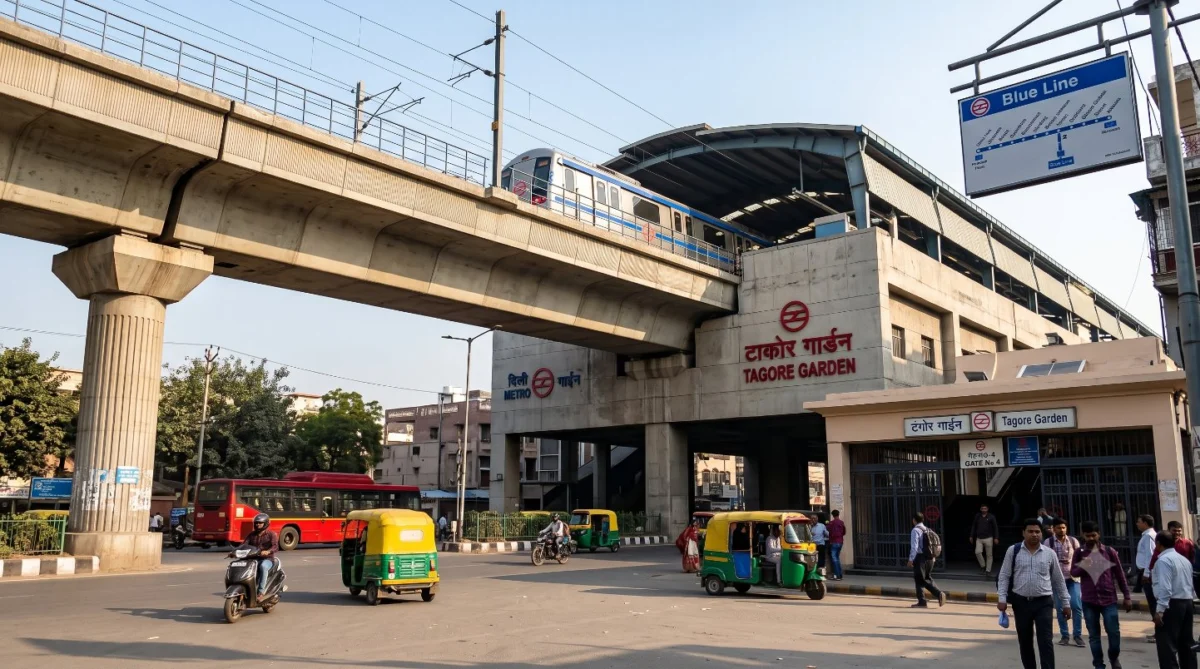
The expansion of the Delhi Metro Rail Corporation (DMRC) network has fundamentally altered the socio-economic landscape of the National Capital Region (NCR). Among the critical nodes in this vast transit web is the Tagore Garden Metro Station. Situated on the busy Blue Line, this station serves as a vital artery for the residents of West Delhi, bridging the gap between quiet residential enclaves and the bustling commercial hubs of Central Delhi, Noida, and Gurugram.
As one of the more established neighborhoods in the city, Tagore Garden represents a blend of traditional Delhi charm and modern urban convenience. The metro station, which became operational nearly two decades ago, has not only simplified the daily commute for thousands but has also acted as a catalyst for real estate appreciation and commercial growth in its periphery.
Main Facts and Technical Overview
The Tagore Garden Metro Station (Station Code: TG) is an elevated structure located on the Najafgarh Road, specifically within Block BF of the Rajouri Garden Extension. Since its inauguration, it has remained a high-footfall station due to its proximity to major educational institutions, healthcare facilities, and shopping districts.
Quick Facts Table
| Detail | Information |
|---|---|
| Station Name | Tagore Garden Metro Station |
| Line | Blue Line (Line 3/4) |
| Station Code | TG |
| Structure Type | Elevated, Double Track |
| Platforms | Two Side Platforms (Platform 1: Noida/Vaishali; Platform 2: Dwarka) |
| Opening Date | December 31, 2005 |
| Operator | Delhi Metro Rail Corporation (DMRC) |
| Location | Najafgarh Road, West Delhi |
| Accessibility | Parking available, E-rickshaw and Bus connectivity |
The station architecture follows the standard elevated design of Phase 1 of the Delhi Metro, featuring robust safety protocols and efficient crowd management systems. It serves as a midway point between the Rajouri Garden interchange and the residential hub of Subhash Nagar.
Chronology: The Evolution of Connectivity in West Delhi
To understand the impact of the Tagore Garden Metro Station, one must look at the timeline of its development and the subsequent transformation of the region.
- Late 1990s – Early 2000s (Planning Phase): The DMRC identified the Najafgarh Road corridor as a high-priority route. West Delhi was suffering from extreme traffic congestion, and the existing Delhi Transport Corporation (DTC) bus network was struggling to keep pace with the growing population.
- December 31, 2005 (Inauguration): The station was opened to the public as part of the Blue Line expansion. This was a landmark moment for West Delhi, as it provided the first high-speed rail link to the heart of the city (Connaught Place).
- 2010 (The Commonwealth Games Surge): Leading up to the 2010 games, the Blue Line saw significant upgrades in frequency and train length (moving from 4-coach to 6-coach and eventually 8-coach trains) to handle the influx of commuters.
- 2018 (The Pink Line Integration): While Tagore Garden itself did not become an interchange, the opening of the Pink Line at the adjacent Rajouri Garden station significantly boosted Tagore Garden’s utility. Residents could now reach South Delhi and North Delhi with a single, one-stop transfer.
- Post-Pandemic Modernization: In recent years, the station has seen the introduction of QR-code-based ticketing and integrated digital payment systems, aligning with the "Digital India" initiative.
Operational Dynamics and Supporting Data
The efficiency of the Tagore Garden Metro Station is defined by its rigorous schedule and the frequency of its service. As part of the Blue Line, it experiences some of the highest ridership figures in the entire DMRC network.
Train Timings and Frequency
The station follows the standard DMRC operational hours, though these are subject to minor adjustments on Sundays and national holidays.
- Towards Noida Electronic City / Vaishali: The first train typically departs at 5:18 AM, with the last train at 10:59 PM.
- Towards Dwarka Sector 21: The service begins slightly later at 6:04 AM, with the last train departing at 12:05 AM.
During peak hours (8:30 AM to 11:00 AM and 5:30 PM to 8:00 PM), the headway between trains is approximately 3 to 4 minutes. During off-peak hours, this increases to 5 to 7 minutes. This high frequency is essential for preventing platform overcrowding, especially given the station’s role in serving the student population and office-goers.
Fare Structure and Ticketing
The DMRC utilizes a distance-based fare system. For commuters traveling from Tagore Garden:
- Short distances (0-2 km): Rs 10.
- Medium distances (12-21 km, e.g., to Rajiv Chowk): Rs 40.
- Long distances (Above 32 km, e.g., to Noida or Deep Dwarka): Rs 60.
A 10% discount is applied to Smart Card users, with an additional 10% discount during off-peak hours, incentivizing travel outside of the busiest times.
Navigational Guide: Entry and Exit Points
The Tagore Garden station is strategically designed with four exit gates to distribute passenger flow across different sectors of the neighborhood.
- Gate No. 1: Provides access to the Khyala region and the local Kendriya Vidyalaya. It is primarily used by students and residents of the Khyala village area.
- Gate No. 2: The "Healthcare Gate," leading toward Kukreja Hospital and Guru Gobind Singh Hospital. This is a critical exit for those visiting the area for medical consultations.
- Gate No. 3: Serves the residential heart of the area, including Cambridge School, DDA Flats, and Tagore Garden Extension.
- Gate No. 4: The "Commercial Gate," opening toward J-Block Rajouri Garden and the TDI Mall side. This is the busiest gate during weekends and evenings as it caters to shoppers and diners heading toward the Rajouri Garden markets.
Supporting Infrastructure and Last-Mile Connectivity
A metro station’s success is often measured by how easily a commuter can reach their final destination after stepping off the platform. Tagore Garden excels in this regard due to its location on the Najafgarh Road.
Multimodal Integration
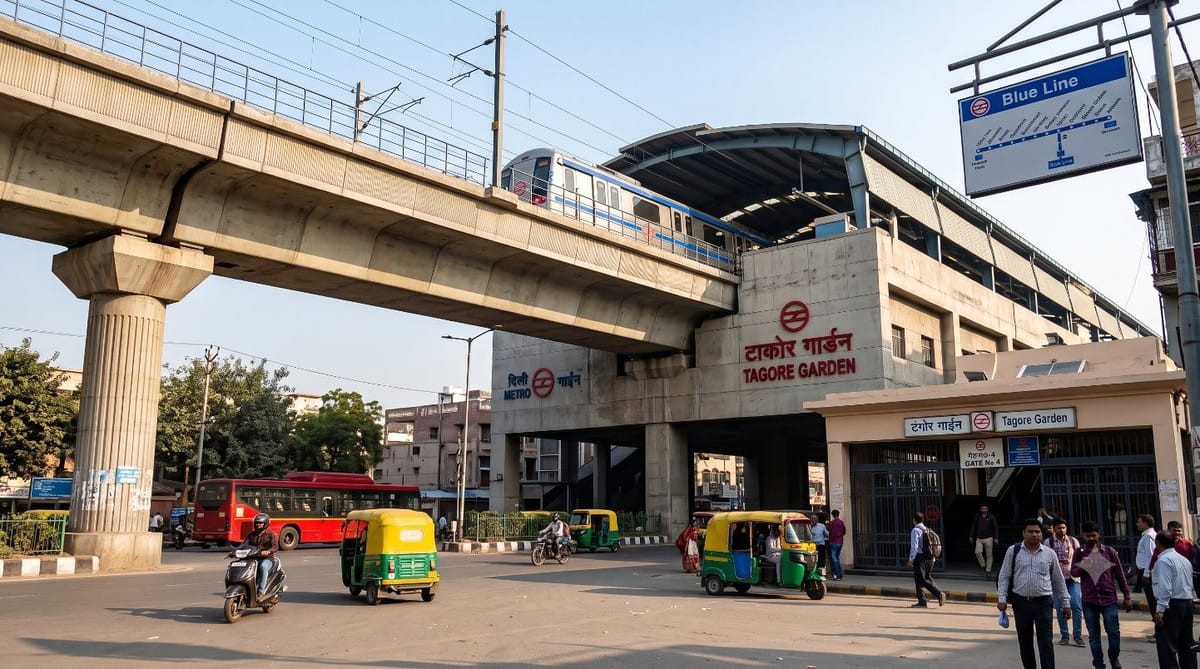
The station is served by several DTC bus routes, including 810, 816, 817, and 871, which connect the metro to deeper pockets of West Delhi like Uttam Nagar, Tilak Nagar, and Paschim Vihar. Furthermore, the station premises include authorized parking for two-wheelers and four-wheelers, though these lots often reach capacity by 10:00 AM on weekdays.
The rise of the "E-rickshaw" has also revolutionized last-mile connectivity here. Dozens of e-rickshaws are stationed at Gates 3 and 4, providing affordable, short-distance transit to the inner blocks of Tagore Garden and Subhash Nagar.
Economic and Real Estate Implications
The "Metro Effect" on property values is well-documented in Delhi, and Tagore Garden is a prime example. Since the station’s opening in 2005, the area has transitioned from a standard residential colony to a premium real estate destination.
Residential Trends
The neighborhood primarily consists of builder floors and DDA (Delhi Development Authority) flats.
- Builder Floors: There is a high demand for 3BHK and 4BHK builder floors in Tagore Garden and Vishal Enclave. Proximity to the metro has seen property prices appreciate by an estimated 15-20% over the last decade compared to areas further from the rail link.
- Rental Market: The station makes the area highly attractive for working professionals. A 2BHK apartment in this vicinity can command a monthly rent ranging from Rs 25,000 to Rs 35,000, depending on the age of the building and specific amenities.
Commercial Growth
The presence of Gate 4 near the Rajouri Garden market boundary has blurred the lines between the two neighborhoods. High-street retail outlets, coaching centers, and gyms have proliferated along the main road, driven by the constant stream of foot traffic from the metro.
Official Context and Safety Standards
The DMRC maintains a high standard of safety and maintenance at the Tagore Garden station. Security is managed by the Central Industrial Security Force (CISF), which handles baggage screening and manual frisking.
While the station currently lacks an internal ATM, DMRC officials have frequently pointed out that the surrounding market area is densely packed with banking facilities, making internal kiosks less of a priority than at more isolated stations. In official statements regarding Blue Line maintenance, the DMRC has emphasized its commitment to upgrading signaling systems to further reduce delays, a move that directly benefits Tagore Garden commuters.
Implications for the Future
As Delhi continues to grow, the Tagore Garden Metro Station remains central to the city’s "Transit-Oriented Development" (TOD) goals. The station is not just a point of transit; it is a community hub.
The future of this station is likely to involve further integration with digital "smart city" features. There are ongoing discussions regarding enhancing the aesthetics of the elevated pillars and improving the pedestrian walkways beneath the station to ensure a safer experience for those walking to the nearby TDI Mall or residential blocks.
Conclusion
Tagore Garden Metro Station stands as a testament to the transformative power of urban rail. For the daily commuter, it offers a reliable escape from the notorious traffic of Najafgarh Road. For the homeowner, it represents a secure investment. For the city of Delhi, it is a crucial link in the Blue Line—one of the world’s busiest metro corridors.
Whether one is heading to a medical appointment at Kukreja Hospital, attending classes at Cambridge Foundation School, or embarking on a shopping spree in Rajouri Garden, this station provides the necessary infrastructure to make urban life in West Delhi seamless and efficient. As the DMRC moves into Phase 4 and beyond, the foundational importance of Phase 1 stations like Tagore Garden continues to underpin the city’s mobility strategy.
