

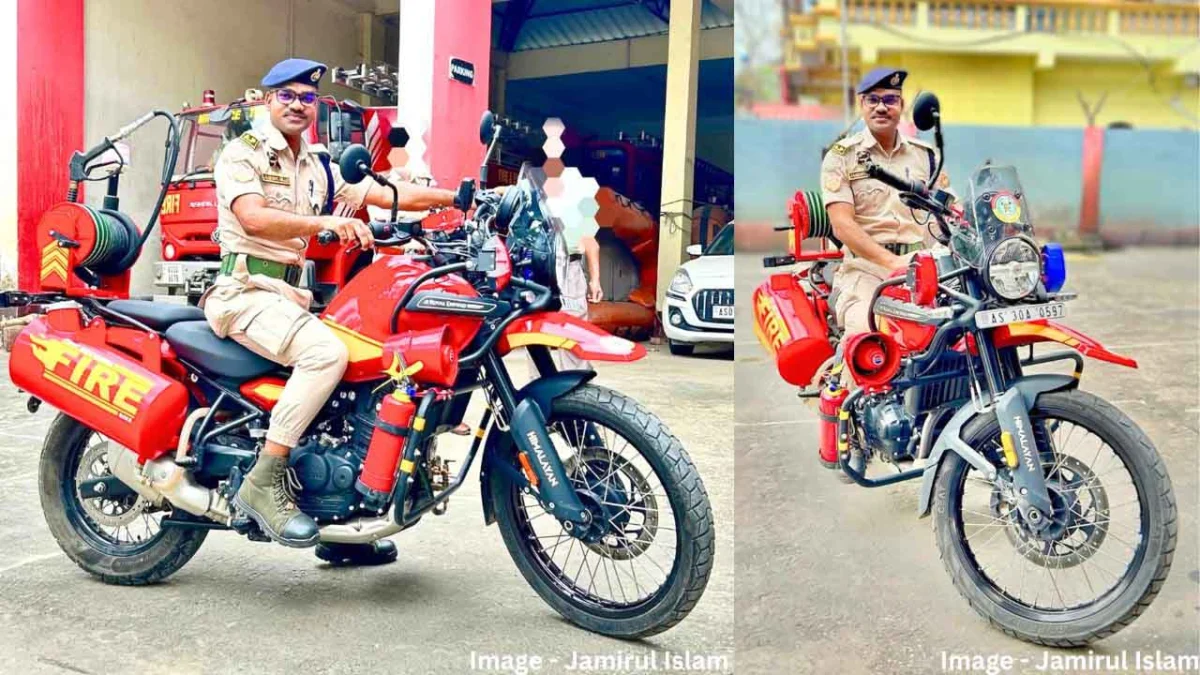
GUWAHATI — In a strategic move to modernize its emergency response infrastructure, the Assam Fire and Emergency Services (F&ES) has officially inducted a specialized fleet of 14 Royal Enfield Himalayan 450 motorcycles. These units are not merely transport vehicles but are fully equipped, high-performance "First Response Units" (FRUs) designed to navigate the complex topographical and infrastructural challenges of the state.
The induction marks a significant evolution in the department’s strategy to combat fire outbreaks in their infancy. By leveraging the agility and off-road prowess of the Himalayan 450, the Assam Fire Brigade aims to slash response times, ensuring that life-saving intervention begins long before traditional, heavy-duty fire tenders can navigate through congested urban corridors or reach remote, rugged settlements.
I. Main Facts: The Strategic Necessity of Two-Wheeled Responders
The primary objective behind the deployment of the Royal Enfield Himalayan 450 fleet is the "containment of the fire at the source." In the realm of firefighting, the first ten minutes—often referred to as the "Platinum Minutes"—determine whether a small electrical short-circuit or a kitchen fire remains a localized incident or escalates into a catastrophic blaze.
The Urban and Rural Challenge
Assam presents a unique set of challenges for emergency services. Major urban centers like Guwahati are characterized by dense populations and narrow, often encroached-upon lanes where a standard fire engine—carrying thousands of liters of water—simply cannot enter. Conversely, the state’s rural and hilly terrains require vehicles with high ground clearance and robust suspension to reach incidents in areas with poor road connectivity.
The Role of the Himalayan 450
The 14 inducted units are strategically distributed across high-risk zones. Each motorcycle acts as a mobile firefighting station, operated by trained personnel capable of providing immediate suppression and real-time reconnaissance. While they do not replace the heavy rigs, their role is to "hold the line," preventing the spread of fire and providing crucial data back to the command center regarding the scale and nature of the emergency.

II. Chronology: The Evolution of the Fire-Fighting Motorcycle in India
The use of motorcycles in Indian fire services is not a new concept, but the technology and hardware have seen a dramatic upgrade over the last decade.
- The Bullet 500 Era: Initially, fire departments in metros like Mumbai and Delhi experimented with the Royal Enfield Bullet 500. While iconic and torquey, these bikes lacked the cooling systems and suspension travel required for prolonged emergency use in varied terrains.
- The Himalayan 411 Transition: With the launch of the original Himalayan (LS410), departments saw an opportunity to move into the "Adventure-Touring" segment. The long-travel suspension allowed firefighters to hop over curbs and navigate debris-strewn paths.
- 2024: The Himalayan 450 Induction: The current induction of the Himalayan 450 (the "Sherpa" platform) represents the most advanced iteration to date. This move by the Assam Fire Brigade follows rigorous testing of the bike’s liquid-cooled engine and its ability to carry heavy payloads (water tanks and equipment) without compromising stability.
III. Supporting Data: Technical Specifications and Firefighting Modifications
The Royal Enfield Himalayan 450 was chosen not just for its brand heritage, but for its specific engineering metrics, which make it a superior "mule" for heavy firefighting equipment.
The Powerplant: Sherpa 450
The heart of these units is the 452cc, liquid-cooled, DOHC, single-cylinder engine.
- Performance: It produces 40.02 PS of power and 40 Nm of torque. The liquid-cooling is critical; unlike air-cooled engines, the Sherpa 450 can manage its thermal profile better when idling in the intense heat of a fire site.
- Transmission: A 6-speed gearbox with a slip-and-assist clutch allows for rapid gear changes in high-stress traffic situations.
Specialized Firefighting Hardware
The 14 units have undergone extensive modifications to transform them from adventure tourers into emergency vehicles:
- Water Suppression System: The bikes are fitted with twin water tanks mounted on a heavy-duty subframe. Each tank has a capacity of approximately 20 to 25 liters, providing a total of 40-50 liters of immediate "first-strike" water or foam.
- High-Pressure Pump: Mounted on the left-side engine protector is a compact, high-pressure water pump. This pump allows the rider to discharge water through a specialized pressure gun with enough force to penetrate deep into the seat of a fire.
- Hose Reel: At the rear, a custom-built jig houses a high-pressure hose, estimated to be approximately 100 feet in length, allowing the firefighter to park the bike safely and enter a burning building.
- Ancillary Extinguishers: For fires involving oils or electrical equipment (where water is dangerous), the right side of the bike carries a CO2-based fire extinguisher.
- Navigation and Communication: The "Tripper Dash" full-color TFT display is integrated with Google Maps. This is vital for responders to find the quickest route through back-alleys. Furthermore, the units are equipped with wireless radio systems for constant communication with the Fire Control Room.
Safety and Presence
To ensure the safety of the responders and the public, the motorcycles feature:

- Emergency Lighting: High-intensity LED strobe lights (Red and Blue) mounted on the front and rear.
- Audible Alerts: A multi-tone siren and a Public Address (PA) system to clear traffic and instruct civilians at the scene.
- Visual Identity: A high-visibility Red and Yellow livery, consistent with international firefighting standards.
IV. Official Responses: A Commitment to Modernization
While official statements from the Assam Fire & Emergency Services emphasize the "modernization of the force," experts in disaster management highlight the tactical advantages of this deployment.
"The induction of the Himalayan 450 is a calculated response to the changing urban landscape of our cities," noted a senior fire official during the flag-off ceremony. "Our standard fire tenders are state-of-the-art, but they are often held hostage by traffic congestion and narrow infrastructure. These motorcycles provide us with the ‘speed of thought’ response. They are the scouts and the first-strike force."
Automotive analysts have also noted that Royal Enfield’s move toward more technically sophisticated platforms like the Himalayan 450 has made them the default choice for government contracts. The availability of a robust service network across the Northeast ensures that these life-saving machines will remain operational with minimal downtime.
V. Implications: Impact on Public Safety and Future Outlook
The deployment of the Himalayan 450 fleet carries several long-term implications for the state of Assam and the broader field of emergency response in India.
1. The "Golden Hour" in Firefighting
Much like medical emergencies, firefighting has a "Golden Hour"—though in this case, it is usually the first five to ten minutes. By deploying motorcycles, the Assam Fire Brigade is prioritizing "Time-to-Site" as the most critical metric for success. This shift is expected to significantly reduce property damage and, more importantly, lower the fatality rate in residential fires.

2. Versatility in Disaster Management
Assam is prone to various natural disasters, including annual floods and occasional seismic activity. The Himalayan 450’s off-road capabilities—230mm ground clearance and 200mm suspension travel—mean these units can reach affected populations even when roads are partially destroyed or submerged in slush, providing a dual-use benefit beyond urban firefighting.
3. Economic Efficiency
Maintaining a fleet of motorcycles is significantly more cost-effective than maintaining a fleet of heavy trucks. For smaller fires, deploying a motorcycle consumes a fraction of the fuel and requires fewer personnel, allowing the Fire Brigade to optimize its budget for larger-scale equipment and training.
4. A Template for Other States
Assam’s proactive approach is likely to be studied by other states with similar topographical challenges, such as Himachal Pradesh, Uttarakhand, and Meghalaya. The success of the Himalayan 450 in this role could lead to a nationwide standard for two-wheeled fire units.
Conclusion
The induction of 14 Royal Enfield Himalayan 450s into the Assam Fire Brigade is more than just a departmental upgrade; it is a vital evolution in how the state protects its citizens. By combining rugged engineering with specialized firefighting technology, Assam is setting a new benchmark for rapid emergency response, proving that in the race against fire, agility is just as important as volume. As these units begin their patrols, the residents of Assam can look forward to a faster, more resilient shield against the threat of fire.
