

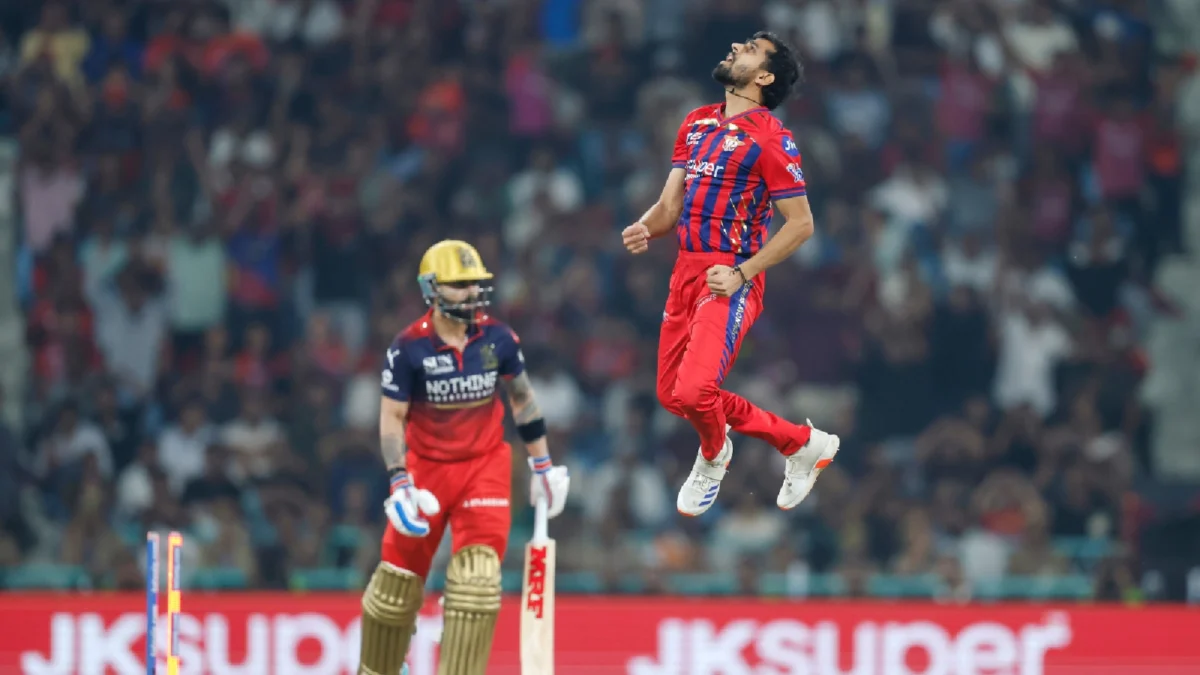
Bengaluru, India – May 15, 2026 – In a cricketing landscape often defined by fierce rivalries and relentless competition, a moment of profound sportsmanship recently captured headlines during the ongoing Indian Premier League (IPL) 2026 season. Young prodigy Prince Yadav, after claiming the prized wicket of batting maestro Virat Kohli, revealed that it was none other than Kohli himself who had offered him invaluable advice before the game, ultimately contributing to his success. This revelation has since sparked widespread discussion, prompting Kohli to candidly share the philosophy underpinning his magnanimous approach to mentoring even his direct opponents.
Speaking exclusively to Royal Challengers Bengaluru’s (RCB) in-house media team, Kohli articulated a vision that transcends immediate match outcomes, prioritizing the long-term health and sustained excellence of Indian cricket. His insights shed light on a mindset that balances an unyielding competitive drive with a profound commitment to nurturing the next generation of talent, regardless of their team colours. This philosophy, he asserts, is not merely about individual acts of kindness but a strategic investment in the future of the sport he so passionately serves.
The Genesis of a Guiding Philosophy: Main Facts Unveiled
The central narrative revolves around the remarkable incident involving Prince Yadav. In a high-stakes IPL fixture, Yadav, a relatively unheralded talent, managed to outwit and dismiss Virat Kohli, a batsman widely considered among the greatest of all time. What made the moment truly extraordinary was Yadav’s subsequent admission that Kohli had provided him with tactical guidance prior to the game, suggesting specific areas to bowl that proved instrumental in securing the wicket. This act of mentorship, coming from a direct competitor, resonated deeply within the cricketing fraternity, prompting questions about Kohli’s motives.
Kohli’s explanation, delivered with characteristic sincerity, offered a compelling rationale. He framed his actions not as a momentary lapse in competitive focus but as an integral part of his responsibility as a senior figure in Indian cricket. For Kohli, the development of young talent, irrespective of their IPL franchise, is paramount to ensuring a robust and high-quality national team for years to come. His philosophy posits that short-term rivalries pale in comparison to the overarching goal of elevating the standard of cricket across the nation. He views helping a promising young player as an investment in Indian cricket’s future, a testament to his belief in collective growth over individual gains.
A Chronological Account of Mentorship: From Vijay Hazare to IPL Glory
The roots of Kohli’s generous spirit extend beyond isolated IPL encounters. His interaction with Prince Yadav, which culminated in the now-famous IPL dismissal, began earlier. Kohli revealed that he had formed a rapport with Yadav during the Vijay Hazare Trophy games, a domestic one-day competition.
Pre-Match Counsel and the Fateful Delivery:
"I didn’t know Prince at all," Kohli recounted, describing Yadav as initially intense on the field but ultimately a "sweet guy." During those Vijay Hazare matches, standing at mid-off or covers, Kohli engaged with the young bowler, offering unprompted advice. "I was telling him even on those times, even through those Vijay Hazare games, standing at mid-off, covers, whatever—what to do, where to bowl." This early connection laid the groundwork for the IPL moment. When Yadav eventually delivered the ball that sent Kohli back to the pavilion in the IPL 2026 fixture, it was a testament to the effectiveness of the very counsel he had received from the legendary batsman. Yadav’s post-match acknowledgment of Kohli’s guidance transformed what could have been a routine dismissal into a powerful narrative of mentorship and sportsmanship.
The Yashasvi Jaiswal Hypothetical: A Vision for India:
To further illustrate his point, Kohli presented a hypothetical scenario involving another rising star, Yashasvi Jaiswal, who plays for the Rajasthan Royals. "You look at my situation. If Yashasvi Jaiswal reaches out to me before we have to play Rajasthan Royals, right? He’s probably looked up to me for a long period of time. Now I’m thinking, ‘He needs help’."
Kohli elaborated on the internal dialogue that guides his decision-making: "Even though he’s going to play against us, it’s one game. But if he plays well for the whole season, eventually he’s going to play for India. So how can I not help him? He might score against us tomorrow or the day after. It’s okay." This powerful statement encapsulates his broader vision: the immediate outcome of a single IPL match pales in comparison to the long-term benefit of developing a player who could eventually represent the national team. He acknowledged the possibility of Jaiswal scoring against RCB but emphasized that finding a way to win despite an opponent’s individual brilliance is part of the challenge. "Despite Jaiswal scoring, we should find a way to win. Whatever it is, he might or might not. I’m not saying he would. There’s a possibility he might." For Kohli, the potential for a young talent to flourish and contribute to Indian cricket far outweighs the risk of conceding a few runs in a domestic league match.
The Mohammed Siraj Example: Competing Against the Best:
Kohli also cited an instance where he offered advice to his own teammate, Mohammed Siraj, even when they were set to face an opponent in a couple of days. "Before playing Gujarat in Bangalore, I spoke to Siraj on the boundary. I told him my observations, how I saw him run in, and you know, it was different to before. And he spoke to me about rhythm. And we’re playing them two days later!"
This example reinforces a crucial aspect of Kohli’s competitive philosophy: he desires to compete against the absolute best version of his opponents. "I want his best version. I should be able to play his best version; I don’t want him to be at his worst. I actually want him to be at his best so I can compete with him. So that you can compete with the best, right?" This speaks volumes about his own commitment to excellence and his belief that true competition arises when all participants are operating at their peak. It’s a mindset that rejects the notion of gaining an advantage from an opponent’s struggles, instead seeking to elevate the entire competitive environment.
Supporting Data and Broader Context: The Legacy of Mentorship
Kohli’s actions are not isolated but resonate with a rich tradition of mentorship in sports, particularly in cricket. His stature as one of the most influential figures in contemporary cricket amplifies the impact of his philosophy. With a career spanning over a decade and a half, replete with numerous records and leadership stints, Kohli embodies the aspiration of countless young cricketers.
Kohli’s Role as a Senior Statesman:
As a veteran player, Kohli recognizes the responsibility that comes with his experience and influence. He is acutely aware that he won’t "be here forever," and therefore, sharing his vast knowledge becomes a moral imperative. This aligns with the natural progression of any sport where seasoned professionals guide newcomers, ensuring a continuous cycle of learning and improvement. His current role is less about individual glory and more about shaping the future landscape of Indian cricket, making him a true elder statesman.
IPL’s Uniquely Fostering Environment:
The IPL, with its unique blend of domestic and international talent playing together in a franchise model, provides an unparalleled platform for such interactions. Young Indian players share dressing rooms and practice facilities with cricketing legends, offering direct access to mentorship that traditional domestic structures might not provide as readily. Kohli’s willingness to engage transcends the formal boundaries of team affiliations, leveraging the IPL’s unique ecosystem to foster talent across the board. This cross-pollination of knowledge is a significant, if often unquantified, benefit of the league.
Elevating the Standard of Indian Cricket:
At the heart of Kohli’s philosophy is a profound desire to maintain and elevate the standard of Indian cricket. "You have to share experience. You’re not going to be here forever and if people have the opportunity to learn and get better in their careers, eventually who gets helped? If all these guys play well, eventually they play for India. The standard of cricket remains high." He argues that by helping young players reach their full potential, he is ultimately contributing to a stronger national team. A broader pool of highly skilled players ensures competitive selection, greater depth, and ultimately, more success for India on the international stage. This long-term strategic thinking underscores his commitment to the national cause above all else.
The Psychological Impact on Young Players:
For young players like Prince Yadav or a hypothetical Yashasvi Jaiswal, receiving advice from a legend like Virat Kohli is not just about technical tips; it’s a monumental confidence booster. It validates their potential, instills belief, and provides an invaluable learning experience that can accelerate their development by years. Such interactions can be career-defining, offering clarity and direction that might otherwise take much longer to acquire through trial and error. The psychological uplift can be as impactful as any technical correction.
Official Responses and Articulation of Principle
Kohli’s candid dialogue with the RCB media team serves as the primary "official response," directly addressing the public’s curiosity. His words are not merely off-the-cuff remarks but a coherent articulation of deeply held principles.
"You have to share experience," Kohli asserted, emphasizing the communal aspect of knowledge in sports. "You’re not going to be here forever and if people have the opportunity to learn and get better in their careers, eventually who gets helped? If all these guys play well, eventually they play for India. The standard of cricket remains high. You don’t want to see a situation where tomorrow the standards are dropping. If you can help someone to get to their potential best, then their best version will eventually help Indian cricket. That’s the progress I see."
This statement is a manifesto for collective growth. It positions individual success within the larger framework of national sporting excellence. He is not just a player but a guardian of the game’s future in India.
Regarding his personal interactions, Kohli clarified his approach: "I don’t do a lot of these post-match social catch-ups, to be honest, in the IPL. But if someone genuinely needs help and they want to talk about the game, I’m always there to help." This indicates a discerning approach, prioritizing genuine requests for guidance over superficial social engagements. It underscores the sincerity of his mentorship, reserved for those truly seeking to improve their game.
Implications: Reshaping Perceptions and Inspiring a Generation
Virat Kohli’s willingness to mentor rivals carries significant implications across various facets of cricket, from individual careers to the sport’s overarching culture.
Impact on Individual Careers:
For young cricketers, a word of advice from Virat Kohli can be transformative. It’s not just the technical input but the immense psychological boost that comes from being acknowledged and guided by a legend. This can accelerate their learning curve, instil confidence, and potentially unlock their full potential much sooner. Prince Yadav’s wicket of Kohli, armed with Kohli’s own advice, will forever be a highlight of his career, a testament to both his skill and the generosity of his opponent. Such encounters can define the trajectory of a young player’s journey.
Shaping the IPL’s Culture:
While the IPL is fiercely competitive, Kohli’s actions foster a healthier, more collaborative culture within the league. It demonstrates that rivalry on the field doesn’t preclude mutual respect and a shared commitment to the sport’s growth off it. This could inspire other senior players to adopt similar approaches, creating an environment where knowledge flows freely, ultimately benefiting all teams by raising the overall standard of play. The league, often criticized for its commercialism, gets a powerful reminder of the ‘spirit of cricket’.
Strengthening Indian Cricket’s Pipeline:
The most profound implication lies in its contribution to Indian cricket. By actively nurturing talent across various franchises, Kohli is directly contributing to a stronger national talent pool. As he articulated, if young players perform well in the IPL, they are more likely to earn national call-ups, ensuring a continuous supply of high-quality cricketers for Team India. This long-term vision safeguards the future success of Indian cricket on the global stage, preventing any potential drop in standards that might occur if mentorship was restricted along team lines.
Reinforcing Kohli’s Legacy:
Beyond his extraordinary batting prowess and aggressive captaincy, this philosophy adds another layer to Virat Kohli’s already formidable legacy. It positions him not just as a champion player, but as a true sportsman, a mentor, and a visionary who understands his role in the broader ecosystem of the sport. It humanizes the fierce competitor, revealing a generous and thoughtful individual committed to the collective good. This elevates his status beyond mere statistics, cementing his place as an icon whose influence extends far beyond the boundary ropes.
The "Spirit of Cricket" in Action:
In an era where professional sports are often seen through the lens of cut-throat competition, Kohli’s actions are a powerful reaffirmation of the "spirit of cricket." It underscores the values of sportsmanship, respect, and camaraderie, reminding everyone that while winning is important, the integrity and development of the game itself hold ultimate precedence. It sets a precedent for how elite athletes can contribute meaningfully to their sport’s future, inspiring a generation of players and fans alike to embrace both fierce competition and genuine fellowship.
Virat Kohli’s unique blend of competitive fire and philanthropic spirit offers a compelling model for professional athletes globally. His willingness to guide those who may one day be his rivals is not a weakness but a testament to his strength of character and his unwavering commitment to the progress of Indian cricket. As the IPL 2026 season continues, these acts of quiet mentorship will undoubtedly leave a lasting impact, far beyond the immediate results on the scoreboard.
