

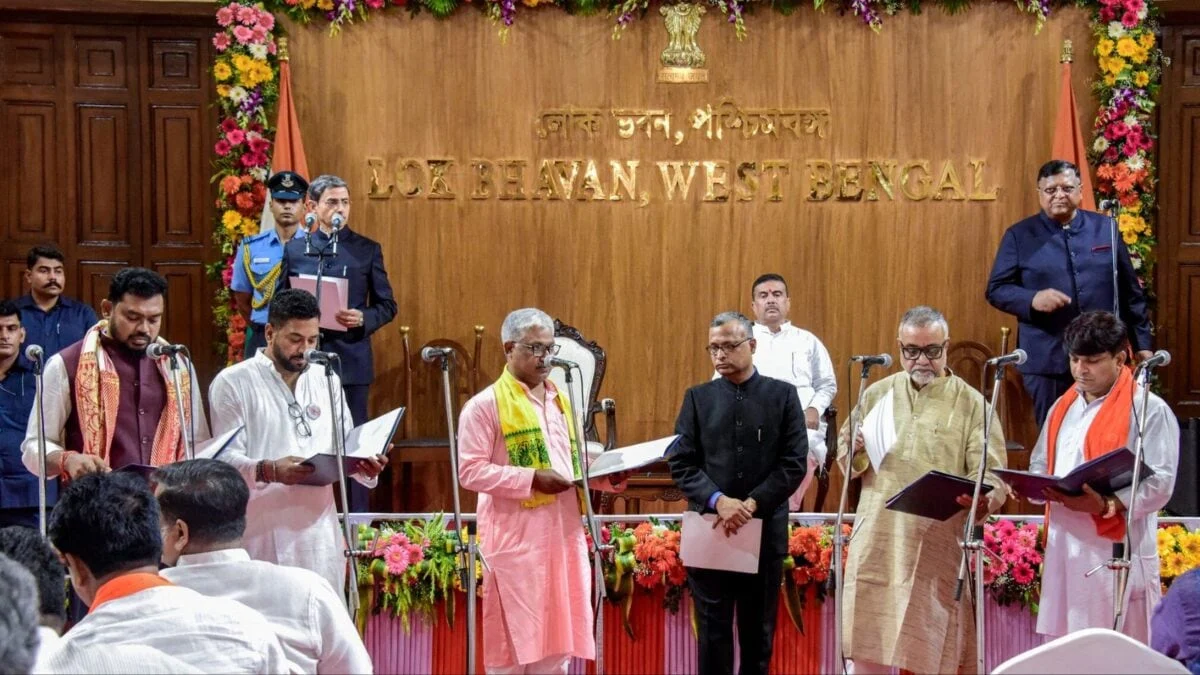
Kolkata, India – June 1, 2026 – In a move signaling a carefully orchestrated political strategy, the Bharatiya Janata Party (BJP) has formally inducted 18 ministers into the newly sworn-in West Bengal Cabinet. This formation is not merely an administrative exercise but a meticulously crafted political statement, blending seasoned leadership with youthful dynamism, broad social representation, and a significant emphasis on professional and academic credentials. With an average age of 57, the cabinet seeks to project both stability and a forward-looking vision, aiming to consolidate the party’s influence across the diverse socio-political landscape of the state.
The composition, described by party insiders as an intricate balance between governance experience and expansive electoral outreach, aims to resonate with West Bengal’s key social and regional constituencies. The blend of 18 ministers drawn from 13 distinct caste groups, alongside a notable emphasis on higher education with three PhD holders and numerous postgraduates, underscores the BJP’s ambition to create an inclusive yet highly capable administrative body. This strategic architecture is designed not only to govern effectively but also to position the party firmly for future electoral challenges in the politically charged state.
A Cabinet Forged in Strategy: The BJP’s Bengal Blueprint
The formation of West Bengal’s new cabinet under the BJP’s leadership marks a significant turning point in the state’s political narrative. Following what is understood to be a landmark electoral victory, this cabinet represents the party’s first full term in power, necessitating a robust and representative ministerial team capable of translating electoral mandate into tangible governance.
The Genesis of a New Era: From Mandate to Ministry
The period leading up to the swearing-in ceremony on June 1, 2026, was characterized by intense deliberations within the BJP’s central and state leadership. Sources close to the party’s decision-making apparatus indicate that the selection process was exhaustive, involving multiple rounds of consultations aimed at identifying candidates who could fulfill a dual mandate: effective administration and strategic political outreach. The party leadership, keenly aware of West Bengal’s complex social fabric and regional disparities, meticulously analyzed demographic data, electoral performance, and individual profiles to construct a cabinet that would reflect the state’s diversity while adhering to the BJP’s ideological framework.
The initial phase involved shortlisting potential candidates based on their legislative experience, organizational contributions, and public image. This was followed by a rigorous assessment of their educational backgrounds and professional expertise, a criterion the BJP has increasingly emphasized in its recent appointments. The final selection was reportedly a consensus-driven process, balancing the demands of various internal factions, regional aspirations, and the overarching goal of projecting a unified and competent governmental front. The swiftness with which the cabinet was finalized and sworn in, barely weeks after the electoral results, also speaks to the party’s readiness and methodical approach to assuming power.
Demographic Engineering: A Mosaic of Representation
One of the most striking features of the new cabinet is its intentional demographic diversity, a clear signal of the BJP’s ambition to broaden its appeal across West Bengal’s varied communities.
Caste and Community Outreach: The inclusion of representatives from 13 caste groups, encompassing eight of West Bengal’s ten largest caste communities, highlights a deliberate strategy to ensure comprehensive social representation. Among the Scheduled Castes (SC), the BJP has strategically accommodated leaders from both the Rajbongshi and Namasudra communities. Nishith Pramanick, a prominent figure, and Deepak Barman represent the Rajbongshi community, which wields significant electoral influence in the northern districts of Bengal, particularly in regions like Cooch Behar and Alipurduar. Their inclusion is seen as a reinforcement of the BJP’s strong base in North Bengal, a region that has increasingly tilted towards the saffron party.
Ashok Kirtania’s induction, representing the Namasudras, underscores the party’s focus on the significant SC population in South Bengal, especially in districts bordering Bangladesh. The Namasudra community, historically marginalized, has been a crucial demographic for political parties in the state, and Kirtania’s presence aims to solidify the BJP’s inroads into this vote bank. This dual representation among SCs is a testament to the party’s granular approach to caste politics, recognizing the distinct social and political dynamics of different sub-groups.
Similarly, the two Scheduled Tribe (ST) ministers have been chosen with specific regional and community considerations. Manoj Kumar Oraon represents the Oraon community, predominantly found in the tea-garden belts of North Bengal. This area has specific socio-economic challenges and a distinct political identity, and Oraon’s inclusion is designed to address the aspirations of the plantation workers and tribal communities there. Kshudiram Tudu, hailing from the Santhal community of Junglemahal, signifies the BJP’s sustained focus on this historically sensitive region comprising parts of West Midnapore, Bankura, and Purulia. Junglemahal has been a crucial political battleground, often witnessing shifts in allegiances, and Tudu’s appointment aims to strengthen the party’s ties with the Santhal community, a significant tribal group in the area. This meticulous mapping of caste and tribal representation across regions demonstrates a sophisticated understanding of West Bengal’s electoral demography.
Age and Experience: A Blend of Wisdom and Dynamism: With an average age of 57, the cabinet strikes a balance between seasoned political veterans and a younger generation of leaders. The presence of four ministers below the age of 50, with Mathabhanga MLA Nishith Pramanick emerging as the youngest member, signals the BJP’s intent to nurture new talent while leveraging the wisdom of experience. The "seasoned leadership" brings invaluable administrative acumen, legislative understanding, and a deep grasp of state politics, crucial for navigating the complexities of governance. These experienced hands are expected to provide stability and strategic direction.
Conversely, the inclusion of younger politicians like Pramanick, who also served as a Union minister previously, injects fresh perspectives and dynamism into the government. This blend is projected as a balance between continuity and renewal, essential for a party seeking to consolidate its hold over a state known for its vibrant and often tumultuous political landscape. It also aims to connect with younger voters and address contemporary issues with a modern outlook.
Professional Prowess: A Cabinet of Minds: The educational and professional qualifications of the new ministers stand out as a notable feature. Fifteen of the 18 ministers hold graduate or higher degrees, with an impressive 12 possessing postgraduate qualifications. Furthermore, three ministers hold PhD degrees, underscoring the party’s emphasis on academic credentials and intellectual depth. This focus on education is intended to project an image of a government that is not only politically astute but also intellectually capable and well-equipped to tackle complex policy challenges.
The cabinet also boasts a diverse professional background, including doctors, professors, journalists, and teachers. This professional diversity is arguably one of the most comprehensive seen in Bengal politics in recent years. The inclusion of medical professionals could lead to a more informed approach to public health policies, especially relevant in the post-pandemic era. Professors and teachers bring pedagogical and research expertise, potentially influencing education reform and policy-making. Journalists offer a unique understanding of public perception and communication strategies, vital for effective governance. This multi-faceted professional representation is expected to enrich policy discussions and lead to more nuanced and effective governance.
Geographic Imperatives: Spanning the State’s Diversity: The regional distribution of ministers is another critical aspect of the BJP’s strategy. The cabinet draws ministers from all five major organizational zones of the BJP in Bengal, ensuring that administrative and political outreach extends across the entire state. There is particularly strong representation from North Bengal and Rarh Bengal, regions where the BJP has made significant electoral gains in recent years.
North Bengal, with its distinct socio-economic profile, tribal populations, and border dynamics, has been a stronghold for the BJP. Strong representation from this region aims to reinforce the party’s commitment to its development and address its unique challenges. Rarh Bengal, characterized by its tribal communities and significant mineral resources, has also emerged as a crucial area for the BJP. By giving these regions substantial ministerial berths, the party aims to strengthen its administrative grip and deepen its political roots, signaling that no region is overlooked in its governance agenda.
Voices from Within and Without: Reactions and Rationale
The formation of the new cabinet has elicited various reactions, both from within the BJP and from external political analysts, all of whom acknowledge the strategic depth of its composition.
Party’s Strategic Vision: Balancing Ambition and Reality
Senior BJP functionaries have been quick to articulate the party’s rationale behind the cabinet choices. "This cabinet is a clear reflection of our commitment to inclusive governance and holistic development for West Bengal," stated a senior BJP leader, who requested anonymity due to the sensitivity of internal discussions. "We have meticulously balanced experience with fresh perspectives, ensuring that every significant social and regional segment of our state finds representation at the highest level of government. It’s about laying a strong foundation for future growth and proving our capability to govern effectively."
Another party strategist highlighted the emphasis on qualifications. "The inclusion of highly educated professionals, including PhDs, is not just a symbolic gesture. It reflects our belief that modern governance requires intellectual rigor and diverse expertise. These individuals bring a wealth of knowledge that will be invaluable in crafting and implementing progressive policies for West Bengal." The party projects this as a testament to its forward-thinking approach, aiming to counter narratives that sometimes portray political leadership as lacking in academic depth. The strategic appointments of organizational heavyweights also underscore the BJP’s focus on leveraging party strength to bolster governmental efficiency. "Leaders like Dilip Ghosh and Arjun Singh bring not only legislative experience but also a deep understanding of the party’s grassroots machinery. Their induction ensures a seamless synergy between the party organization and the government," remarked a state vice president.
Expert Analysis: A Pragmatic Approach to Power
Political analysts view the cabinet’s composition as a highly pragmatic and calculated move by the BJP to cement its power base in West Bengal. Dr. Indranil Roy, a prominent political scientist based in Kolkata, observed, "The BJP has clearly learned from its previous electoral performances and has crafted a cabinet that addresses many of the perceived shortcomings. The emphasis on caste and tribal representation is not merely tokenism; it’s a direct response to the specific electoral arithmetic of Bengal. By including prominent leaders from communities like the Rajbongshis and Namasudras, they are trying to consolidate their gains and prevent any backsliding."
Dr. Roy further commented on the age and professional diversity: "The blend of youth and experience, coupled with a strong academic background, sends a message of both stability and progressiveness. It’s an attempt to appeal to a broad spectrum of voters, from the traditional older electorate to the aspirational younger generation. The inclusion of professionals also aims to counter the narrative that politicians lack real-world expertise, projecting a more competent image."
However, some analysts also cautioned about the challenges ahead. "While the composition is impressive on paper, the real test will be in governance delivery," stated Professor Ananya Chatterjee, a sociologist. "West Bengal has unique socio-economic challenges, and the diverse cabinet will need to work cohesively to address them. The representation is a good start, but performance will ultimately define its success."
The Road Ahead: Implications and Challenges
The new BJP cabinet in West Bengal is poised to embark on a crucial journey, with its composition carrying significant implications for governance, future electoral dynamics, and the state’s political landscape.
Governance and Policy Impact: A Holistic Approach
The diverse professional backgrounds within the cabinet suggest a potential for a more holistic and nuanced approach to policy-making. Ministers with academic and professional expertise are expected to bring evidence-based perspectives to their portfolios, potentially leading to more effective policy design and implementation. For instance, the presence of doctors could lead to innovative healthcare reforms, while professors might drive educational advancements.
Given the strong regional representation, especially from North Bengal and Rarh Bengal, the cabinet is likely to prioritize addressing regional disparities. This could manifest in targeted development projects, infrastructure upgrades, and specific welfare schemes tailored to the unique needs of these areas. The emphasis on social representation also suggests that policies aimed at empowering marginalized communities, including Scheduled Castes and Tribes, will likely receive significant attention. This might include initiatives for skill development, employment generation, and cultural preservation, reflecting the aspirations of these communities.
Electoral Dynamics and Future Prospects: Consolidating the Base
This cabinet formation is a clear signal of the BJP’s long-term electoral strategy in West Bengal. By ensuring broad representation across caste, community, and region, the party aims to consolidate its existing voter base and attract new segments of the electorate. The strategic inclusion of organizational heavyweights also ensures that the government and party machinery work in tandem, crucial for mobilizing support ahead of future electoral battles, including upcoming local body elections and the next state assembly polls.
The cabinet’s performance will be a critical determinant of the BJP’s future prospects. Successful governance, coupled with effective communication of achievements, could strengthen the party’s narrative as a viable and capable alternative. Conversely, any missteps or failures could provide ammunition to the opposition, which will undoubtedly scrutinize the new government’s every move. The balance between fulfilling regional aspirations and maintaining a unified state vision will be a delicate act for the cabinet.
Internal Party Dynamics: Unity and Potential Factionalism
The inclusion of prominent figures from the BJP’s organizational structure, such as former state president Dilip Ghosh and current state vice presidents, alongside former Union and state ministers, speaks to an effort to project a united front. This blend of organizational experience and governmental responsibility aims to foster synergy between the party and the government.
However, cabinet formations, especially in a state with a complex political history like West Bengal, always carry the potential for internal dynamics and subtle power shifts. How these various strong personalities and experienced leaders collaborate will be crucial. The ability of the Chief Minister and the central leadership to maintain cohesion and prevent factionalism will be a key challenge, particularly as the party navigates the complexities of governing for the first time in the state.
Challenges and Scrutiny: The Road Less Traveled
Despite its strategic composition, the new cabinet faces numerous challenges. West Bengal has a history of robust political opposition, and the BJP government will be under intense scrutiny from day one. Economic development, job creation, law and order, and addressing the state’s substantial debt are just some of the pressing issues that demand immediate attention. The public will expect tangible results, and the diverse cabinet will need to demonstrate its collective capability to deliver on these expectations.
Moreover, the BJP’s ideological positioning in West Bengal will continue to be a subject of debate and scrutiny. While the cabinet has focused on social and regional inclusion, how it balances this with the party’s broader national agenda will be keenly watched. The success of this cabinet will not only define the BJP’s tenure in West Bengal but also set a precedent for its governance model in other diverse states. As the newly sworn-in ministers embark on their responsibilities, the eyes of the nation will be on Kolkata, watching how this meticulously assembled team navigates the intricate political and administrative landscape of West Bengal.
