

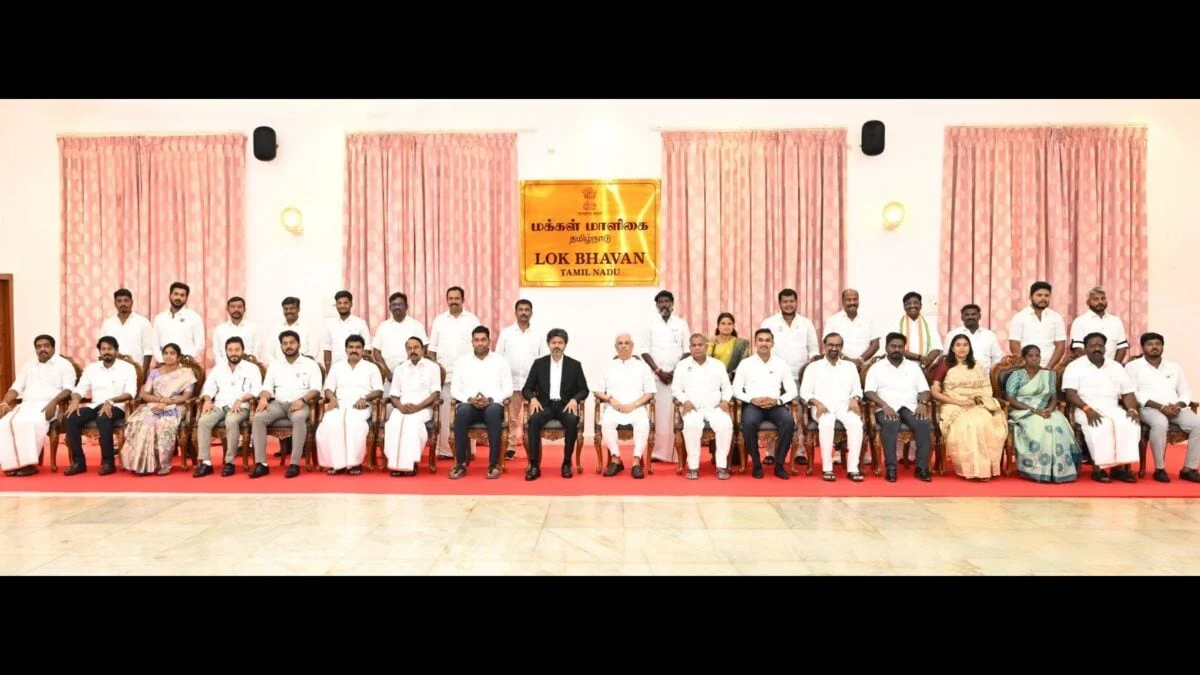
Chennai [Madras], India – In a political move that has sent ripples across Tamil Nadu and beyond, Chief Minister C. Joseph Vijay, leader of the Tamilaga Vettri Kazhagam (TVK), has significantly expanded his cabinet, unveiling a diverse and strategically crafted team. This expansion, which saw the council of ministers grow from an initial 10 to a robust 33, marks a series of unprecedented "firsts" in the state’s political history, meticulously balancing caste representation, youth leadership, gender diversity, and coalition politics. With a record number of Dalit ministers, a rare inclusion of Brahmins, a substantial youth contingent, and the re-entry of Congress into state governance after nearly six decades, Vijay’s new administration is poised to redefine the political narrative of Tamil Nadu.
The composition of this expanded cabinet, finalized on May 21, 2026, is a bold declaration of intent from the newly elected Chief Minister. It seeks to forge a "social justice" narrative that, while rooted in the state’s historical ethos, also signals a deliberate departure from the traditional Dravidian-era political framework that has dominated Tamil Nadu for over half a century. In his inaugural address, Chief Minister Vijay emphatically declared the dawn of "real secularism and social justice" in the state, laying bare the ideological bedrock of his nascent administration. This cabinet, therefore, is not merely an administrative arrangement but a powerful political statement, designed to resonate with a broad spectrum of the electorate and set a new trajectory for the southern powerhouse.
Chronology of Formation and Expansion
The journey to this historic cabinet has been a swift and calculated one, reflecting Chief Minister Vijay’s decisive leadership style and his party’s strategic approach to governance.
Initial Cabinet Formation
Following the Tamil Nadu Assembly elections, C. Joseph Vijay, at the helm of the TVK, quickly formed an initial, leaner council of ministers. This preliminary team, comprising just 10 members, was seen as a foundational step, allowing for immediate administrative continuity while the broader architecture of his government was still being conceptualized. This initial phase allowed Vijay to appoint key portfolios and establish an immediate command structure, setting the stage for a more comprehensive and inclusive expansion.
The Grand Expansion
The true breadth of Vijay’s vision became apparent with the announcement of the cabinet expansion to 33 members. This move was not just about increasing numbers but about embedding a specific political philosophy into the government’s very structure. The expansion was meticulously planned, with each induction carrying symbolic and strategic weight. The decision to broaden the cabinet significantly underscored the TVK’s commitment to inclusive governance and its ambition to represent a wider array of communities and demographic groups. The process involved extensive consultations and negotiations, particularly with alliance partners, to ensure a cohesive and representative team could be presented to the public.
Oath-Taking Ceremonies
The formal induction of the new ministers unfolded in a series of oath-taking ceremonies. These events, steeped in constitutional solemnity, were closely watched by political analysts and the public alike. The ceremonies began with the core TVK members and later included representatives from alliance partners. A notable moment was the oath-taking of Viduthalai Chiruthaigal Katchi (VCK) MLA Vanni Arasu, which, upon his formal induction on Friday, further solidified the Dalit representation to eight. These ceremonies were not just procedural; they were public affirmations of the new government’s commitment to its stated principles of diversity and social justice, culminating in a cabinet that mirrors the complex socio-political tapestry of Tamil Nadu.
Supporting Data: A Cabinet Forged in Inclusivity and Change
The newly constituted cabinet under Chief Minister C. Joseph Vijay is a statistical anomaly in Tamil Nadu’s political history, distinguished by its bold moves towards broader representation. Each aspect of its composition tells a story of strategic intent and a desire to break away from established norms.
Record Dalit Representation: A Landmark in Social Justice
Perhaps the most striking feature of Vijay’s cabinet is the unprecedented representation of Scheduled Caste (Dalit) communities. With seven ministers initially, and an expected rise to eight following VCK MLA Vanni Arasu’s oath-taking, this cabinet boasts the highest proportional representation for the community in any Tamil Nadu cabinet to date. This move is not merely symbolic; it represents a significant shift in the state’s political landscape, where Dalit voices have historically struggled for adequate representation at the highest levels of governance despite their substantial population.
Historically, while Dravidian parties championed social justice, the highest echelons of power often remained less diverse than their stated ideals. The TVK’s deliberate elevation of Dalit leaders is a powerful message, aimed at rectifying past imbalances and empowering a community that forms a crucial demographic bloc. Among the prominent Dalit faces inducted are Aadhav Arjuna, a seasoned party strategist whose intellectual contributions have been vital to TVK’s rise, and Dr. K. G. Arunraj, a former Indian Revenue Service (IRS) officer who resigned from a prestigious bureaucratic career to enter politics with TVK. Their inclusion not only brings administrative acumen but also provides strong, articulate voices for the community within the government. This move is widely interpreted as a concrete manifestation of Chief Minister Vijay’s promise of "real social justice," aiming to build a more equitable political structure.
Bridging Divides: The Unprecedented Inclusion of Brahmins
In a politically astute and equally controversial move, Chief Minister Vijay has included two Brahmin ministers in his cabinet. This decision marks a profound departure in a state whose Dravidian politics have been historically defined by a strong anti-Brahmin rhetoric, a movement born out of social reform and aimed at dismantling caste hierarchies and challenging Brahminical dominance. For decades, Brahmin representation in Tamil Nadu cabinets has been minimal, if not entirely absent, reflecting the ideological foundations of Dravidian parties like the DMK and AIADMK.
The inclusion of figures like P. Venkataramanan, the MLA from Chennai’s Mylapore constituency, as a key Brahmin face, signals a strategic effort by Vijay to project an "all-inclusive" political framework. This move can be seen as an attempt to broaden the TVK’s appeal beyond traditional caste-based vote banks, potentially attracting segments of the electorate that have felt marginalized by the prevailing Dravidian discourse. Political analysts suggest this is a calculated risk, aiming to reposition the TVK as a party that transcends historical animosities and embraces a more pluralistic vision for the state. It challenges the very tenets upon which much of Tamil Nadu’s political identity has been built, inviting both praise for its perceived progressiveness and criticism for potentially diluting the original tenets of Dravidian social justice.
A Generational Shift: Youth at the Helm
Chief Minister Vijay’s emphasis on youth leadership is another defining characteristic of his new cabinet. Out of the 33 ministers, a remarkable 11 are below the age of 40. This substantial infusion of young blood reflects a conscious push for a generational shift in state politics, aiming to bring fresh perspectives, modern approaches, and dynamic energy to governance.
The majority of these young ministers, apart from seasoned veteran K. A. Sengottaiyan who serves as a crucial link to traditional political experience, have no prior ministerial experience. This underscores the government’s commitment to fostering new leadership and empowering a generation that has often been relegated to secondary roles in established political parties. The TVK believes that this youth-centric approach will not only inject vitality into the administration but also better connect with the aspirations of Tamil Nadu’s significant youth population, addressing contemporary challenges with innovative solutions. This strategy also positions Vijay as a leader who is willing to trust and invest in the future, moving away from the often gerontocratic structures of Indian politics.
Empowering Women: Four Voices in Governance
The expanded cabinet also features four women ministers, reflecting the government’s commitment to gender diversity. The selection process appears to have prioritized grassroots leadership and active youth participation among women leaders, aiming to bring diverse experiences to the policy-making table.
Among these notable inclusions is S. Keerthana from Sivakasi, who holds the distinction of being the youngest MLA in the current Tamil Nadu Assembly. Her induction, alongside other women ministers, is a testament to the TVK’s stated goal of empowering women in public life. While the number might still be considered modest by some advocates for gender parity, the emphasis on youth and grassroots involvement signals a qualitative improvement in the representation of women, moving beyond tokenism towards genuine inclusion of capable and engaged leaders. This move is crucial in a state where women’s political participation has been growing, and their voices are increasingly critical in shaping public discourse and policy.
A Return to Coalition Politics: Congress Back After 59 Years
The cabinet expansion marks a significant political realignment, formally transforming Vijay’s administration into Tamil Nadu’s first coalition government in nearly six decades. The induction of two Congress MLAs into the cabinet ends the Congress party’s 59-year wait to return to the state cabinet, a powerful symbol of renewed alliance dynamics.
Tamil Nadu politics has historically been dominated by single-party rule, primarily under the Dravidian majors – DMK and AIADMK – often forming alliances for elections but rarely sharing power in government. This shift signifies a departure from that long-standing tradition. The inclusion of Congress not only strengthens the TVK’s legislative majority but also signals a more collaborative approach to governance. Furthermore, the Indian Union Muslim League (IUML), another key TVK ally, is also expected to join the cabinet, further solidifying the coalition. This move carries profound implications for policy formulation, requiring greater consensus-building and power-sharing among alliance partners. It also potentially provides a more stable legislative environment, allowing the government to navigate complex issues with broader support, while also presenting the challenge of managing diverse party interests within the administration.
Official Responses and Ideological Positioning
The unveiling of the new cabinet has been met with a mix of anticipation, praise, and critical scrutiny, reflecting its transformative potential.
Chief Minister Vijay’s Vision: "Real Secularism and Social Justice"
Chief Minister C. Joseph Vijay has been unequivocal in articulating the ideological underpinnings of his administration. In his inaugural speech, he proclaimed the dawn of an era of "real secularism and social justice" in Tamil Nadu. This statement is a direct challenge to previous administrations, suggesting that while their rhetoric might have invoked these principles, his government intends to implement them in a more profound and equitable manner.
For Vijay, "real social justice" extends beyond traditional affirmative action. It encompasses a holistic approach to representation, ensuring that all marginalized communities, including Dalits, are not just beneficiaries of welfare schemes but active participants in governance. His inclusion of Brahmins, a community often seen as ideologically opposed to the Dravidian movement’s original social justice tenets, is interpreted by his supporters as an attempt to reframe secularism as truly "all-inclusive," where no community feels alienated. This vision seeks to move beyond historical fault lines, promoting a new form of social harmony that respects diverse identities while upholding principles of equality. The TVK’s approach, therefore, is to redefine these foundational concepts, making them more adaptable to the contemporary socio-political landscape of the state.
Reactions from Political Spectators and Parties
The cabinet’s composition has naturally drawn diverse reactions. Political analysts like Dr. R. Kavitha, a professor of political science at Madras University, observe, "Vijay’s cabinet is a masterstroke in political messaging. He’s simultaneously catering to the historical demands of social justice through unprecedented Dalit representation, while also attempting to shed the ‘anti-Brahmin’ tag that has defined Tamil Nadu politics for so long. It’s a delicate balancing act, and its success will depend on how he manages these potentially conflicting narratives."
Opposition parties, while acknowledging the novelty, have also voiced caution. Some critics from traditional Dravidian parties suggest that the inclusion of Brahmins might dilute the core principles of social justice that have shaped Tamil Nadu’s political identity. They argue that true social justice must primarily uplift the most marginalized, rather than offering representation to historically privileged groups. Conversely, some conservative voices have welcomed the move, seeing it as a step towards a more unified and less divisive political discourse in the state. The alliance partners, particularly Congress and IUML, have expressed satisfaction, viewing their inclusion as a recognition of their contributions to the coalition and an opportunity to directly influence state policy.
Implications: Charting a New Course for Tamil Nadu
The formation of Chief Minister Vijay’s new cabinet is more than just a personnel reshuffle; it carries significant implications for the future trajectory of Tamil Nadu, both politically and socio-economically.
Reconfiguring Tamil Nadu’s Political Landscape
The most profound implication of this cabinet is its potential to reconfigure Tamil Nadu’s entrenched political landscape. For decades, the state has been dominated by the DMK and AIADMK, with their respective leaders often embodying a singular charismatic figure. Vijay’s approach, with its emphasis on collective leadership, diverse representation, and coalition governance, could signal a departure from this highly centralized model.
The strategic inclusion of various caste and community representatives, coupled with a generational shift, challenges the traditional vote-bank politics that have long dictated electoral outcomes. If successful, this model could pave the way for a "post-Dravidian" era, where political discourse moves beyond historical grievances and focuses more on governance, development, and inclusive growth. This could force traditional parties to re-evaluate their own internal structures and ideological stances, potentially leading to a broader transformation of state politics. The very notion of what constitutes "Dravidian politics" might undergo a redefinition under the TVK’s leadership.
Governance Challenges and Opportunities
While the cabinet’s diversity presents immense opportunities, it also brings significant governance challenges. Managing a diverse cabinet with members from different political parties (TVK, Congress, VCK, and potentially IUML) will require exceptional leadership, consensus-building skills, and a clear vision to prevent internal conflicts and ensure policy coherence. Each alliance partner will naturally seek to push its own agenda, and reconciling these varied interests will be a continuous test for Chief Minister Vijay.
However, the opportunities are equally compelling. A cabinet that truly reflects the state’s diversity can bring a broader range of perspectives to policy formulation, leading to more inclusive and effective governance. The infusion of young, inexperienced ministers might necessitate a steep learning curve but also promises fresh, innovative approaches to long-standing problems. The emphasis on social justice, if translated into tangible policies, could lead to significant improvements in education, healthcare, and economic empowerment for marginalized communities, potentially fostering greater social harmony and reducing inequalities.
A Model for Future State Politics?
The bold experiments undertaken by Chief Minister Vijay in Tamil Nadu could potentially serve as a model for other states in India grappling with issues of representation, caste politics, and generational shifts. In a nation as diverse as India, the idea of a truly inclusive cabinet that consciously bridges historical divides while embracing youth and gender diversity could resonate widely.
The long-term impact of this cabinet will depend on its performance on key governance metrics, its ability to deliver on its promises of "real secularism and social justice," and its capacity to maintain political stability. If Vijay’s administration succeeds in demonstrating that a diverse, coalition-based government can be effective, stable, and responsive to the needs of all its citizens, it could set a new benchmark for state politics across the country. The eyes of the nation will undoubtedly be on Chennai as Chief Minister Vijay embarks on this ambitious journey, charting a new and potentially transformative course for Tamil Nadu.
Conclusion
Chief Minister C. Joseph Vijay’s expanded cabinet is a landmark moment in Tamil Nadu’s political narrative. It is a meticulously constructed edifice designed to reflect a new era of governance, characterized by unprecedented inclusivity, youthful dynamism, and a conscious effort to transcend historical political divides. From record Dalit representation and the rare inclusion of Brahmins to a significant presence of young and women leaders, and the return of coalition politics after decades, every aspect of this cabinet signals a bold strategic intent. As the TVK government sets out on its journey, the success of this diverse team will not only determine the future of Tamil Nadu but could also offer a new blueprint for inclusive governance in India. The coming years will be a crucial test of Chief Minister Vijay’s vision and his administration’s ability to translate its ambitious promises into tangible progress for the people of Tamil Nadu.
