

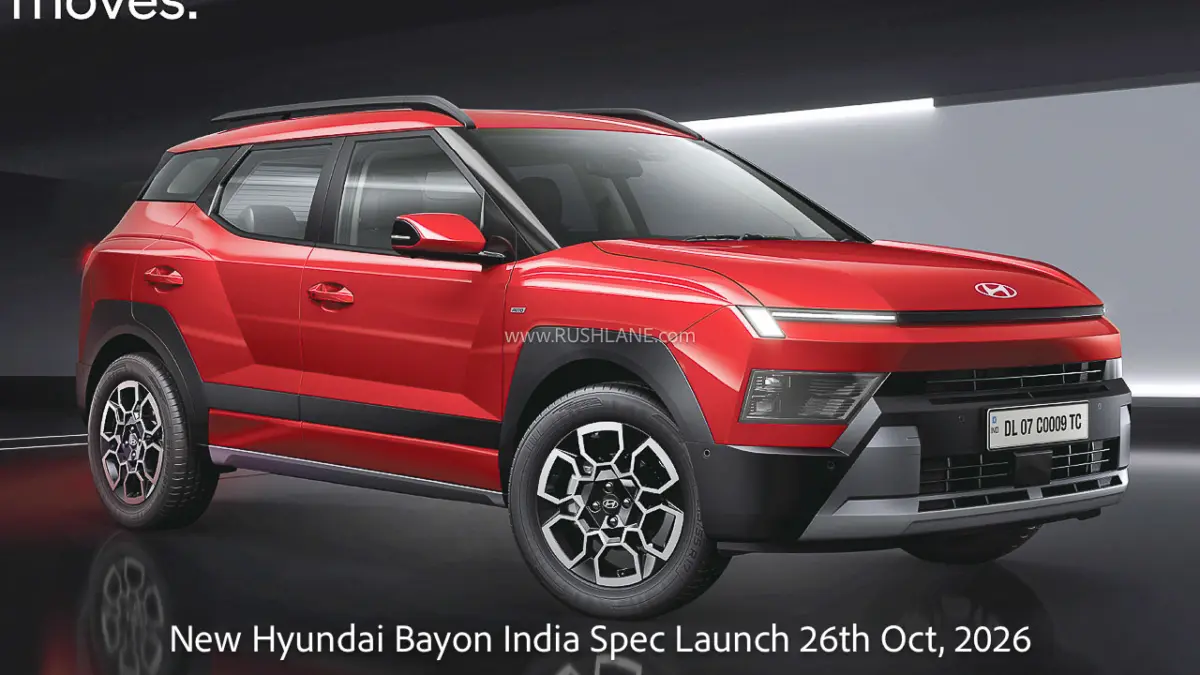
In a strategic move to solidify its dominance in the Indian automotive landscape, Hyundai Motor India Limited (HMIL) has officially pulled the wraps off the India-spec Bayon. Positioned as a sophisticated bridge between the sub-compact Venue and the segment-leading Creta, the Bayon is being marketed as an “Intelligent Utility Vehicle” (IUV). This nomenclature signals a shift in Hyundai’s strategy, moving beyond traditional SUV tropes to focus heavily on software-defined mobility, generative artificial intelligence, and seamless connectivity.
With the official launch scheduled for October 26, 2026, the Bayon arrives at a pivotal moment for Hyundai, following the brand’s record-breaking sales performance in September. As the festive season reaches its crescendo, the Bayon is poised to be the centerpiece of Hyundai’s year-end offensive.
The Main Facts: Positioning and Key Specifications
The Hyundai Bayon measures approximately 4.2 meters in length, placing it squarely in the burgeoning mid-size SUV category. This positioning is critical; it targets a demographic that finds the Venue slightly constrained for family duties but may not require the larger footprint or higher price bracket of the Creta.

At a Glance:
- Launch Date: October 26, 2026.
- Booking Amount: Rs 11,000 (Available via dealerships and online).
- Engine: 1.5-litre, four-cylinder MPi Petrol.
- Output: 115 PS of power and 144 Nm of torque.
- Transmissions: 6-speed Manual and Intelligent Variable Transmission (IVT).
- Platform: Global K Enhanced Platform (Targeting 5-star Bharat NCAP).
- Key Tech: Dual 12.3-inch screens, Generative AI Voice Assistant, and NVIDIA-accelerated infotainment.
By utilizing the 1.5L engine found in the Creta, Hyundai is offering a proven, refined powertrain that balances city drivability with highway adequacy. The choice of an IVT over a traditional CVT or dual-clutch transmission suggests a focus on smoothness and fuel efficiency, catering to the urban professional and modern family.
Chronology of the Launch: Building Festive Momentum
The rollout of the Bayon has been a masterclass in calculated anticipation.
- September 2026: Hyundai India records its highest-ever monthly total sales, moving 77,916 units. This surge provided the perfect backdrop for a new product announcement, ensuring high footfall in showrooms.
- Early October 2026: Initial teasers and "spy shots" (often strategic) began circulating, hinting at a vehicle that shared DNA with the European Bayon but featured distinct Indian adaptations.
- Mid-October 2026: Hyundai officially opens the order books with a booking amount of Rs 11,000. This coincided with the release of the first official high-resolution images of the exterior and interior.
- The Reveal (Current Phase): Hyundai confirms the specific powertrain for India, silencing rumors of a 1.0L Turbo-only lineup. The reveal of the "Intelligent Utility Vehicle" branding and the AI partnership with Perplexity and SoundHound marks the final educational phase before the price announcement.
- October 26, 2026: The official price reveal and variant breakdown.
- Festive Season 2026: Commencement of deliveries, aimed at capitalizing on the auspicious buying period in the Indian calendar.
Supporting Data: Design, Technology, and Architecture
The Bayon’s appeal is built on three pillars: aesthetic presence, technological superiority, and structural integrity.

Exterior Design: "Sensuous Sportiness" Evolved
The India-spec Bayon adopts an upright, assertive stance. The front fascia is dominated by the "H-Edge" LED daytime running lights, a signature that is becoming a hallmark of Hyundai’s modern SUV lineup. These slim lighting elements are connected by a black garnish strip, creating a sense of width.
The side profile reveals geometric 16 or 17-inch alloy wheels (variant dependent) and pronounced body creases that catch the light to emphasize a muscular look. Functional elements like the bridge-type roof rails and substantial black cladding around the wheel arches reinforce its SUV credentials. At the rear, the vertical-horizontal lighting theme continues, complemented by a roof-mounted spoiler and a sophisticated black panel across the tailgate that houses the ‘BAYON’ lettering.
Interior: The Digital Cockpit
Inside, the Bayon takes inspiration from the new-generation i20 recently unveiled in international markets like Brazil. The centerpiece is a curved panoramic panel housing two 12.3-inch high-resolution displays. One serves as the digital instrument cluster, while the other manages the infotainment ecosystem.

The cabin utilizes a dual-tone grey-and-black palette, designed to feel airy yet premium. Notable details include:
- Four-Dot Steering Wheel: A minimalist design that foregoes the traditional logo for a more futuristic look.
- Ergonomic Controls: While the screens are touch-sensitive, Hyundai has retained physical knobs for volume and climate control, a nod to user-requested tactile feedback.
- Connectivity: The "ccNC" (Connected Car Navigation Cockpit) is powered by NVIDIA hardware, ensuring that the interface remains fluid and lag-free, even when running complex navigation and AI tasks simultaneously.
The Generative AI Revolution
Perhaps the most significant data point in the Bayon’s reveal is the introduction of a Generative AI Voice Assistant—a first for Hyundai Motor India. By integrating SoundHound AI with Perplexity’s search capabilities, the car moves beyond simple commands like "Open the sunroof."
Users can engage in natural, conversational queries. For instance, a driver can ask, "Plan a three-day road trip to Coorg including pet-friendly hotels," or "What is the current score of the India-Australia test match?" While the Generative AI currently supports English, the car also features an embedded voice system that works offline in six languages (English, Hindi, Hinglish, Tamil, Bengali, and Telugu) for over 500 vehicle-specific commands.

Official Responses: "Intelligence That Moves"
The leadership at Hyundai Motor India has been vocal about the Bayon’s role in their evolving portfolio. Mr. Tarun Garg, Managing Director and CEO of HMIL, emphasized that the Bayon is not just another SUV, but a software-driven experience.
"With Hyundai BAYON, we are introducing an Intelligent Utility Vehicle that places technology and convenience at the heart of the customer experience," Garg stated during the reveal. "Guided by the philosophy of ‘Intelligence That Moves,’ BAYON seamlessly integrates Artificial Intelligence, advanced connectivity, and software-driven innovation."
Garg further highlighted the importance of Over-The-Air (OTA) updates, noting that the Bayon can update up to 19 vehicle controllers remotely. This ensures that the vehicle "evolves" after purchase, potentially improving engine mapping, safety features, or infotainment UI without the customer needing to visit a service center.

Implications for the Indian Market
The introduction of the Bayon has several far-reaching implications for the Indian automotive sector and Hyundai’s internal hierarchy.
1. The End of "Segment Gaps"
For years, there was a significant price and size gap between the Venue (under 4 meters) and the Creta (4.3 meters). Competitors like the Maruti Suzuki Grand Vitara and the Toyota Hyryder have successfully exploited the lower end of the mid-size segment. The Bayon is Hyundai’s surgical strike to reclaim this middle ground. By being 4.2 meters long, it offers more "road presence" than a sub-compact while remaining more maneuverable than a full-sized mid-size SUV.
2. Safety as a Standard
By utilizing the Global K Enhanced Platform and aiming for a 5-star Bharat NCAP rating, Hyundai is addressing one of the few historical criticisms of its mid-range vehicles. If the Bayon achieves a 5-star rating, it will set a new benchmark for the 4.2-meter segment, forcing competitors to accelerate their safety upgrades.

3. The Democratization of AI
The partnership with Perplexity and SoundHound suggests that high-end computing is no longer reserved for luxury marques like Mercedes-Benz or BMW. Bringing generative AI to a mass-market SUV could trigger a "tech war" in the Indian market, where features like ADAS (Advanced Driver Assistance Systems) and AI assistants become the primary deciding factors for Gen Z and Millennial buyers.
4. Portfolio Synergy
There is a risk of "cannibalization," where the Bayon might take sales away from the top-end Venue or the entry-level Creta. However, Hyundai’s strategy seems to be "keep them in the family." By offering a vehicle at every 50mm of length and every Rs 1 lakh of price difference, Hyundai ensures that no matter a customer’s specific budget or size requirement, there is a Hyundai that fits.
Conclusion
The Hyundai Bayon is more than just a new model; it is a declaration of intent. By combining the reliable 1.5L MPi engine with cutting-edge NVIDIA-powered electronics and Generative AI, Hyundai is attempting to redefine what the Indian consumer expects from a "utility" vehicle.

As the industry looks toward the October 26 launch, the focus will shift from the technology revealed today to the pricing strategy of tomorrow. If Hyundai can price the Bayon aggressively, it may not just be a festive hit, but a long-term disruptor that reshapes the 4-meter-plus SUV landscape in India. For now, the "Intelligent Utility Vehicle" stands ready to prove whether intelligence truly is the new horsepower.
