

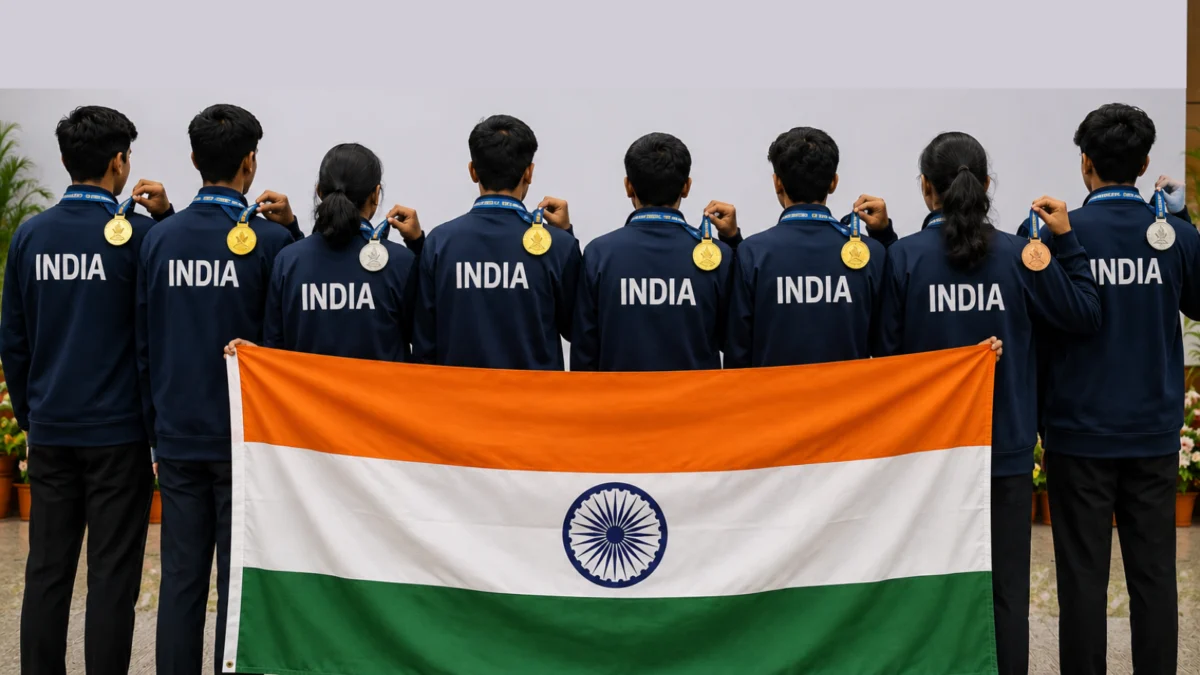
New Delhi, September 5, 2026 – India’s burgeoning talent in the field of Earth Sciences has once again captured global attention. The nation’s young scholars have returned triumphant from the 19th International Earth Science Olympiad (IESO) 2026, held in Italy from August 20th to August 27th, clinching an impressive haul of nine medals. This stellar performance, comprising four gold, three silver, and two bronze medals, underscores India’s growing prowess in scientific education and its commitment to fostering a robust scientific temperament among its youth.
The triumphant contingent was formally felicitated by Union Minister Jitendra Singh, who lauded their exceptional achievement and reiterated the government’s unwavering dedication to empowering young minds through student-centric outreach programs. The IESO 2026 saw a formidable participation of 39 countries, making India’s medal tally a testament to the exceptional caliber of its students on the international stage.
A Historic Feat: India’s Dominance at IESO 2026
The International Earth Science Olympiad, a prestigious competition that challenges students to demonstrate their understanding of geological, atmospheric, oceanographic, and astronomical sciences, has become a proving ground for future scientific leaders. India’s performance this year at the Italian leg of the Olympiad has been nothing short of historic, with its contingent securing a remarkable nine medals across various categories.
The breakdown of the medals signifies a comprehensive mastery of the diverse disciplines within Earth Science:
- Gold Medals (4): These represent the pinnacle of achievement, indicating that Indian students were judged to be among the very best globally in their respective categories.
- Silver Medals (3): A strong second-place finish, showcasing exceptional knowledge and problem-solving skills.
- Bronze Medals (2): Demonstrating commendable performance and a solid grasp of complex scientific concepts.
This collective success is a clear indication of the rigorous training, dedication, and innate scientific curiosity that these young Indian scholars possess.
The Rigorous Pathway to Global Recognition: A Multi-Stage Selection Process
The journey for these medal-winning students was not a casual one. As highlighted by Union Minister Jitendra Singh, the path to representing India at the IESO is a meticulously designed, multi-stage process aimed at identifying and nurturing the nation’s brightest young scientific minds.
The process begins with a nationwide Earth Science Olympiad, conducted under the Ministry of Earth Sciences’ outreach and awareness programs. This initial test serves as a broad net, attracting a vast number of aspiring young scientists. In 2026, nearly 17,800 students from across the country participated in this all-India test, held at approximately 500 centers. This massive participation rate itself reflects the growing interest in Earth Sciences among Indian students.
Following the national-level examination, the top 25 meritorious students were selected for the next phase: an intensive three-week training camp. This year, the camp was held in June 2026 at the prestigious Maharaja Sayajirao University (M S University) in Vadodara, Gujarat. In a strategic move to ensure regional inclusivity and exposure, the Union Minister proposed that these training camps be rotated across different regions of the country. This ensures that students from various geographical backgrounds have equal opportunities to access world-class training facilities and mentorship.
This rigorous selection and training pipeline is crucial in preparing students not just for the competitive nature of the Olympiad but also for the complex challenges and innovative thinking required in scientific research and development. The training camp likely involved intensive theoretical sessions, practical laboratory work, fieldwork, and problem-solving exercises designed to mirror the demands of the international competition.
A Culture of Scientific Excellence: India’s Broader Olympiad Success
The success at the International Earth Science Olympiad is not an isolated event but part of a broader trend of India’s outstanding performances in various international science Olympiads in 2026. This consistent string of victories paints a compelling picture of a nation actively cultivating a strong scientific temperament and equipping its youth with the skills to excel on the global stage.
Earlier this year, India’s physics prodigies made waves at the 56th International Physics Olympiad (IPhO) 2026, held in Bucaramanga, Colombia. The Indian contingent returned with a remarkable achievement of five gold medals, showcasing an exceptional command of the principles of physics.
In July, the International Chemistry Olympiad (IChO) 2026, organized from July 10th to 19th in Tashkent, Uzbekistan, also witnessed India’s brilliance. The Indian team secured four gold medals at the 58th International Chemistry Olympiad. Among the distinguished medalists was Kabeer Chhillar, an exceptional student who also achieved an All India Rank (AIR) 2 in JEE Advanced 2026. Chhillar’s remarkable academic prowess was further evidenced by his perfect score of 329 out of 360 marks and a 100 percentile in JEE Main 2026, highlighting the synergy between foundational scientific education and national-level competitive exams.
Adding to this impressive list of achievements, the 67th International Mathematical Olympiad (IMO), held in Shanghai, China, saw the Indian team secure 2 Gold and 4 Silver medals. This demonstrates a strong performance across the STEM spectrum, from theoretical physics and chemistry to the fundamental logic of mathematics.
These collective successes across multiple prestigious international Olympiads are a clear indicator of the effectiveness of India’s educational policies and the dedication of its educators and students.
Official Responses and Government’s Commitment
The felicitations and congratulatory remarks from Union Minister Jitendra Singh underscore the government’s proactive approach and deep commitment to nurturing scientific talent. His reiteration of the government’s dedication to "empower the youth through student-centric outreach programmes" and encouraging a "foundational scientific temperament" signals a long-term vision for scientific advancement in India.
The Ministry of Earth Sciences, in its statement, emphasized the importance of these outreach programs in not only identifying talent but also in providing them with the necessary resources and training to compete at the highest international levels. The success of the IESO 2026 contingent is a direct validation of these initiatives.
The emphasis on a rigorous selection and training pipeline, coupled with the rotation of training camp locations, demonstrates a strategic and inclusive approach by the government. This ensures that opportunities are not concentrated in specific regions but are accessible to students across the vast expanse of India. The involvement of institutions like M S University in Vadodara in providing intensive training further strengthens the ecosystem of scientific education and research.
Implications for India’s Future Scientific Landscape
The consistent victories of Indian students in international Olympiads have profound implications for the nation’s future scientific and technological landscape.
- Inspiration for Future Generations: These medal winners serve as powerful role models, inspiring countless other young students across India to pursue careers in science, technology, engineering, and mathematics (STEM). Their achievements demonstrate that with dedication and the right support, Indian students can compete and excel on the global stage.
- Strengthening the Research and Development Pipeline: A strong foundation in fundamental sciences, cultivated through rigorous Olympiad training, is crucial for building a robust pipeline of future researchers and innovators. These students are likely to pursue higher education in science and contribute significantly to India’s research and development efforts in the coming years.
- Global Recognition and Collaboration: India’s consistent performance elevates its standing in the global scientific community. It positions the nation as a hub for scientific talent and encourages international collaborations and partnerships in research and education.
- Economic and Societal Advancement: A scientifically literate and skilled population is a cornerstone of economic growth and societal progress. By excelling in science, these young individuals will be instrumental in addressing critical challenges, driving innovation, and contributing to India’s development in fields ranging from climate change mitigation and sustainable energy to advanced healthcare and digital technologies.
- Policy Reinforcement: The success at IESO 2026 and other Olympiads provides strong empirical evidence for the effectiveness of current government policies aimed at promoting STEM education and nurturing young talent. It reinforces the need for continued investment and strategic planning in this critical sector.
In conclusion, the nine medals secured by the Indian contingent at the 19th International Earth Science Olympiad 2026 in Italy are a shining testament to the intellectual prowess and dedication of India’s youth. Coupled with the nation’s recent triumphs in Physics, Chemistry, and Mathematics Olympiads, this stellar performance signifies a bright future for India’s scientific endeavors and reaffirms its growing prominence on the global stage of scientific excellence. The government’s commitment to fostering a strong scientific temperament through comprehensive outreach and training programs is yielding remarkable results, paving the way for a new generation of Indian scientists and innovators.
