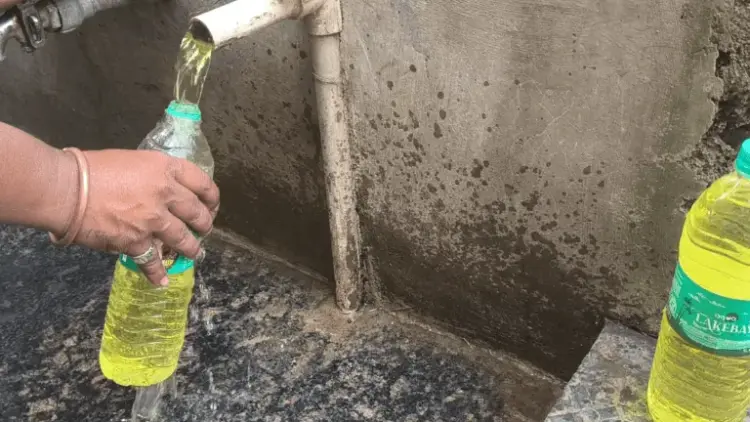
NASHIK, MAHARASHTRA — For the residents of Dattanagar, a working-class enclave nestled on the periphery of the Ambad industrial estate, the act of drawing water has become a confrontation with a slow-motion environmental catastrophe. What should be a clear, life-sustaining resource now pours from borewells in a visceral, neon shade of yellow.
The consequences of this contamination are etched into the skin of the community. For 55-year-old Gangubai Laxmigan Shivale, the crisis has stripped away the simple dignity of cooking for her family. For two months, her household has subsisted on street food—samosas and vada pav—because the rashes on her hands are so severe that they rupture and bleed at the slightest movement.
“There is constant itching, and blood pours out if I scratch the rashes,” Shivale says. “I can’t cook. We are a family of four, and we all sustain on food from outside.”
Shivale is not an isolated case. She is one of more than 400 residents in Dattanagar reporting severe chemical ulcers, swollen lymph nodes, and black lesions. This health crisis is the result of what experts describe as a "toxic emergency": groundwater contaminated with hexavalent chromium at levels more than 1,000 times the legal safety limit.
I. Main Facts: A Concentration of Toxicity
The scale of the contamination in Dattanagar is statistically staggering. Laboratory tests commissioned by the South Asia Network on Dams, Rivers and People (SANDRP) and conducted by Ashwamedh Engineers and Consultants, an independent facility, revealed the depth of the crisis.

The Chromium Breach
The Bureau of Indian Standards (BIS) mandates a maximum permissible limit of 0.05 milligrams per litre (mg/L) for chromium in drinking water. The sample taken from a borewell adjoining a stream of the Nandini river showed:
- Total Chromium: 50.5 mg/L
- Hexavalent Chromium [Cr(VI)]: 50.3 mg/L
Hexavalent chromium is not merely a pollutant; it is a Group 1 carcinogen, as classified by the International Agency for Research on Cancer (IARC) and the World Health Organization (WHO). It is the same chemical that stood at the center of the famous legal battle led by Erin Brockovich in the United States. In Dattanagar, the concentration of this carcinogen is 1,006 times the safe limit.
Scope of the Outbreak
Following public outcry, the Nashik Municipal Corporation (NMC) conducted a massive survey covering 8,887 households and 34,399 residents. Their findings confirmed the residents’ fears:
- 45 out of 229 mapped borewells were yielding yellow, contaminated water.
- Over 400 individuals exhibited clinical symptoms of heavy metal poisoning, primarily dermatological.
- Independent analysis by the Maharashtra Pollution Control Board (MPCB) corroborated these findings, showing levels around 45 mg/L in multiple groundwater samples.
II. Chronology: Fourteen Years of Judicial Neglect
The crisis in Dattanagar is not a sudden accident, but the culmination of over a decade of regulatory failure and ignored court mandates.
- 2012: The Initial Legal Battle: Activist Rajesh Pandit filed a Public Interest Litigation (PIL) in the Bombay High Court. The petition highlighted that the Satpur and Ambad Maharashtra Industrial Development Corporation (MIDC) estates lacked a Common Effluent Treatment Plant (CETP). Industrial waste was being dumped directly into the Godavari river and its tributaries.
- The High Court Mandate: The Bombay High Court directed the MIDC to establish CETPs in both industrial areas and to take strict action against units violating environmental norms.
- 2012–2023: A Decade of Inaction: Despite the court order, the CETPs remained unbuilt. Small-scale industries, particularly those involved in electroplating and metal finishing, allegedly continued to discharge untreated effluents into soak pits or directly into the catchment areas of the Nandini and Godavari rivers.
- 2023: Contempt Proceedings: Facing continued non-compliance, Pandit filed a contempt petition in the High Court. The MIDC filed an affidavit promising the plant would be operational by September 2024—a deadline that has since passed without fulfillment.
- October 2024: The Health Crisis Peaks: As the groundwater turned bright yellow, hundreds of residents fell ill.
- October 16, 2024: Activists moved the National Green Tribunal (NGT) Western Zone Bench. The NGT ordered the MPCB and the District Collector to submit a status report and ensure the immediate provision of safe drinking water.
- October 31, 2024: The crisis gained national attention as the Simhastha Kumbh Mela flag-hoisting ceremony approached, raising fears of river contamination ahead of the 2027 pilgrimage.
III. Supporting Data: The Cost of Contamination
The burden of this environmental crime falls most heavily on the working-class families of Dattanagar, many of whom are employed by the very industries suspected of the pollution.

The Economic Drain
For a family earning a modest wage, the medical costs associated with chromium exposure are devastating.
- Monthly Medical Bills: Residents report spending between ₹5,000 and ₹6,000 per month on dermatological treatments, private clinic visits, and wound dressings.
- Alternative Living Costs: Some families, like that of 30-year-old Preeti Shah, have been forced to rent separate accommodations just to access clean water for bathing and cooking. Shah pays an additional ₹5,000 to ₹6,000 in rent, effectively doubling her monthly housing expenditure.
The Science of the "Yellow Water"
The yellow tint in the water is a classic signature of high-valence chromium. While trivalent chromium is an essential nutrient in trace amounts, hexavalent chromium is highly soluble and mobile in groundwater. It penetrates the skin easily, causing "chrome holes"—deep, slow-healing ulcers—and systemic inflammation. Long-term ingestion or skin absorption is linked to lung cancer, liver damage, and reproductive issues.
IV. Official Responses: Denials and Delayed Action
The response from government officials has been a mix of damage control, bureaucratic finger-pointing, and controversial scientific claims.
The Minister’s Contradiction
Girish Mahajan, Maharashtra’s Minister and Nashik’s Guardian Minister, sparked outrage when he claimed that the yellow chemical detected was "not carcinogenic." This statement directly contradicts the WHO and IARC classifications of hexavalent chromium. Activists argue that such rhetoric downplays the severity of the health risks to avoid political fallout.
The MPCB Strategy
Vidyasagar Killedar, the Regional Officer of the MPCB in Nashik, maintains that the Godavari river remains safe. "This issue is in groundwater… there is little to no possibility of it contaminating the Godavari, as it is 150-200 feet deep," he stated.

However, the MPCB has recently intensified its enforcement:
- 22 industrial units have been closed in the last 15 days.
- 10 show-cause notices have been issued.
- A proposal for bioremediation—using microorganisms to neutralize the chromium—is currently being discussed with the District Collector.
The Civic Body’s Emergency Measures
The Nashik Municipal Corporation has sealed the contaminated borewells and ramped up tanker deliveries. However, residents report that the supply remains irregular. Kunti Balu Sarkate, a resident, noted that on days when tankers don’t arrive, families are forced to use the "yellow water" for sanitation, further prolonging their exposure.
V. Implications: Beyond Dattanagar’s Borders
The Dattanagar crisis is not a localized incident; it is a warning of a broader ecological threat to Western India’s water security.
The Threat to the Godavari
Activists from SANDRP argue that the MPCB’s claim of the Godavari being "safe" is scientifically flawed. Chromium-laden water from Dattanagar’s borewells eventually migrates through the soil into the Nandini river, which feeds directly into the Godavari. Samples taken at the confluence of these rivers have already shown chromium levels exceeding permissible limits.
The 2027 Kumbh Mela
Nashik is one of the four sites of the Simhastha Kumbh Mela. In 2027, millions of pilgrims are expected to perform ritual baths in the Godavari. If the industrial effluent discharge is not permanently halted and the groundwater remediated, the state faces a potential international health scandal involving millions of people.

Social Stigma and Human Rights
The physical manifestations of the poisoning have led to a secondary crisis: social ostracization. Sangeeta Jadhav, 45, recounted being shunned on public transport when a passenger saw her lesions. More alarmingly, children in Dattanagar have been told by teachers to stay away from school, with the "infection" being mistaken for a contagious disease rather than chemical poisoning.
The National Human Rights Commission (NHRC) has taken suo motu cognisance of the matter, noting with concern that doctors have reportedly advised women in the area to avoid pregnancy due to the risk of birth defects—a chilling testament to the long-term toxicity of the environment.
Conclusion: A Demand for Accountability
The residents of Dattanagar are caught in a pincer movement between industrial greed and regulatory apathy. While the closure of 22 units is a start, the fundamental infrastructure required to prevent this—the Common Effluent Treatment Plant—remains a phantom project, fourteen years after a High Court order.
For Gangubai Shivale and her neighbors, the "yellow water" is more than a pollutant; it is a thief of health, savings, and dignity. As the legal battle shifts to the National Green Tribunal, the eyes of the nation are on Nashik. The question remains: will the government prioritize the profits of the electroplating industry, or the lives of the citizens who live in its shadow?
The crisis in Dattanagar is a stark reminder that environmental laws are only as effective as their enforcement. Without a permanent, scientifically-backed remediation plan, the "Golden City" of Nashik risks being remembered for a much darker, yellow hue.