

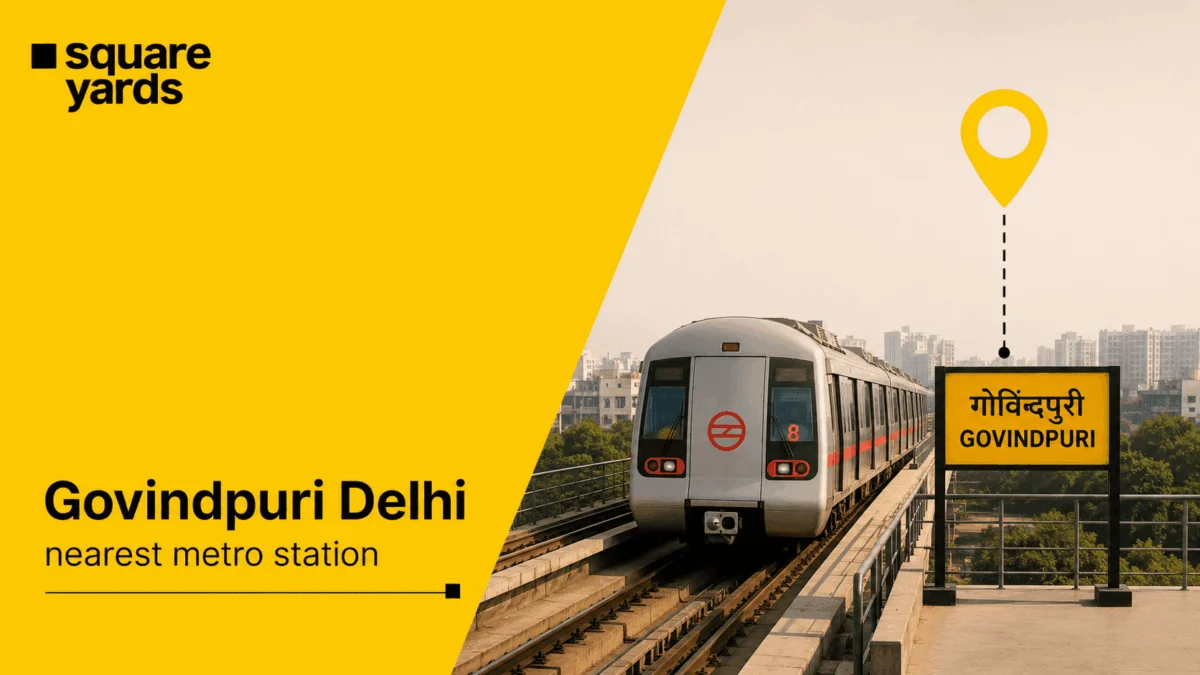
The urban landscape of South Delhi is often characterized by sprawling bungalows, gated communities, and high-walled residential pockets. However, nestled within this premium district lies Govindpuri, a locality that defies the typical South Delhi transit struggle. While residents in neighboring posh localities often rely on private vehicles or long auto-rickshaw rides to reach the nearest transit point, Govindpuri offers a rare luxury: a metro station integrated directly into the fabric of the neighborhood.
For property seekers, students, and working professionals, understanding the metro ecosystem around Govindpuri is more than a matter of convenience—it is a critical factor in determining the area’s economic and residential viability. This report explores the intricacies of Govindpuri’s connectivity, the strategic importance of its neighboring stations, and the long-term implications for the local real estate market.
1. Main Facts: The Centrality of the Violet Line
At the heart of Govindpuri’s accessibility is the Govindpuri Metro Station, situated on the Violet Line (Line 6) of the Delhi Metro Rail Corporation (DMRC) network. Unlike many "feeder" locations, Govindpuri acts as a primary node.
Key Transit Highlights:
- Direct Access: Most residents live within a 5-to-10-minute walking radius of the station, eliminating the need for daily last-mile transport expenses.
- The Violet Line Advantage: This line serves as a vital artery connecting the historic hubs of North Delhi (Kashmere Gate) to the industrial corridors of Faridabad (Raja Nahar Singh).
- Interchange Proximity: Govindpuri is just one stop away from Kalkaji Mandir, a major interchange station that bridges the Violet Line with the Magenta Line.
- Commercial Synergy: Its location provides seamless access to Nehru Place (the city’s IT hub) and Okhla Industrial Estate, two of Delhi’s largest employment centers.
2. Chronology: The Evolution of Connectivity
To understand Govindpuri’s current status, one must look at the timeline of Delhi’s infrastructure development, which transformed this locality from a dense residential pocket into a high-demand transit hub.
- October 2010: The first section of the Violet Line opened, connecting Central Secretariat to Sarita Vihar. This was a watershed moment for Govindpuri, as it finally integrated the area into the rapid transit map of the capital.
- December 2014: In a move to better reflect the industrial geography of the area, the neighboring station was renamed from "Okhla" to Harkesh Nagar Okhla. This helped commuters distinguish between the residential core of Govindpuri and the industrial/educational sectors of Okhla Phase II.
- December 2017 – May 2018: The phased opening of the Magenta Line and the expansion of the Kalkaji Mandir Interchange revolutionized travel for Govindpuri residents. It cut travel time to Noida and West Delhi by nearly 40 minutes, as commuters no longer needed to travel up to Central Secretariat or Mandi House to change lines.
- Present Day: Govindpuri stands as one of the most densely populated transit-oriented developments in South Delhi, with a constant influx of tenants driven by the ease of the Violet and Magenta line synergy.
3. Supporting Data: Stations, Distances, and Logistics
The utility of Govindpuri’s location is best understood through a comparative look at the surrounding stations. Depending on a commuter’s destination, different stations offer varying strategic advantages.
Comparative Metro Station Analysis
| Metro Station | Line(s) | Approx. Distance from Govindpuri Center | Travel Time (from Locality) | Primary Strategic Use |
|---|---|---|---|---|
| Govindpuri | Violet Line | Within Locality | 5-10 min walk | Daily commute; North Delhi/Faridabad access. |
| Kalkaji Mandir | Violet + Magenta | 1.5 – 2.0 km | 8-12 min by auto | Interchange for Noida, IGI Airport, and West Delhi. |
| Harkesh Nagar Okhla | Violet Line | 2.0 – 2.5 km | 10-15 min by auto | Access to IIIT Delhi and Okhla Phase II industries. |
| Nehru Place | Magenta Line | 2.5 – 3.0 km | 12-18 min via Metro | Access to the commercial/IT district and offices. |
| Lajpat Nagar | Violet + Pink | 5.0 – 6.0 km | 15-20 min via Metro | Connections to South-West Delhi via the Pink Line. |
Operational Logistics: Timings and Frequency
Commuters can generally rely on a consistent schedule across these stations, though peak hour traffic at the station gates is a known factor.
- First Train: Approximately 6:00 AM (Monday–Saturday); slightly later on Sundays.
- Last Train: Approximately 11:00 PM.
- Peak Frequency: A train arrives every 4 to 6 minutes.
- Off-Peak Frequency: Trains run every 8 to 10 minutes.
4. Last-Mile Connectivity: Beyond the Metro Gates
While the metro is the star of the show, the ecosystem of transport outside the Govindpuri station is equally vital. The station serves as a dispersal point for several sub-localities, including Tughlakabad Extension and Govindpuri Extension.
- Walking: The most common mode for those in the main Govindpuri blocks.
- Auto Rickshaws: Readily available at the station exit. Fares typically range from ₹30 to ₹60 for nearby extensions.
- E-Rickshaws: A more affordable, shared alternative to autos, though they contribute significantly to evening congestion at the station mouth.
- DTC Buses: Frequent bus services run along the main road, connecting the area to Ambedkar Nagar, Saket, and Mehrauli.
5. Official and Expert Perspectives: Real Estate and Urban Planning
Urban planning experts often cite Govindpuri as a prime example of high-density residential growth spurred by transit availability. From a real estate investment perspective, the data suggests a unique trend compared to the rest of South Delhi.
The Rental Yield Phenomenon
According to market data, the average rental yield in Govindpuri sits at approximately 6%. To put this in perspective, premium areas like Greater Kailash or Shanti Niketan often see yields as low as 1.5% to 2%.
Why is the yield so high?
- Lower Entry Cost: Property prices in Govindpuri range from ₹4,900 to ₹6,900 per sq. ft., making it significantly more affordable than Kalkaji (₹8,700–₹18,000+).
- Constant Demand: The proximity to Nehru Place and Okhla creates a "perpetual tenant" market.
- Transit Efficiency: For a tenant, the ability to walk to the metro is a cost-saving measure that justifies a higher relative rent for the area’s building quality.
Investment Caveats
Real estate analysts warn that while rental income is strong, capital appreciation has been sluggish. The high density of the area and the nature of the building stock—predominantly older builder floors rather than modern gated societies—mean that property values don’t skyrocket at the same rate as more organized developments. Experts suggest that Govindpuri is an "income play" rather than a "capital gains play."
6. Implications: What This Means for Residents and Investors
The robust metro connectivity of Govindpuri has several long-term implications for the neighborhood’s socio-economic fabric.
For Students and Young Professionals
The proximity to IIIT Delhi (via Harkesh Nagar Okhla) and various coaching hubs makes Govindpuri a "student village" of sorts. The ease of reaching the Magenta Line via Kalkaji Mandir also means that students at South Campus (Delhi University) can commute with ease, making Govindpuri a viable alternative to more expensive student housing in Satya Niketan.
For the Working Class
The area provides a crucial "middle-ground" for those employed in the high-pressure environments of Noida or Gurgaon. By living in Govindpuri, a professional can work in Noida (via the Magenta Line) while their spouse might work in Central Delhi (via the Violet Line), making it a strategic compromise for dual-income households.
The Challenge of Infrastructure
The success of the metro has brought its own challenges. The sheer volume of commuters has led to:
- Congestion: The roads leading to the station are often choked during peak hours.
- Density Issues: As demand for housing near the metro increases, builders often maximize floor space, leading to a lack of open areas and parks.
- Parking Scarcity: While the metro station has parking, the residential lanes do not, making it a difficult locality for those who own cars.
7. Conclusion: A Transit-First Neighborhood
In the final analysis, Govindpuri stands as a testament to the transformative power of the Delhi Metro. It is a locality where the "nearest metro station" isn’t just a point on a map—it is the economic engine of the community.
For those looking to move into the area, the choice is clear: the convenience of the Violet and Magenta lines offers a level of freedom rarely found in this price bracket in South Delhi. However, one must balance this convenience against the realities of living in a high-density, older urban pocket. Whether you are a student heading to IIIT, a professional commuting to Nehru Place, or an investor looking for steady rental checks, Govindpuri’s metro connectivity remains its greatest asset and its most compelling selling point.
Frequently Asked Questions (FAQ)
1. Is Govindpuri Metro Station safe for late-night travel?
The station is generally busy and well-lit. However, like many high-density areas in Delhi, the walk from the station to the inner lanes of the locality can be crowded. It is advisable to use e-rickshaws or autos for last-mile travel after 10:00 PM.
2. How do I reach the IGI Airport from Govindpuri?
The most efficient metro route is taking the Violet Line to Central Secretariat, switching to the Yellow Line for one stop to New Delhi, and then taking the Airport Express Line. Alternatively, one can take the Magenta Line from Kalkaji Mandir toward Janakpuri West and get off at the Terminal 1-IGI Airport station.
3. Which is better for investment: Govindpuri or Kalkaji?
If your goal is high rental yield and lower entry cost, Govindpuri is superior. If you are looking for long-term capital appreciation and a more premium lifestyle/infrastructure, Kalkaji is the better bet.
4. Does the Govindpuri Metro Station have parking facilities?
Yes, Govindpuri Metro Station has a designated DMRC parking lot for two-wheelers and four-wheelers, though it fills up quickly during office hours.
