

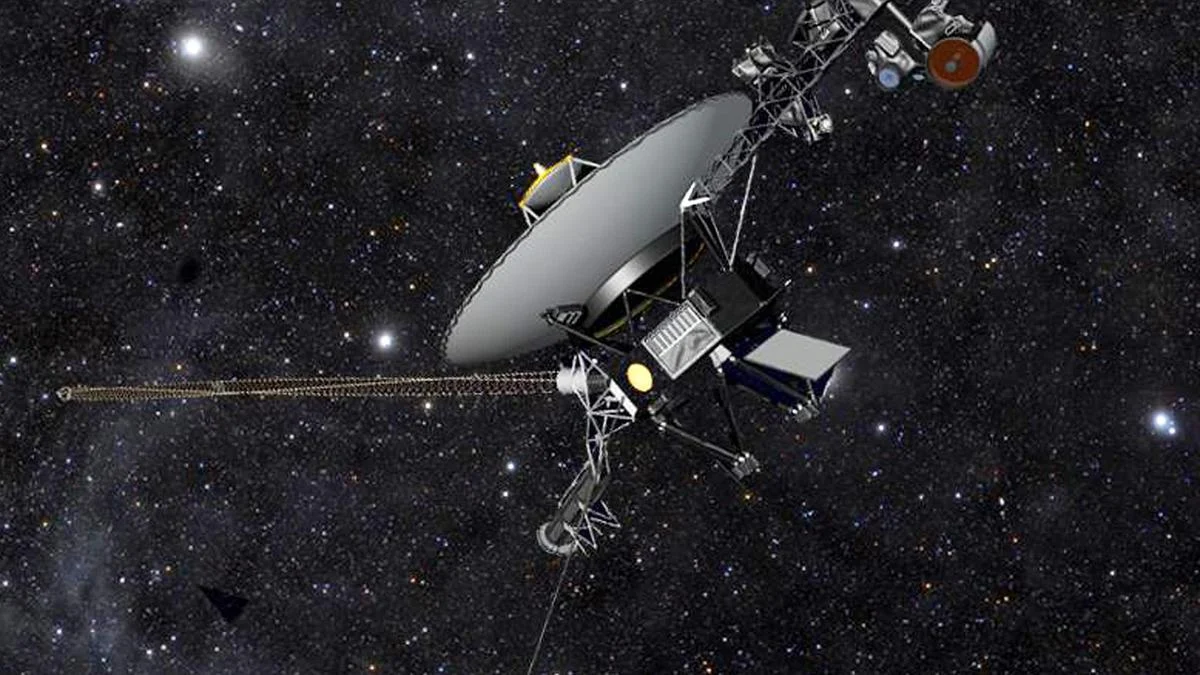
In the vast, silent reaches of the interstellar medium, a small, plutonium-powered messenger from Earth is about to cross a symbolic threshold. By November, NASA’s Voyager 1 spacecraft will be approximately one light-day away from its home planet. This means that any radio signal—traveling at the cosmic speed limit of roughly 300,000 kilometers per second—will require a full 24 hours to traverse the gulf between the spacecraft and the Deep Space Network antennas on Earth.
This milestone is more than a mere telemetry update; it is a testament to human persistence and the sheer scale of the cosmos. As Voyager 1 continues its journey into the "undiscovered country" beyond our solar system, it forces a reckoning with our history, our economic priorities, and our fundamental identity as a species.
Main Facts: The Current State of the Interstellar Pioneers
Voyager 1 and its twin, Voyager 2, were launched in 1977 during a rare planetary alignment that occurs only once every 175 years. Today, they stand as humankind’s most distant operating probes. Voyager 1, having crossed the heliopause—the boundary where the sun’s solar wind meets the interstellar medium—in 2012, is currently navigating the "picket fence" at the edge of our celestial neighborhood.
To reach this distance of one light-day, the spacecraft has traveled at an average velocity of 17 kilometers per second for nearly 18,000 days. While this speed is staggering by terrestrial standards, it highlights the agonizingly slow pace of physical exploration compared to the reach of our vision. While Voyager 1 has spent nearly half a century reaching the edge of our solar system, our telescopes—such as the Hubble and James Webb—regularly capture light from the Pillars of Creation and the Sombrero Galaxy, objects located thousands to millions of light-years away.
The Voyager mission is now in its "Interstellar Mission" phase. Both probes are operating well past their original five-year lifespans, powered by Radioisotope Thermoelectric Generators (RTGs) that convert the heat from the decay of plutonium-238 into electricity. However, as this power supply wanes, NASA engineers have been forced to turn off non-essential heaters and scientific instruments to keep the primary systems functioning.
Chronology: A Half-Century of Discovery
The trajectory of the Voyager missions represents the pinnacle of 20th-century systems engineering and celestial mechanics.

- 1977: The Launch. Voyager 2 launched on August 20, followed by Voyager 1 on September 5. Voyager 1 was placed on a faster trajectory, allowing it to reach Jupiter first.
- 1979: Jupiter Flybys. Both probes revealed Jupiter as a complex, turbulent world. They discovered the volcanic activity on the moon Io—the first time active volcanoes were seen on a body other than Earth—and the faint rings of the gas giant.
- 1980-1981: Saturn Encounters. Voyager 1’s encounter with Saturn included a close flyby of the moon Titan, which diverted it out of the ecliptic plane and toward interstellar space. Voyager 2 continued on to the outer planets.
- 1986-1989: The Outer Reach. Voyager 2 became the first and, to date, only spacecraft to visit Uranus (1986) and Neptune (1989), discovering new moons and rings around both.
- 1990: The Pale Blue Dot. At the request of astronomer Carl Sagan, Voyager 1 turned its camera back toward Earth one last time, capturing an image of our planet as a tiny speck of light in a sunbeam.
- 2012: Entering Interstellar Space. Voyager 1 officially crossed the heliopause, becoming the first human-made object to taste the environment between the stars.
- 2024: The One Light-Day Threshold. Voyager 1 reaches a distance where communication latency hits the 24-hour mark, symbolizing its deepening isolation from its creators.
Supporting Data: The Logistics of the Long Journey
The technical reality of the Voyager mission is defined by the harsh constraints of deep space.
Velocity and Distance
Voyager 1 travels at approximately 38,000 miles per hour (61,000 km/h). Despite this incredible speed, it would still take the craft over 70,000 years to reach Proxima Centauri, the nearest star to our sun, were it headed in that direction (it is not). The "one light-day" distance translates to roughly 26 billion kilometers (16 billion miles).
The Economic Argument: "Bread vs. Roses"
A common critique of deep-space exploration is the perceived trade-off between terrestrial needs and cosmic curiosity. However, the data suggests this is often a false dichotomy. According to planetary scientist Jim Bell in his book The Interstellar Age, the total cost of the Voyager 1 mission, when spread over its multi-decade lifetime, amounted to approximately one dime per American citizen per year.
This "dime a year" investment has provided a return that is difficult to quantify in purely financial terms. In nations like India, where the space program (ISRO) often faces scrutiny regarding government spending on "roses" while "bread" remains a priority for many, the Voyager example serves as a benchmark. It suggests that space exploration is not a luxury for the wealthy but a fundamental pursuit of knowledge that can be achieved with remarkably modest per-capita investment.
The Golden Record
Each Voyager carries a "Golden Record"—a 12-inch, gold-plated copper disc containing:
- 115 images of Earth, its people, and its biology.
- Greetings in 55 different languages (including Tamil and Telugu).
- A 90-minute selection of music from various cultures.
- An essay in sound titled "Sounds of Earth" (featuring wind, rain, and animal calls).
Official Responses and Expert Perspectives: Why We Explore
To understand the significance of Voyager, one must look beyond the hardware to the philosophy of exploration. Historian Stephen Pyne, in his 2010 work Voyager: Exploration, Space, and the Third Great Age of Discovery, offers a framework for understanding why some civilizations reach for the stars while others remain stationary.

The "Lumpers" vs. the "Splitters"
Pyne categorizes thinkers into two camps. "Lumpers" see exploration as a biological imperative, an urge encoded in the human genome. "Splitters," conversely, view exploration as a specific cultural institution shaped by history, politics, and rivalry. Pyne notes that history is full of "non-explorers"—societies like Ming China, which dismantled its great treasure fleets, or Medieval Islam, which shifted from global travel to localized ritual.
Pyne’s analysis suggests that exploration is not an anthropological necessity but a fragile institution sustained by competition. If the "rivalry" that fueled the 20th-century Space Race disappears, the institution of exploration may wither, much like the Norse colonies in Greenland.
The Moral Universe of Carl Sagan
The late Carl Sagan, who chaired the committee that created the Golden Record, saw the mission as a moral exercise. Upon seeing the "Pale Blue Dot" image, Sagan famously remarked that it underscored our responsibility to "deal more kindly with one another."
Jon Lomberg, the science journalist who co-authored Murmurs of Earth with Sagan, notes that the Golden Record was intentionally "aspirational." The team made the controversial decision to exclude depictions of war, poverty, disease, and crime. As Lomberg put it, the Record represents "us at our best, or at least not at our worst." It was a message to the universe, and perhaps more importantly, a message to ourselves about who we could become.
Implications: The Future of a "Commonwealth of Space"
As Voyager 1 drifts further into the dark, it leaves behind a legacy that is both inspiring and paradoxical.
The Paradox of Rivalry
If Stephen Pyne’s assessment is correct—that rivalry is the primary engine of exploration—then a truly peaceful, egalitarian world might paradoxically lose the drive to explore the cosmos. This creates a tension between our social goals and our exploratory ambitions. To sustain the "Third Great Age of Discovery," humanity may need to find a new "engine" for exploration that does not rely on geopolitical competition but on a collective, international authorship.

The Aspirational Mirror
The Voyager mission serves as a mirror. By looking back from the edge of the solar system, we see the Earth not as a collection of warring states, but as a "pale blue dot" in a vast cosmic arena. The Golden Record remains a time capsule of 1977, but also an invitation to "join a commonwealth of space-faring societies."
The End of the Mission
Within the next decade, the power levels on both Voyagers will drop below the threshold required to operate any scientific instruments. At that point, the probes will become silent ambassadors, wandering the Milky Way for millions, perhaps billions, of years. Long after the Deep Space Network has lost the ability to hear their "murmurs," the Voyagers will continue to carry the story of a small planet that, for a brief moment in cosmic time, dared to look outward.
The transition to a "one light-day" distance is a reminder that while we may never visit the distant nebulae captured by our telescopes, we have already begun the journey. Voyager 1 is no longer just a machine; it is a piece of human consciousness, extended into the void, proving that while we are bound by the laws of physics, our reach is limited only by our collective imagination and our willingness to pay a "dime a year" for the sake of the roses.
